Introduction
Twenty years after the end of the First World War Europe found itself on the road to another conflict, one that would eventually involve almost the entire globe. The Nazis’ seemingly inexorable march through Europe finally crossed a line when Poland was invaded in the late summer of 1939 and on the 3rd of September Britain declared war on Germany.
Within this post I will describe how the Hallé Choir fared during the Second World War, and how the experience was very different to that of the earlier conflict. Unlike the First World War, we still have the minutes of the meetings of the Hallé Concerts Society Executive Committee for this period. These give us fascinating detail on how choral singing was wound down at the start of the war, kept ticking over during the course of the war, and wound back up again once victory appeared inevitable.
1939
This would be a very different kind of war to the previous one, fought as much in the air as on the ground. Since 1918 aircraft technology had moved on apace, particularly in the military arena, and the civilian bombardments carried out during the Spanish Civil war proved that the front line of a conflict could just as easily be in the centre of a city as out in the fields.
As a result the government quickly took measures to reduce the potential damage from aerial warfare. Blackouts were instituted to limit the enemy’s ability to identify targets at night, camouflaged shadow factories were established away from city centres to enable industrial production to continue. Importantly for the story of the Hallé Choir during the Second World War, so-called ‘evacuation areas’ were designated. These were generally urban areas most at risk from bombing and included the major conurbations of the North of England, including Manchester. The most obvious immediate effect of this designation was the evacuation of children from these areas to safer areas of the country.
There had been limited aerial bombing during the First World War but to all intents and purposes life in the big cities continued as normal through the conflict. As we saw in my previous post the Hallé Orchestra and Choir continued a programme of regular concerts throughout the war. As the war started, there was definite doubt that this would be the case during this war. Indeed, a columnist in the Huddersfield Daily Examiner, writing on September 14th, reported that the London Philharmonic Orchestra had already closed down for the duration of the conflict, and because ‘the centres in which big orchestras operate are all “evacuated areas”… it seems that orchestras like the Hallé and the Liverpool Philharmonic will not be able to continue’. His view was that only the BBC would be able to carry the flag for classical music.
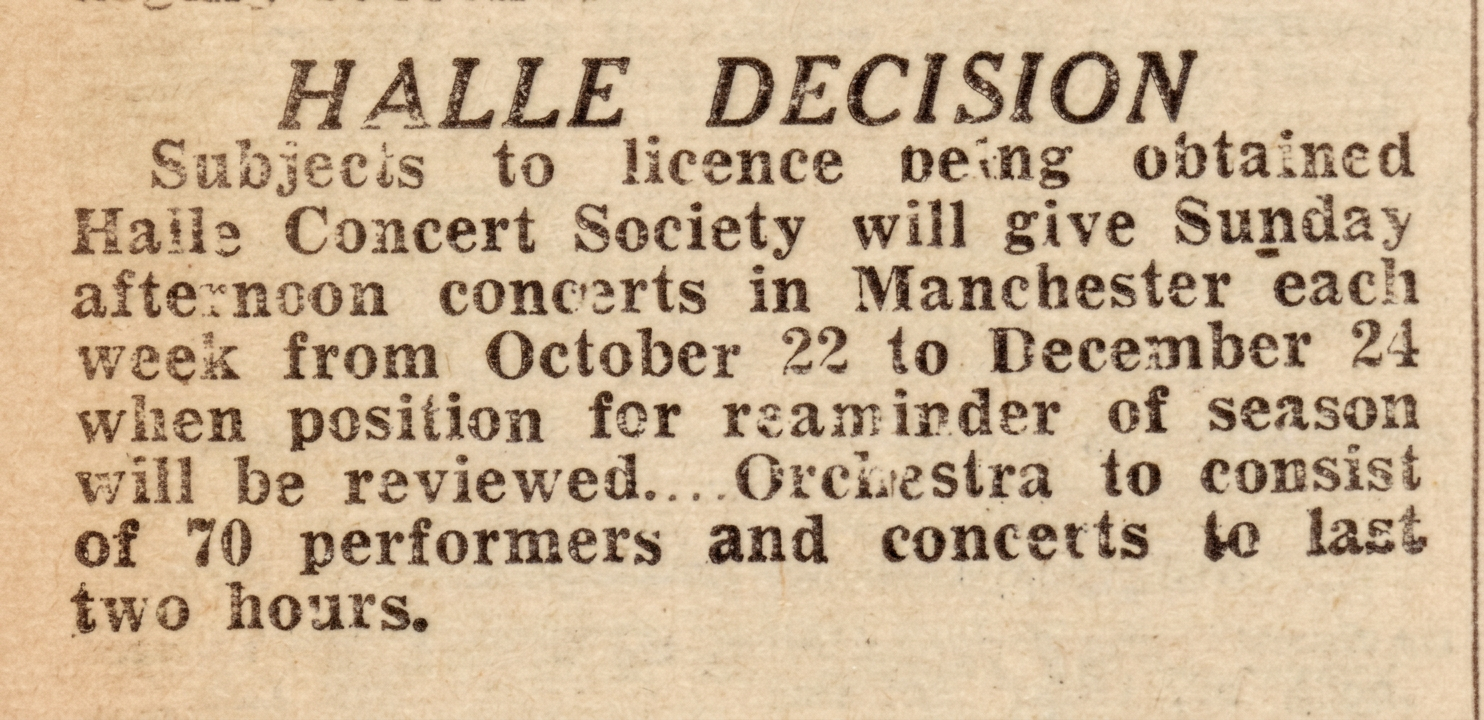
In fact, his worst views were not realised. A brief announcement in the Manchester Evening News on September 18th confirmed that there would be Hallé concerts in Manchester during the first half of the 1939/40 season. Yes, they would be in the afternoon, the orchestra would be reduced in size, and the programmes would be shorter, but there would be concerts.
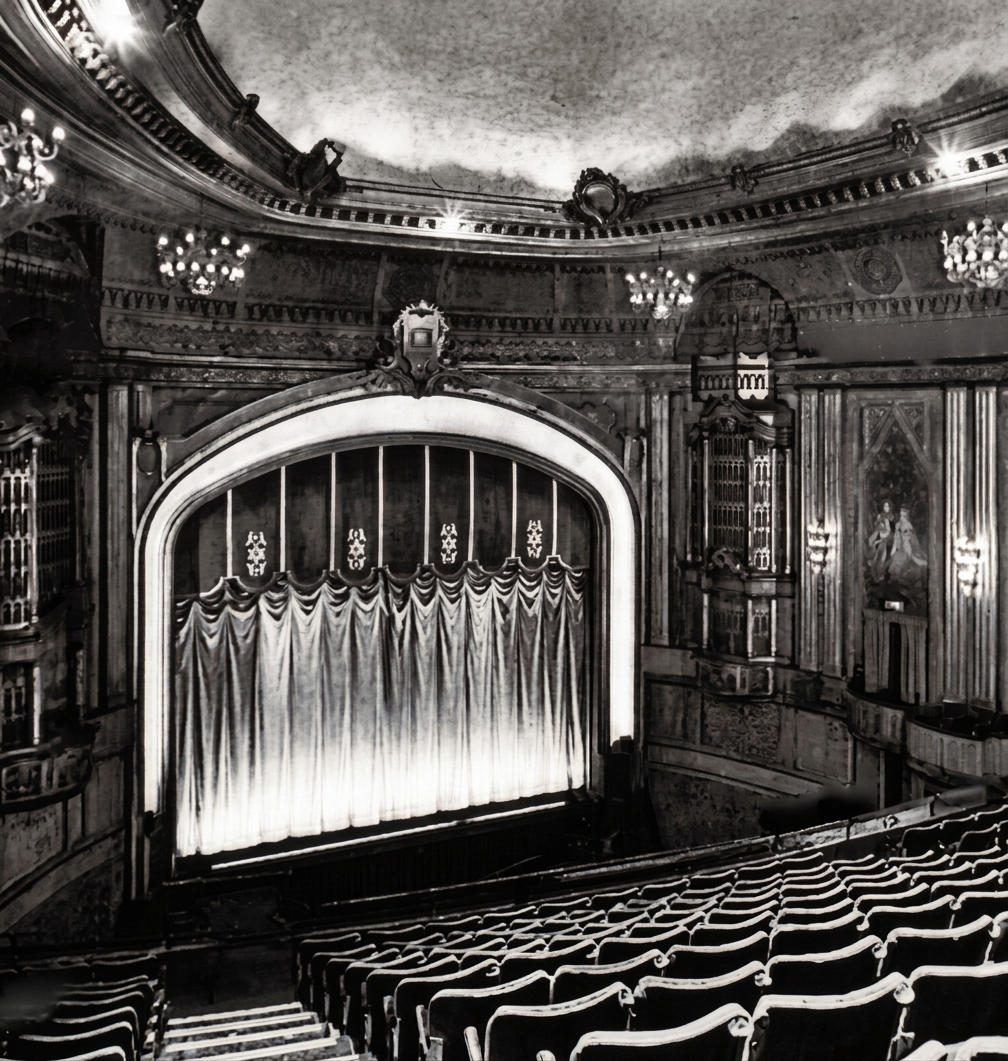
An article in the same paper on September 30th gave more details. There would be 10 concerts on Sunday afternoons between October 22nd and Christmas, conducted by Thomas Beecham, Henry Wood and Malcolm Sargent. However, they would take place not at the Free Trade Hall, which had been requisitioned for government and military purposes. Instead they would be held at the large Paramount Theatre, a cinema built in 1931 on Oxford Street. However, the article made no mention of any involvement by the Hallé Choir.
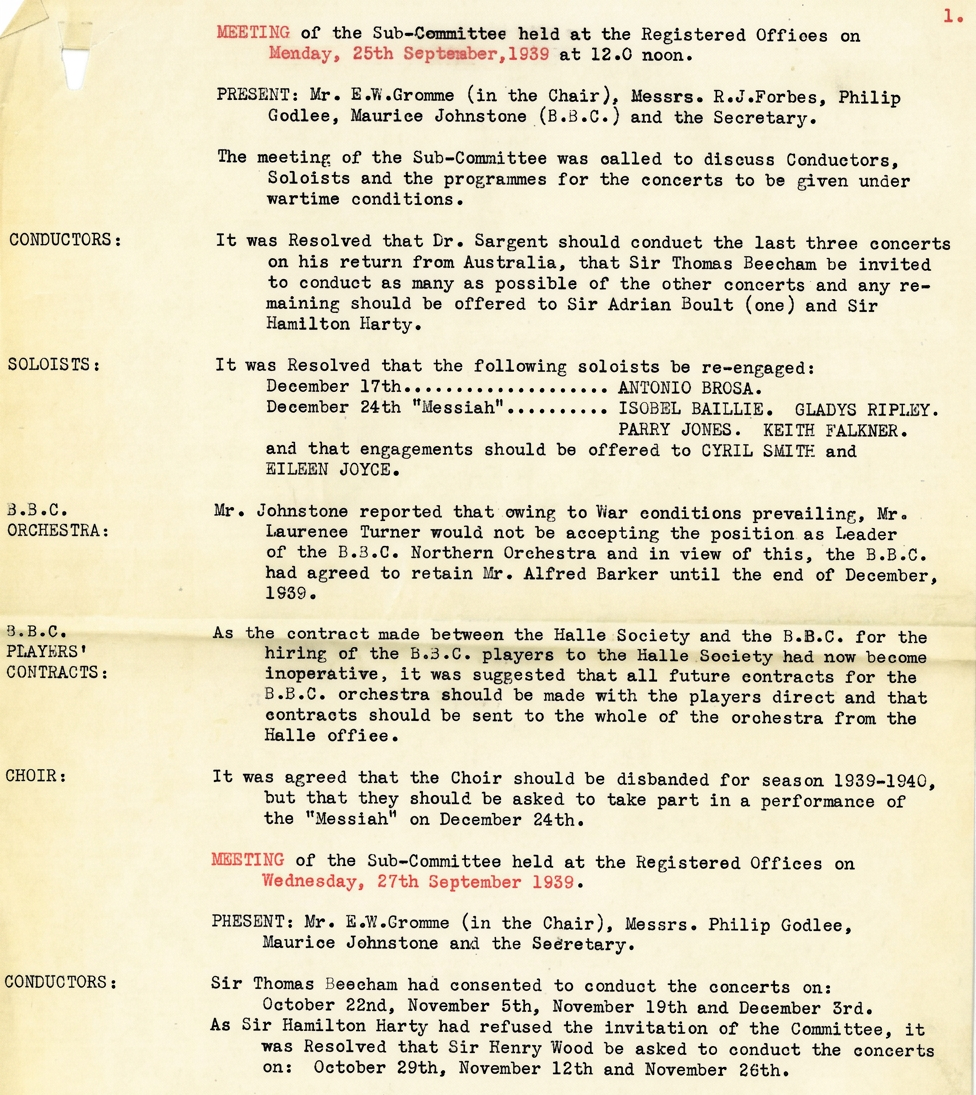
These decisions had been made by a sub-committee of the Hallé Concert Society’s Executive Committee and the minutes of the meeting held on September 25th tell us of the fate that had befallen the choir. In it we read that ‘it was agreed that the Choir should be disbanded for season 1939-1940, but that they should be asked to take part in a performance of the “Messiah” on December 24th’.
The minutes do not state the reason why this was done when the same was not done in 1914, but one can speculate. We saw in my previous post that the choir often had to call on another choir to help bolster their numbers, and with large numbers of tenors and basses especially likely to be called up it was maybe felt that maintaining a permanent roster of singers would be difficult. Also it would have been felt that the centre of Manchester would be inherently more dangerous than it had been during the First World War, for reasons given above, and that putting amateur singers in harm’s way was something they would want to limit.
As a corollary to this, there is evidence that choirs away from the centre of the ‘evacuation areas’ continued to operate on a full-time basis and indeed thrive, at least initially. An item in the Manchester Evening News on November 21st suggests why this might have been:
Nothing can stop a good Lancashire, Cheshire, or Yorkshire man from having his choirs and brass bands. Today I heard that one of the choirs, the Sale Musical Society, has gone from strength to strength, and only since the outbreak of war. There are about 140 members, some of whom are members of the Hallé Choir.
From ‘Singing Time’ in the Manchester Evening News, 21st November 1939
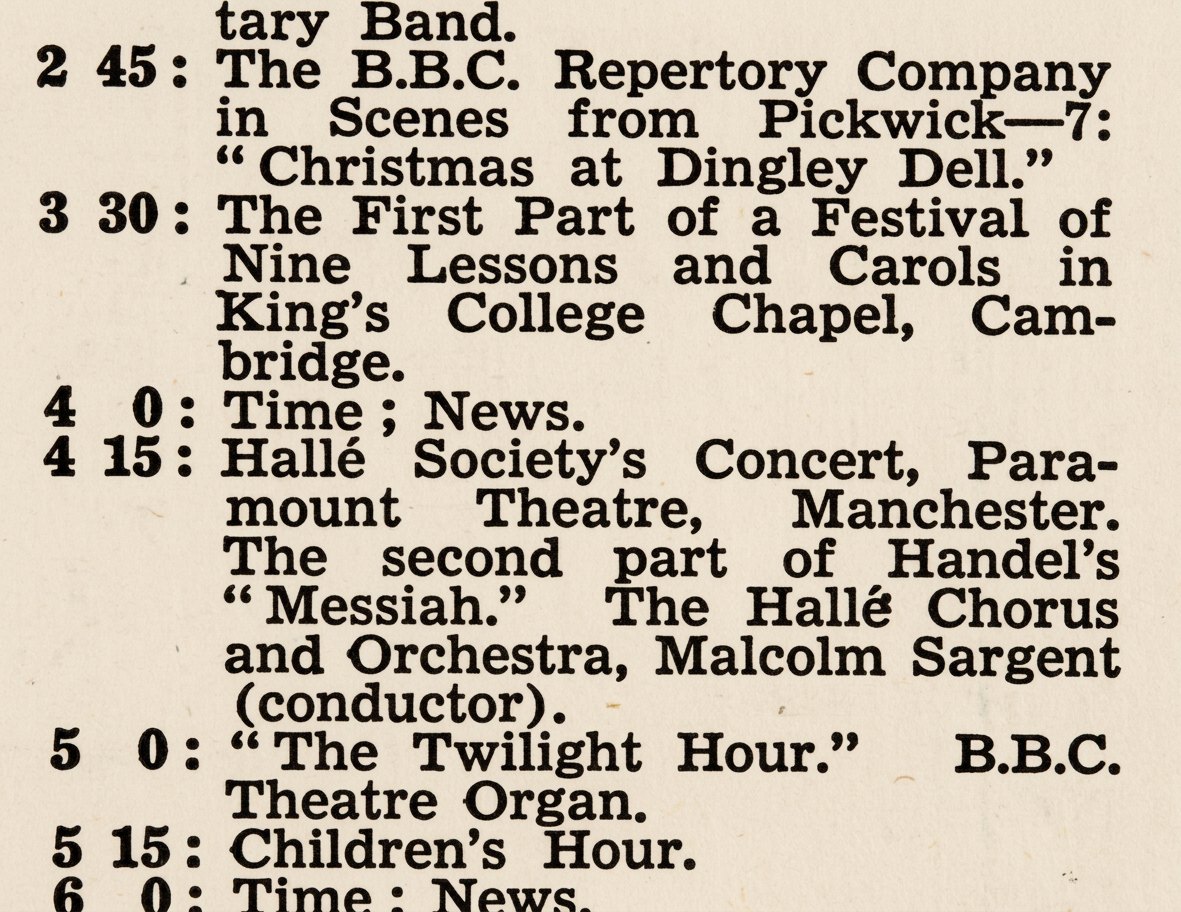
This is particularly interesting – as we shall see later Sale played a part in keeping a couple of the Hallé choral performances going through the darkest days of the war. In the event these performances consisted, apart from one outlier, only of the annual performances of Messiah. The first of these was to be on Christmas Eve, and a choir was put together under the Hallé Choir name to sing in it. What’s more, as you can see from the radio listing, the second half was to be broadcast live on the BBC, coming directly after a dramatisation of Christmas scenes from Dickens’ Pickwick Papers and the first half of the King’s College, Cambridge Nine Lessons and Carols. Quite the pre-Christmas feast! Note that the listing is quite happy to announce that the performance will come from the Paramount Theatre. Broadcast performances of Messiah by the choir later in the war, after the arrival of mass bombing raids by the Nazis, would not have their precise location identified.
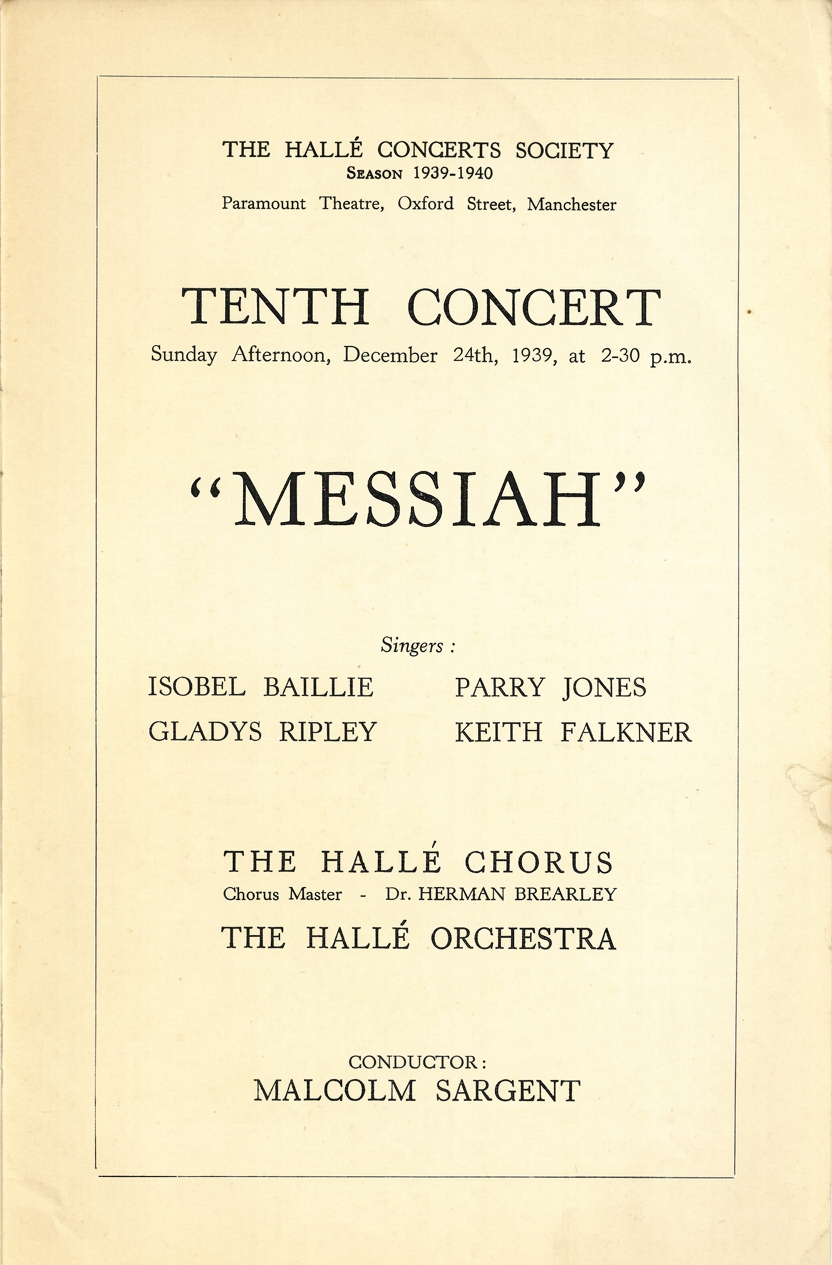
The choir were prepared for the conductor Malcolm Sargent, who would conduct all of the choir’s wartime concerts, by Herman Brearley. He had succeeded Harold Dawber as the choir’s chorus master in 1937, though as we will see Dawber maintained some involvement with both the Concerts Society and the choir. Neville Cardus, reviewing the concert in the Manchester Guardian, noted that this performance of Messiah ‘attracted a larger audience than ever’, not surprising given the Paramount Theatre had about 500 more seats than the Free Trade Hall. What it did not have, however, was as much space on stage – ‘the platform of the Paramount Theatre could not contain the usual mass of singers, and frankly lost something of sublimity.’ The singers, though, could not be faulted for their commitment:
Still, the Hallé vocalists who took part in this festival revealed no loss of enthusiasm and ability; the basses rumbled and thundered sonorously; the sopranos scaled the heights of the “Hallelujah” without stress or screams; and the tenors and contraltos provided the right colour for the inner parts.
Extract from a review by Neville Cardus in the Manchester Guardian, 27th December 1939
Cardus also praised all of the soloists, especially Isobel Baillie (‘nobody in the country shares the secret of her singing in this music’) and made special mention of brass band legend Harry Mortimer, who played the trumpet in The Trumpet Shall Sound, and would do so the following year even though he left the orchestra in 1940.
1940
As 1940 dawned we were still in the period that became known as the ‘phoney war’, a period of relative inactivity that ended when German forces entered the Low Countries in May 1940. This was soon followed by the evacuation of the British Expeditionary Forces from Dunkirk and the Battle of Britain, where Allied aircraft engaged the enemy over the late summer. By September of 1940 the Germans had begun a new tactic of heavy bombing of not just military and industrial targets but also civilian ones. Starting on 7th September German bombers targeted London on 56 of the following 57 days and from October these raids were largely at night. Other cities were to follow.
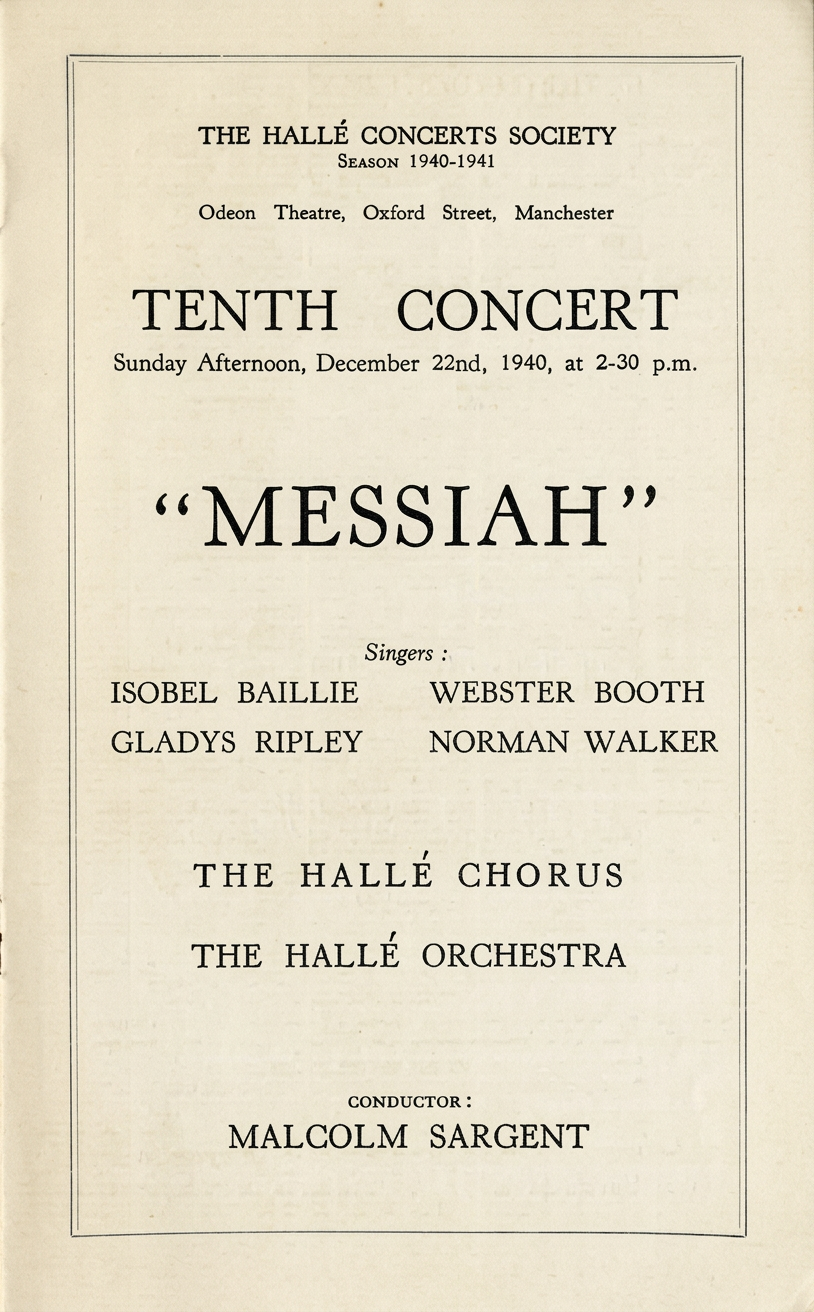
In early November of 1940, some would say quite late in the day, the Hallé Concerts Society had finally got round to planning the Messiah concert for that year. The Executive Committee minutes for November 4th stated that ‘it was resolved to invite Mr Albert Hardie to purpose the choir for the Messiah on December 22, and Sea Drift on February 23 1941’, which implied that Herman Brearley had stepped aside from involvement in the choir.
Albert Hardie was a local organist and conductor who occasionally played continuo for Hallé concerts and later became well known as the conductor of the CWS Male Voice Choir through the later 1940s and 1950s. Note that he was also being asked to put together and prepare a choir for a concert in February 1941, which would end up being the only non-Messiah concert the choir would perform through the whole of the war. More of that later.
In my post about the Hallé Choir’s long history performing Messiah I devoted some time to the performance of the work on 22nd December 1940. Since writing that I have managed to gather more information so will expand on what I said in the previous post.
The performance took place on the afternoon of the 22nd in the Odeon Theatre with Malcolm Sargent again conducting. This was in fact exactly the same venue in which the previous year’s Messiah had been sung, the Paramount Theatre, as in the interim the building had been bought by Oscar Deutsch’s Odeon chain and renamed. Isobel Baillie returned as the soprano soloist and the tenor soloist was Webster Booth, much better known as a singer of light classical music in a duo with his third wife Anne Ziegler, with whom he made many popular recordings on the HMV label during the 1940s and early 1950s before the rise of rock and roll and pop began to move musical tastes in different directions.
Granville Hill’s review in the Manchester Guardian two days later on Christmas Eve was very matter-of-fact. He was noting the slow introduction of period appropriate performance practises when he talked of how ‘the rapid pace at which one or two of the choruses are taken nowadays is apparently accepted without demur even by the most conservative listeners’. He acknowledged the difficulties faced by the choir in preparing for such a concert in wartime conditions:
The success of the choral singing on Sunday proves that in spite of war-time duties, and difficulties about rehearsal the Hallé Choir possesses much of its wonted brilliancy in florid music. Occasionally in loud passages the tenor tone was hard, and the high notes of the basses lacked resonance, but splendour of style, mobility of technique, and precision of attack shown during the biggest choruses left no one in doubt about the choir’s ability.
From a review by Granville Hill in the Manchester Guardian, 24th December 1940
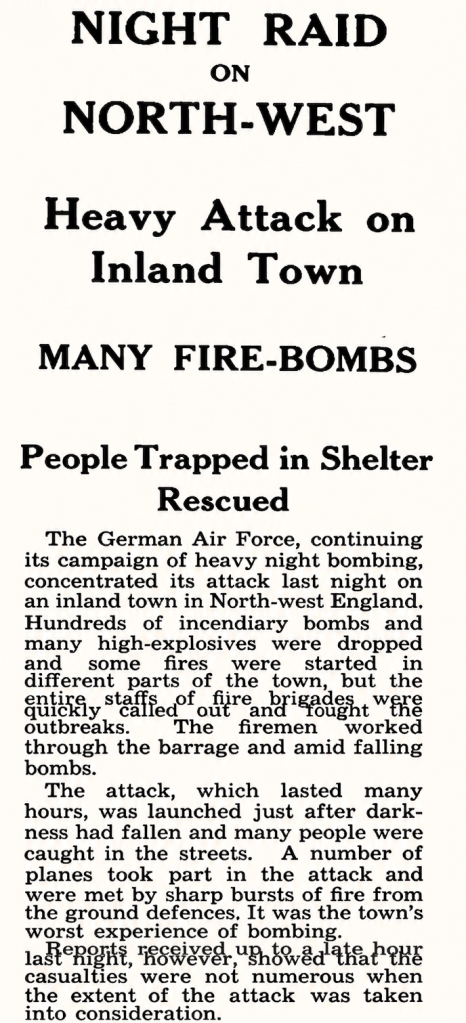
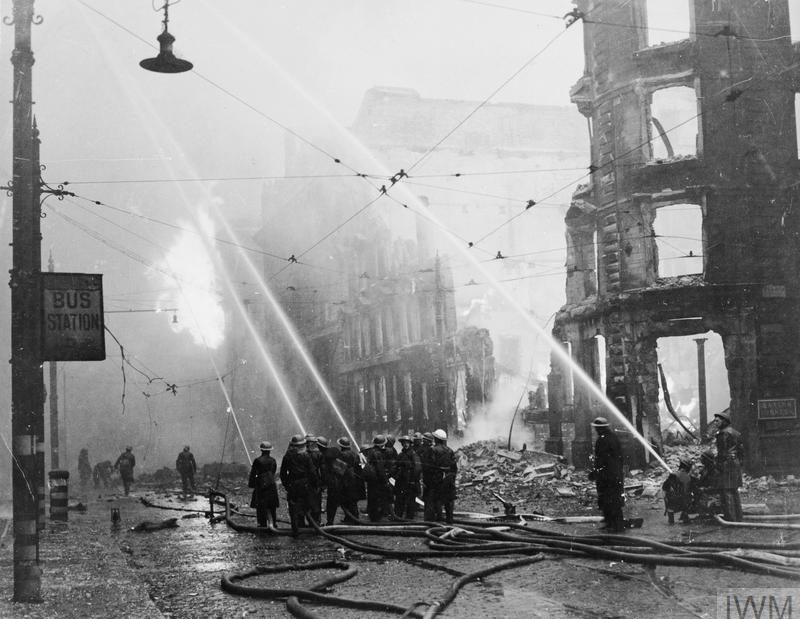
All well and good, but there was no hint of a mention in this review of the tragedy that had befallen Manchester on the nights of the 22nd and 23rd of December. German air raids on Manchester had begun in August but accelerated through the autumn until they reached a zenith on these two nights, during which almost 500 tons of high explosives and 2,000 incendiaries were dropped on Manchester. 684 people were killed and more than 2,000 injured. In the Guardian of December 23rd, the day before Hill wrote his review, there was simply a report that there was a ‘heavy attack’ on an ‘inland town’, obviously a reference to Manchester. The report stated that ‘the attack was launched just after darkness had fallen’ and that ‘many people were caught in the streets’. The Messiah concert began at 2.30pm and would have finished as darkness was indeed falling. It is therefore totally conceivable that both audience members and performers were caught up in the mayhem.
1941
It was not until January 3rd that the Guardian were able to specifically acknowledge the damage that had been done to Manchester over the two nights of heavy bombing in a graphic photo montage. You can see that along with damage to Manchester Cathedral and Royal Exchange, images showing that the Free Trade Hall, home to the Hallé Orchestra and Choir since their foundation back in 1858, had been completely bombed out.
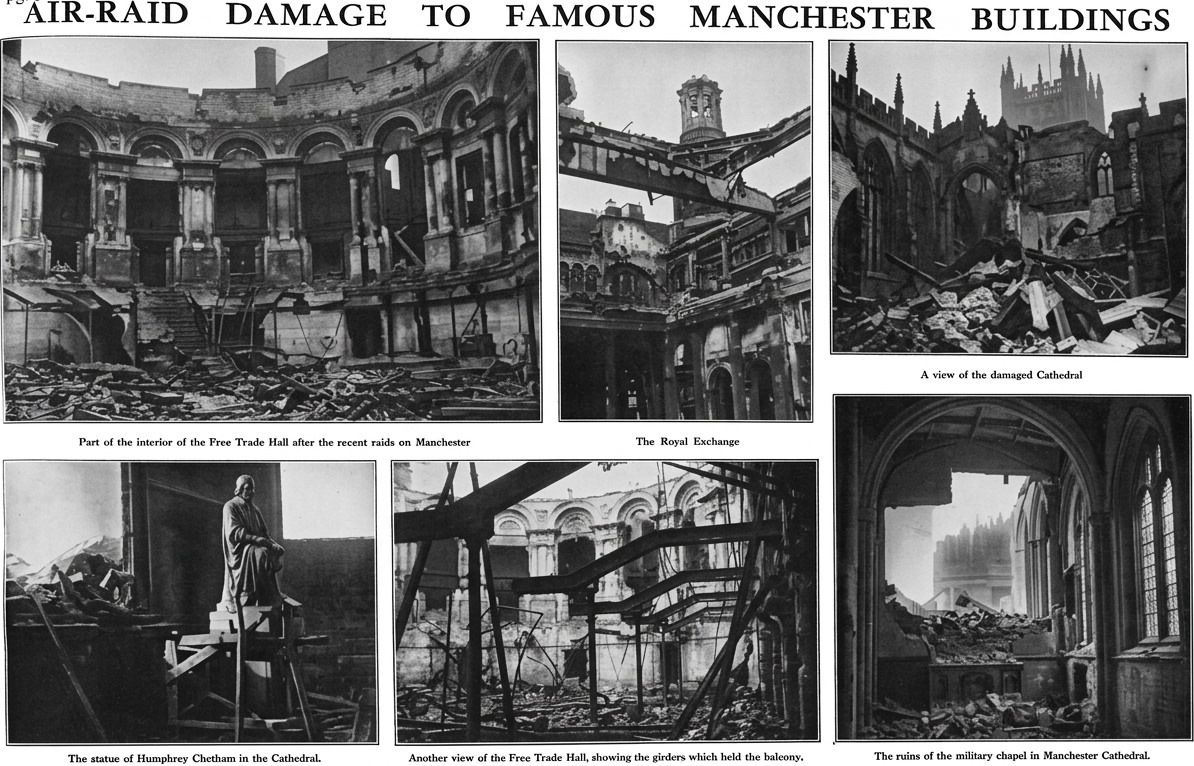
Further imagery from the bombing raids can be found in a contemporary film produced by the Cooperative Wholesale Society Film Unit that can be watched by following this link. It includes footage of the bombed out Free Trade Hall.
Over the following days there were letters in the Guardian suggesting a fund be established to assist with the rebuilding of the hall, and what sort of a hall it should be, but it would be another decade before a new concert hall, built within the shell of the old building, would receive the orchestra and choir back.
Musical life continued. The extra choral concert in February that Albert Hardie had been asked to fix a choir for would include not only the aforementioned Sea Drift by Delius but also the war-themed Morning Heroes by Arthur Bliss. In a previous post I wrote about the occasion in 1956 when Bliss himself conducted the choir in a performance of this work, but this, 15 years earlier, would be the first Manchester performance. The Executive Committee minutes for 20th January 1941 reported that Mr Godlee of the committee ‘had been in communication with Mr Robert Donat with a view to his appearance at the Hallé Concert on February 23 as narrator in “Morning Heroes”’. Donat was very much a matinée idol at that time, perhaps best known at the time for his portrayal of Richard Hannay in Alfred Hitchcock’s 1935 film adaption of John Buchan’s novel The 39 Steps.
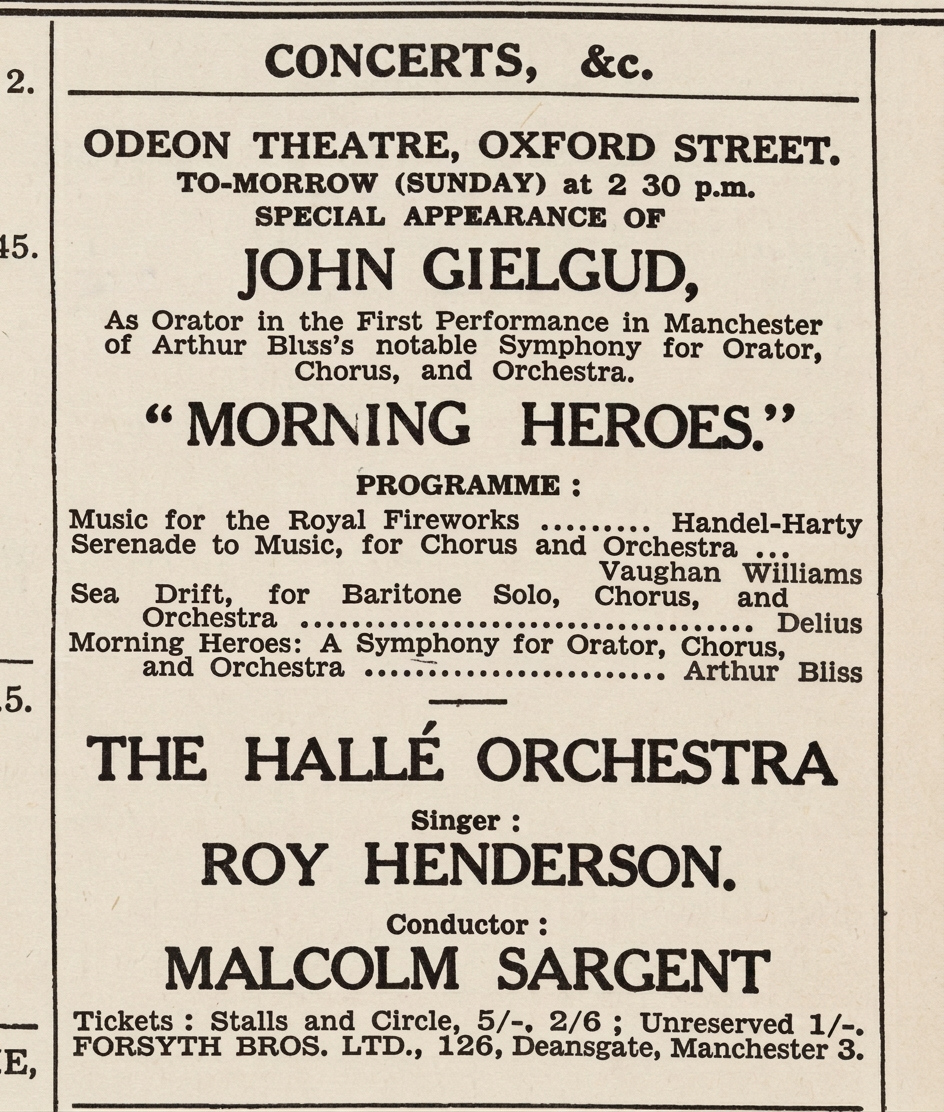
The concert, which would also include the chorus-only version of Ralph Vaughan Williams’ Serenade to Music, and Hamilton Harty’s arrangement of Handel’s Music for the Royal Fireworks and be conducted by Malcolm Sargent, would take place on February 22nd. However, two days before the concert came a further shock for music-lovers in Manchester with the announcement of the death of Hamilton Harty, who had guided the Hallé through the years following the First World War, and indeed had conducted the choir in their first recording, before moving to London in the early 1930s to conduct the London Symphony Orchestra. He had been asked to be one of the conductors the Hallé could call upon early in the war, but had declined, presumably because of ill-health.
The advertisement for the concert on the morning of the 22nd showed that Robert Donat would not in fact be appearing, but would be replaced by an equally noteworthy actor in the form of John Gielgud. Unlike Donat, he was then better known as a theatre actor, but would go on to achieve considerable fame later in life as an actor in film and television productions such as Chariots of Fire, The Elephant Man, Brideshead Revisited and Arthur.
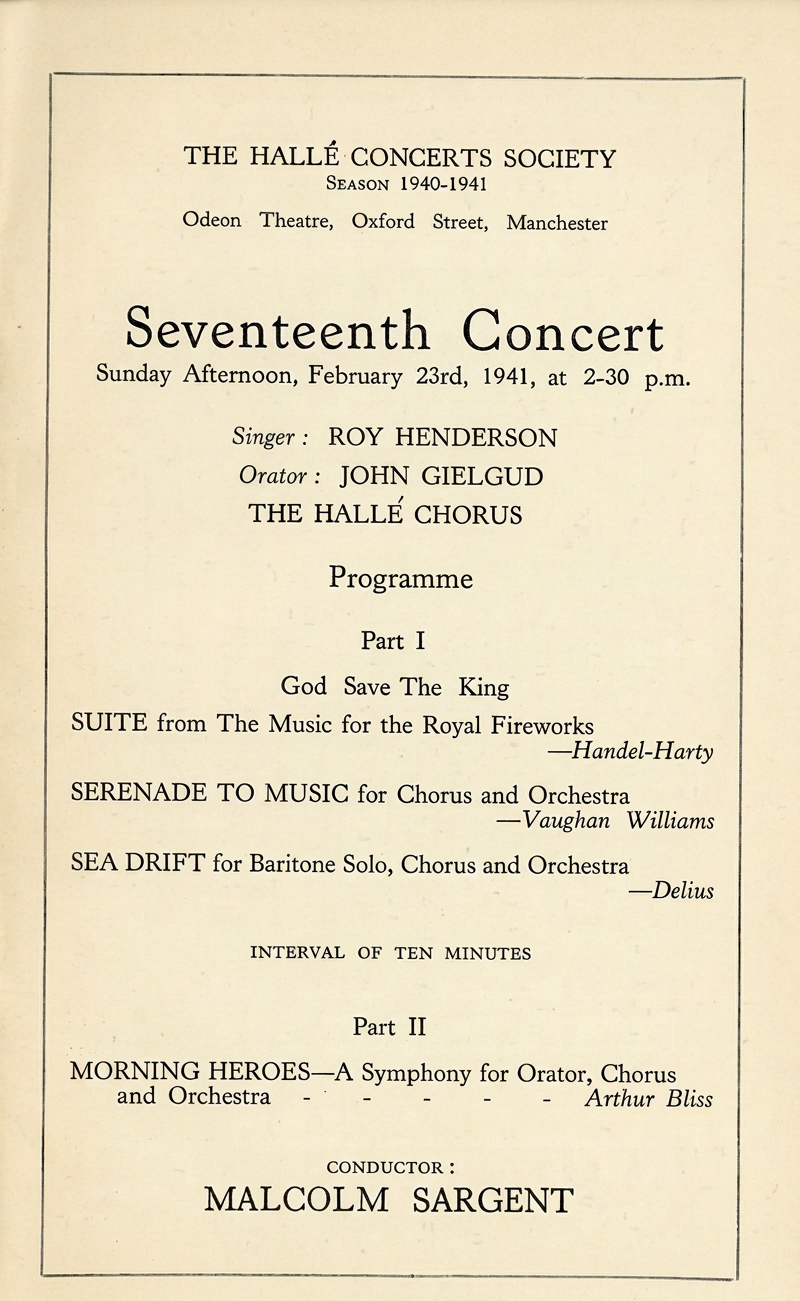
Let us remind ourselves that the version of the Hallé Choir assembled for this concert was very much a scratch chorus, assembled by Albert Hardie back in November but not one that had been rehearsing and singing together regularly. They had also had little time to prepare what are three fairly substantial choral works in three very different idioms. Granville Hill’s review of the concert in the Manchester Guardian does provide evidence that the time taken had not been enough.
He began his review by reflecting on the occasion, overshadowed the death of Hamilton Harty: ‘Yesterday’s concert… would in any case have been one of the most memorable in the recent history of the Hallé Society, and a sad event deepened the feelings of poignancy and solemnity aroused by much of the music given.’ He praised Gielgud’s narration in Morning Heroes, describing it as ‘beautifully ordered, each sentence flowing into its place and each poem being given with a concentrated expression into which nothing irrelevant intruded.’
However, he was less complementary about the choir. Whilst admitting that in Morning Heroes the choir was ‘more successful in the reflective parts than in the vigorous movements’, he felt ‘the tenors ought to be more careful about the quality of tone they produce. It was extremely crude yesterday.’ From the following comments one feels that less time had been spent rehearsing the Vaughan Williams Serenade, a work in the choral version of which the choir are also singing lines normally given to soloists: ‘Judging from the tentative choral expression in Vaughan Williams’s “Serenade” we gather that the choir lacked familiarity with the score.’ Sea Drift received a slightly better reception:
…in the Delius work there were many imaginative stretches of ensemble singing and a good vocal and orchestral balance was kept, though from where they were stationed the choralists probably found it difficult to get the tone forward.
From a review by Granville Hill in the Manchester Guardian, 24th February 1941
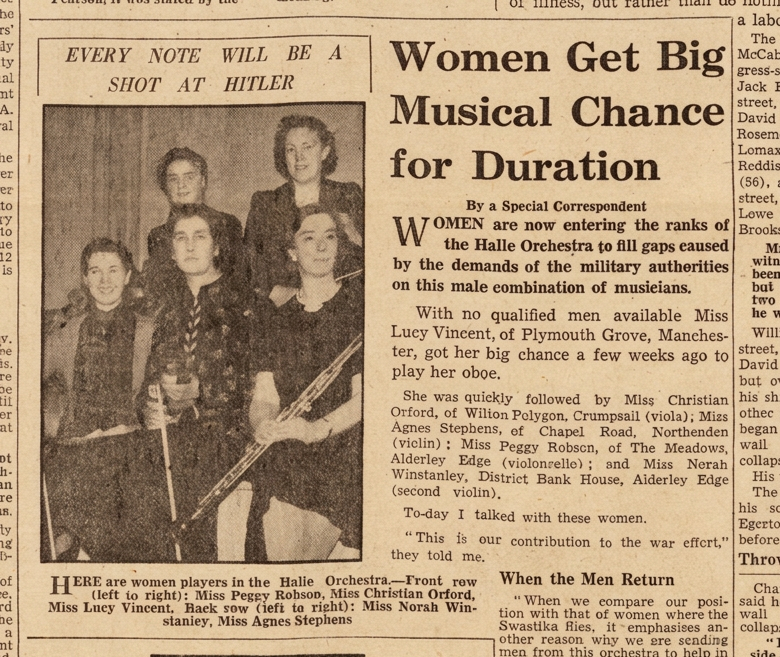
An article in the Manchester Evening News of that same day, February 24th, brought into focus the problem that was affecting the orchestra, and would surely have affected the choir as well. It talked about the increasing numbers of women who were being recruited to play with the Hallé Orchestra at this time, as increasing numbers of men were called up to serve. For the orchestra this was a simple solution, but obviously for the choir it was. For all that Vivaldi’s all-girl choir at the Ospedale della Pietà in the 18th century is reputed to have included female tenors and basses, that was not a workable solution for the Hallé Choir, resulting in tenor and bass sections that would be have been both older and smaller than before the war. The extra effort that this would have required on the part especially of the tenors may have resulted in the tone that Hill described as ‘crude’.
The women of the choir had other problems. During the long period I have been singing in choirs, one of the thorniest issues any choir committee has to address is that of the soprano and alto dress code. This was certainly the case in March 1941. At the Executive Committee of March 3rd it was decided, whether from comments from within or without the choir it does not say, ‘to ask the ladies of the chorus to avoid brilliant and clashing colours in their dresses when they appeared on the platform at Choral concerts’.
In December of 1941 another Messiah performance was fast approaching, and the war impacted the preparation for the concert. The minutes for the Executive Committee meeting of December 12th, nine days before the concert: ‘“Messiah”: The engagement of Mr Henry Cummings in place of Mr Keith Falkner, who is unable to obtain leave from his Military duties, was confirmed, at a fee of £15.18.0.’
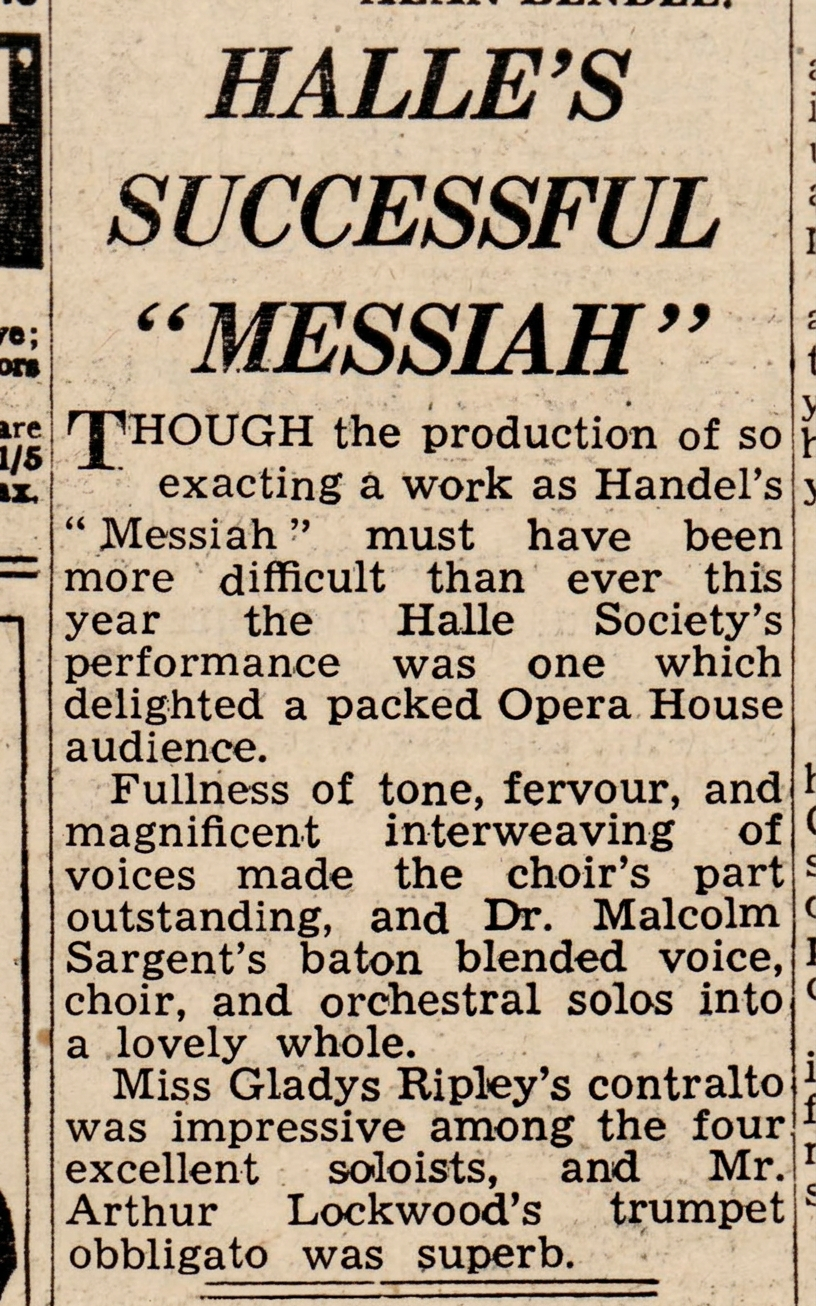
One further development in December 1941 was the news that for the first time women were to be conscripted to help the war effort. Those of service age would be given the option of working in industry, on the land or in one of the auxiliary forces, the Auxiliary Territorial Service (ATS), the Women’s Auxiliary Air Force (WAAF) or the Women’s Royal Naval Service (WRNS). This would often mean a posting away from home which would inevitably have a knock-on effect on the number of women available to sing in the Hallé Choir. Given the timing of the announcement it is unlikely it had an immediate effect on the composition of the choir, even though the Manchester Guardian review of the concert talked of ‘an inevitable thinning down of the choir owing to war-time duties’ and Manchester Evening News talked about how ‘the production of so exacting a work as Handel’s “Messiah” must have been more difficult than ever this year’.
The performance had moved from the Paramount Theatre to the perhaps more musically appropriate setting of the Manchester Opera House, down the street from the bombed out Free Trade Hall, built in 1912 and though containing fewer seats than the Odeon an equally grand venue. The Manchester Evening News review of the concert describe a ‘successful “Messiah”‘ that ‘delighted a packed Opera House audience.’ Granville Hill in the Manchester Guardian was more forgiving than he had been the previous February, describing how ‘the choruses were sung with power and sonority’. He still had a bit of a dig at the tenors though softened his final verdict: ‘though in high tenor notes the tone occasionally became harsh there was never any lack of fluency.’
1942
As we move into 1942 there is a note in the Executive Committee minutes for March 22nd that ‘it was resolved that the Orchestra be booked for the Huddersfield Choral Society’s concert on Saturday, December 12 1942.’
This brings to mind an interesting fact about the war, which is that the Hallé Orchestra played far more frequently with other choirs during the war than they did with the Hallé Choir. If we look beyond the Huddersfield Choral Society concert above, during 1943 alone the Hallé’s concert book for 1943 to 1945 shows at least four performances with other choirs, as follows:
| Date | Venue | Work | Conductor |
| July 16th 1943 | Sheffield City Hall | Creation | Malcolm Sargent |
| October 16th 1943 | Huddersfield Town Hall | Sea Symphony | Malcolm Sargent |
| October 21st 1943 | Hanley Victoria Hall | Creation | John James |
| December 19th 1943 | Huddersfield Town Hall | Messiah | Clarence Raybould |
From this it is evident, as suggested earlier, that other choirs such as Huddersfield Choral Society and the Sheffield Philharmonic Chorus were managing to keep up a much more normal concert schedule. Therefore, when it was decided that the annual Messiah for 1942 would take place in the 6,000 seater King’s Hall at Belle Vue, it was to choirs such as these that the Hallé Concerts Society and choirmaster Albert Hardie turned to for the inevitable bolstering of the choir, just as they had turned to the Orpheus Choir during the latter stages of the First World War.
The Executive Committee minutes for December 30th record the committee’s appreciation to the two choirs chosen:
Grant to Huddersfield & Sale Choirs: In appreciation of the services given by the Huddersfield Choral Society and Sale and District Choir, at the Messiah performance held on December 20, it was resolved that a grant of £25 should be made to each choir.
From the Hallé Concerts Society Executive Committee minutes, 30th December, 1942
As for the concert itself, it received a less than favourable review from Granville Hill in the Guardian, his ire mostly aimed at the venue: ‘With its comparatively low roof the building seems to prevent an expansion of tone.’ He noted the larger than normal choral forces and that ‘all the choral singing was ardent in feeling and the technique was firm, the rapid articulation in florid numbers showing notable skill.’ However, ‘there was not the flexibility of expression that a smaller force would have given.’
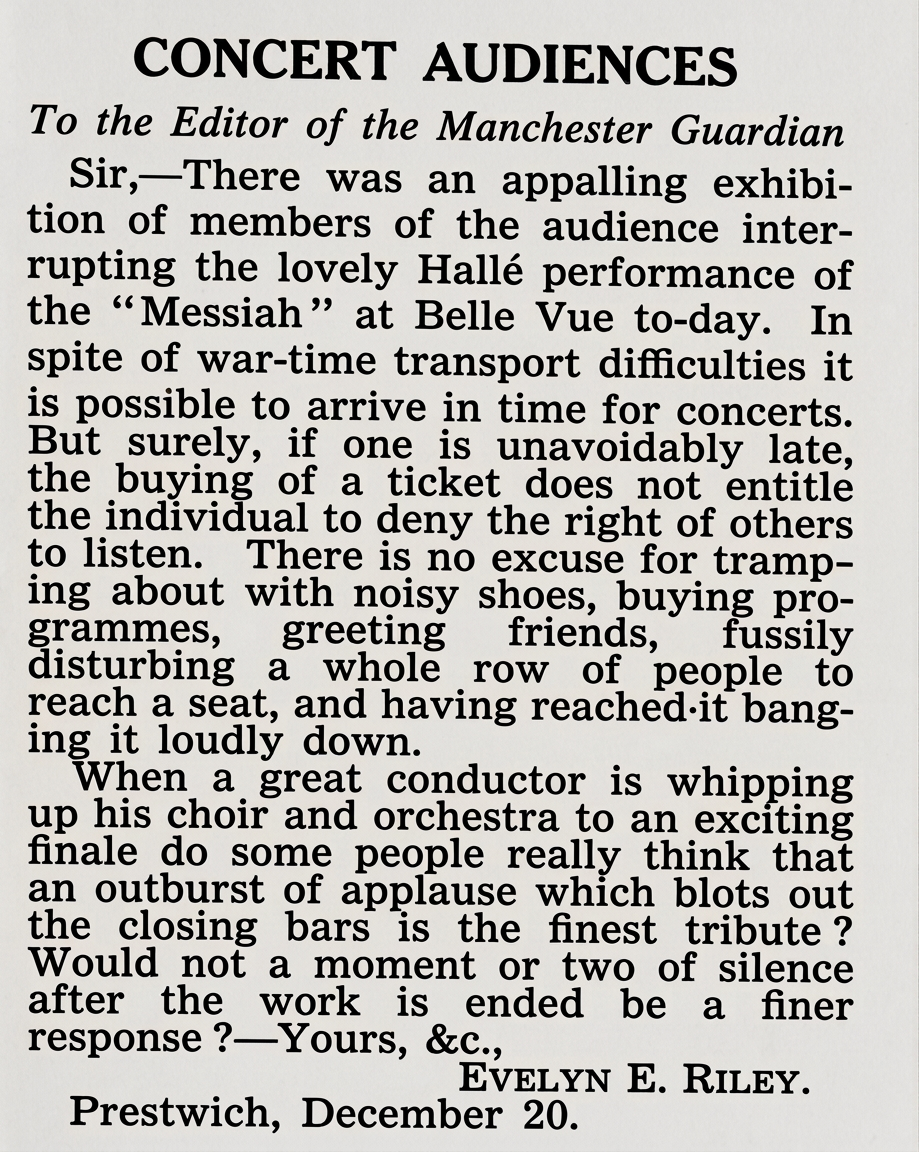
An audience member wrote a letter to the Guardian showing that the new venue had its own kind of teething trouble, praising ‘the lovely Hallé performance of the “Messiah”‘ but bemoaning both the noisy behaviour of latecomers and outbreaks of premature applause!
1943
Come 1943 and the planning process for the annual Messioh concert started early. At the March 3rd Executive Committee meeting we see a resolution that ‘the Kings Hall, Belle Vue be booked for the Messiah performance on Sunday December 19 and that Dr Sargent be engaged to conduct the concert.’
A far more monumental event was recorded in the minutes of the meeting of March 29th. At around this time a long-standing arrangement with the BBC that the BBC Northern Orchestra would share musicians with the Hallé ended. With all of the extra broadcasting their orchestra was doing during the war, the BBC decided that they needed all of their musicians to work full-time for the corporation. This left the Hallé with barely 30 contracted musicians. At this lowest of ebbs the Concerts Society took the leap of faith to end the situation where for so many years they had been using a succession of guest conductors and musical advisors and appoint a new full-time chief conductor to galvanise the orchestra and recruit new players. The person chosen was John Barbirolli, lately of the New York Philharmonic, and though the choir would not encounter him until after the war this appointment would herald a new era in the Hallé’s history:
John Barbirolli: The appointment of Mr Barbirolli as conductor of the Hallé Orchestra was discussed after which it was Proposed by Mr Leonard F Behrens, Seconded by Mr C.J.G. Hall and Resolved that Mr Barbirolli be appointed conductor for a period of 12 months to conduct 150 Concerts at a Salary of £3,750, subject to contract terms which are to be mutually agreed upon his arrival in England.
From the Hallé Concerts Society Executive Committee minutes, 29th March 1943
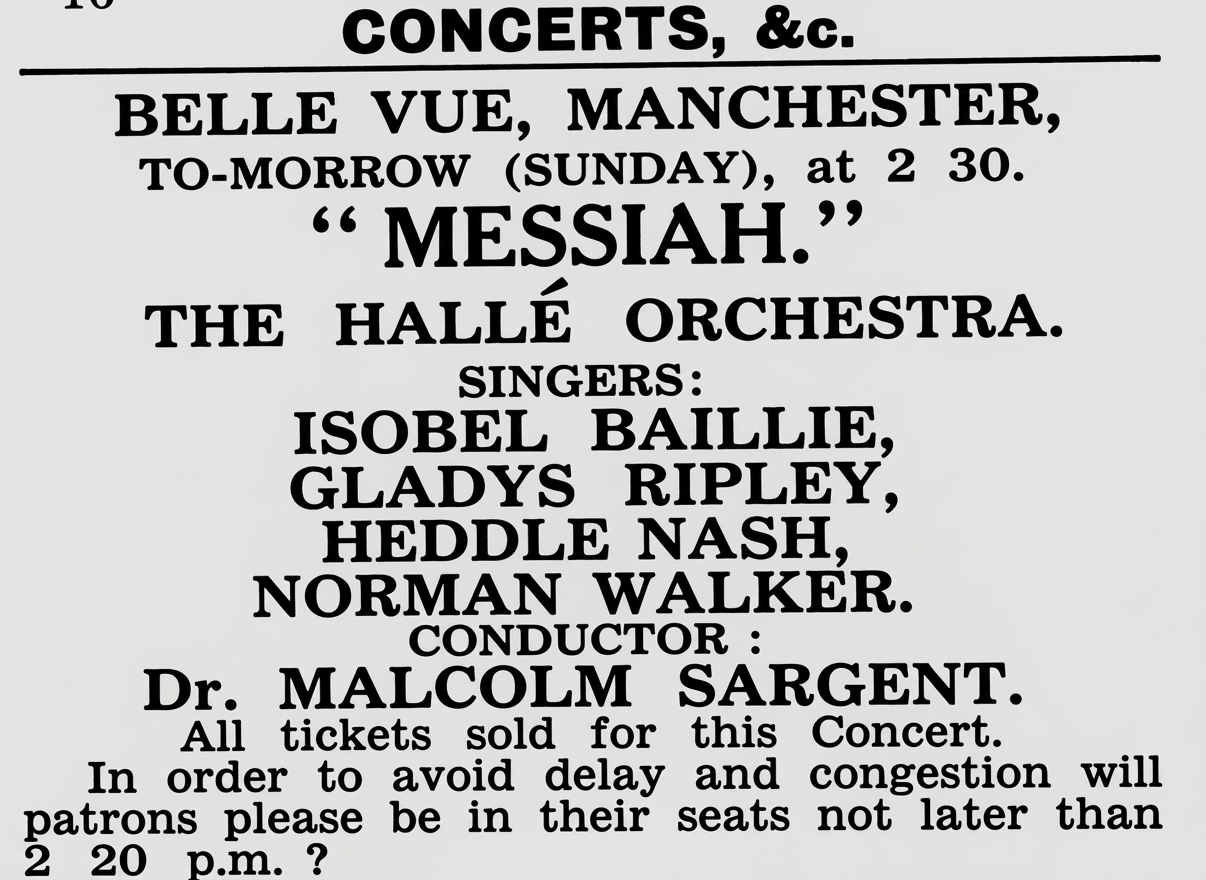
With the hope that the long-term future of the Hallé Orchestra was secured, arrangement continued for the 1943 Messiah concert. In July ‘the engagement of Miss Isobel Baillie, Miss Gladys Ripley, Mr Heddle Nash and Mr Norman Walker to sing in the performance of the Messiah was confirmed’, and by the end of September the ticket prices had been settled at 7/6, 5/., 3/6, 2/6 and 1/6.
The advertisement in the Manchester Guardian the day before the December 19th concert contained the following plea: ‘In order to avoid delay and congestion will patrons please be in their seats not later than 2.20 p.m.?’ I assume this message was in part a response to criticisms on the part of people like Evelyn Riley of the behaviour of latecomers at the previous year’s concert.
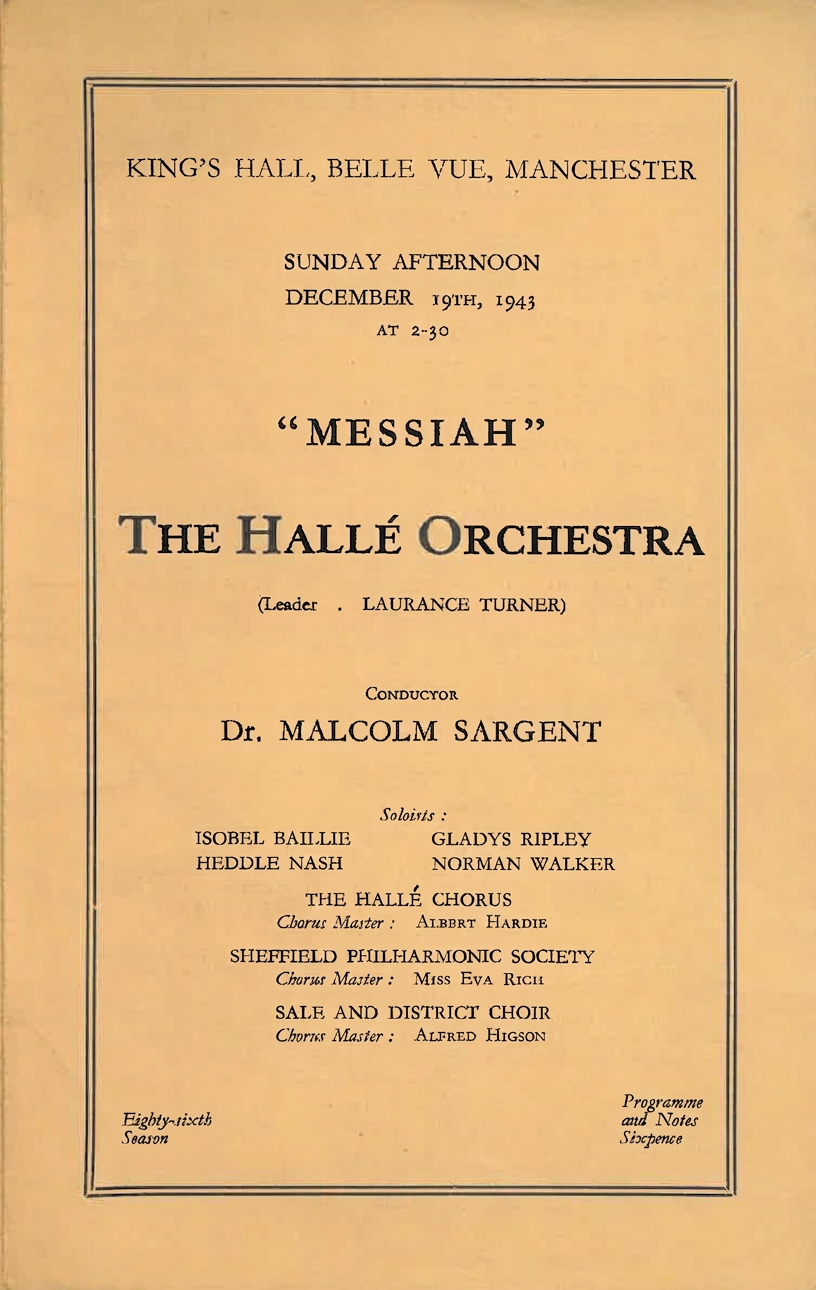
Once again the Hallé Choir, prepared for the occasion again by Albert Hardie, were bolstered by two other choirs, on this occasion the Sale and District Choir and the Sheffield Philharmonic Chorus. The review in the Manchester Guardian by ‘W.W.R.’ made great play of the spectacle this great gathering of singers and orchestra produced, describing:
A vast circular arena, the orchestra at its centre; singers filling a large block of the sloping tiers of seats; the Sheffield Philharmonic Society and the Sale and District Choir adding their numbers to the ranks of the Hallé Chorus; such conditions, as Dr. Malcolm Sargent clearly realised, made for steadiness and massiveness in interpretation, for no great speed and no great subtlety.
From a review by W.W.R. in the Manchester Guardian, 20th December 1943 (Guardian Archive)
By his reckoning, despite the effect of this vast space deadening their sound the choirs strove diligently to overcome the difficulties: ‘Such being the conditions, it was remarkable that as much fine choral singing, so many delicacies of solo singing, and so many nuances of orchestra playing found their way to our ears’. He was particularly complimentary about the Hallelujah chorus, describing its rendition as ‘sheer splendour with no overweight of noise’.
The reviewer in the Manchester Evening News contrasted the occasion, ‘sitting in the vast amphitheatre of the King’s Hall, Belle Vue, yesterday among the thousands of eager and enthusiastic listeners’, with the first performance of Messiah in Dublin in a room that seated 600 but where ‘in order that a further 100 might be accommodated women had been asked to attend without their hoops and men without swords.’ They spent most of their time critiquing the soloist but saved one sentence of praise for the choirs: ‘The massed choirs, although they had a tremendous hall to fill, sang with great effect.’
1944
And so into 1944, with the tide beginning to turn in the war. The Nazis had been turned back in Russia and the Allies had triumphed in North Africa and since September 1943 had been working their way through Italy. The preparations for D-Day, and an invasion of Western Europe, were underway.
It was at this time that the Society’s Executive Committee minutes began to go into much more detail about the logistics of the Messiah concert that year, but more importantly, what the plans were for the Hallé Choir once the war was over. Together these make an interesting narrative so from this point on I will quote from the minutes in more detail.
As early as February 2nd there were discussions about the date of the concert. Christmas Eve was the preferred date, but as Malcolm Sargent was probably unavailable on that date it was decided to ask him to do it on the 17th, with the 24th pencilled in for an extra performance if he were to become available. In the event there was only a performance on the 17th.
On August 7th the minutes report Sargent’s preference for the additional choirs, ‘the Sheffield and Huddersfield Choirs’, and we get an idea of the kind of enticement that was offered to the visiting choirs to persuade them to come over, ‘a meal… at the expense of the Hallé Society after the concert’. There is no mention of whether the Hallé Choir members would offered food as well! We also see that erstwhile chorus master Harold Dawber, who had attended many of the committee meetings, was being asked to prepare the Hallé Choir.
Two weeks later on the 16th we see that Dawber has agreed to rehearse the choir, and we get an insight into how the choir was selected for these individual performances during the war, or at least how it was selected by Dawber for this concert. At the bottom of the minute, after concern that the Huddersfield Choral Society had not replied to the invitation, is a paragraph that shows the Society is beginning to look to the future. D-Day had successfully taken place two months previously and the end of the war in Europe was in sight, so now was the time to look to the future of the choir. It is interesting that at this earliest stage the Society would looking at a very different sort of Hallé Choir:
Messiah: A letter was read from Mr. Dawber agreeing to rehearse members of the Hallé Chorus in preparation for a performance of the Messiah on December 17th, and the General Manager was instructed to call a meeting of the member of the Chorus at the Rehearsal Room so that the necessary choir could be selected and the dates of rehearsals arranged.
The General Manager reported that no reply had yet been received from the Huddersfield Choral Society on the question of their participation in this event.
The Committee discussed the reforming of the Hallé Chorus on a permanent basis, and there was general agreement that a small efficient choir would be preferable to the large choirs of the past.
From the Hallé Concerts Society Executive Committee minutes, 16th August 1944
The meeting of 6th September reported agreement from the Huddersfield and Sheffield choirs to take part in the concert, and that travelling expenses should be paid and meals provided. The Huddersfield choir were obviously asking for an additional payment as there was also a statement that ‘it was decided to defer the question of special allowance to the Huddersfield Society until the results of the concert were known.’ It is interesting to note that the minutes also reported that the ticket prices would have to be increased to cover the cost of engaging these two choirs.
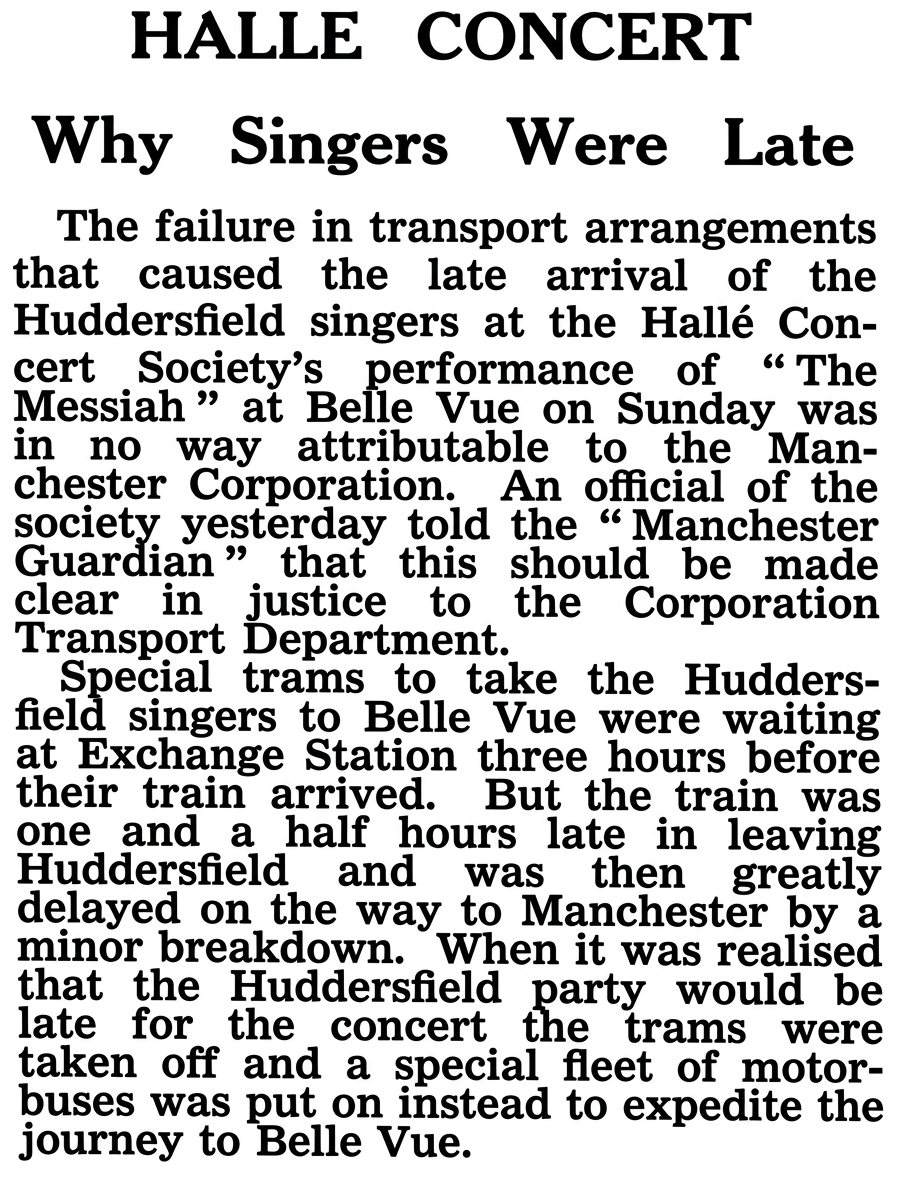
The minutes also show that a permanent re-formation of the Hallé Choir was very much in progress with the resolution that ‘Mr. Arthur Gregson be appointed Secretary of the Hallé Chorus at an honorarium of £26 per annum, and that he be asked to call a meeting of the present members of the Choir to discuss their participation in the “Messiah”.’ £26 is just over £1,000 in today’s money, so Gregson’s position would very much have been a part-time position, but nonetheless his appointment marked a positive step forward.
In the event, the Messiah performance on December 17th ended up being something of a logistical nightmare. Not only did the bass soloist, Norman Walker, have to be replaced at the very last moment by John Dethick, but the Huddersfield singers had the journey from hell coming over the Pennines by train, resulting in them completely missing the first half of the concert. The reasons were given in a brief report in the Guardian, namely a combination of a late departure time from Huddersfield and further delays on the way. The Society did their best to hurry them to Belle Vue by chartering ‘a special fleet of motor-buses’ to replace the planned tram journey, but to no avail.
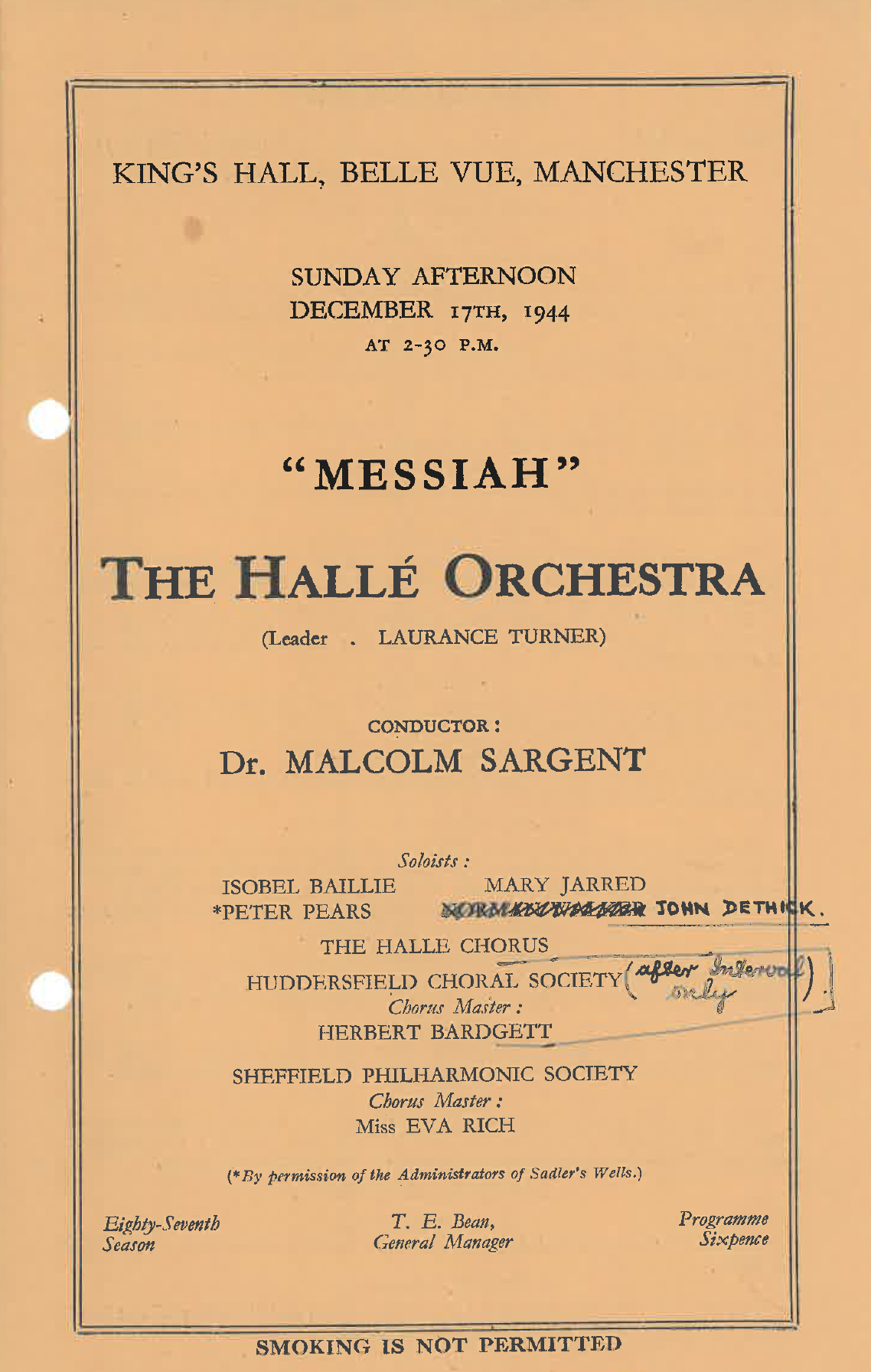
The front cover of the copy of the concert programme held in the Hallé Archive is one that was annotated, presumably contemporaneously, to record the drama of the day, with Norman Walker’s name scrubbed out and John Dethick’s penned in, and against the Huddersfield Choral Society’s name the words ‘after interval only’!
Two other soloists are worth mentioning. Isobel Baillie performed in all but one of the Hallé Choir’s wartime Messiah performances and would eventually appear in no fewer than 26 performances of the work with the choir between 1925 and 1951. Alongside her as tenor soloist, as he would also be the year after, was the 35 year old Peter Pears, at the time a member of the Sadlers Wells Opera Company having returned from the USA with his partner Benjamin Britten two years previously. Fine and distinctive though his voice was, one imagines it was not best suited to the cavernous acoustics of the King’s Hall. Granville Hall, writing in the Manchester Guardian, certainly must have thought as much, writing that ‘Mr. Peter Pears and Mr. Norman Walker are two of our most cultured singers, but neither was really convincing on this occasion. In so vast a hall more power of tone was wanted, especially in the bass solos.’ Note that Hall makes mentioned of Norman Walker – his replacement by John Dethick was so late in the day that the critics were not aware of the change. The Guardian had to issue a correction to the review the following day naming the correct bass soloist.
Hall does however make mention of the late arrival of the Huddersfield Choral Society and yet another problem, ‘the uneasy behaviour of the electric light’, but despite the difficulties found words of praise for the choirs: ‘…under Dr. Sargent’s vigorous baton the chorus singing and orchestral playing throughout the afternoon were the most completely successful features of the performance.’
Three days after the performance, on the 20th, the Executive Committee minutes make further comment on the reconstitution. After recording that Isobel Baillie, Kathleen Ferrier, Peter Pears and Norman Walker (hopefully in full health!) had already been pencilled in for two potential 1945 performances of Messiah, the minutes also talk about whether, given the potential reforming of the choir, other choirs would be needed. They also report that Harold Dawber would not put himself forward as choirmaster, but also that he commented that the new choir, whoever led them, would not be happy with just having Messiah to sing:
Choirs: Before outside choirs were invited to take part in next year’s “Messiah” the question of the re-constitution of the Hallé Choir should be considered. Mr. Dawber pointed out that if the Hallé Choir were reconstituted there should be more to offer them than an annual performance of the “Messiah”. Mr. Dawber said that he would not become choir master, but would make enquiries about securing one. No further action was decided upon.
From the Hallé Concerts Society Executive Committee minutes, 20th December 1944
1945
As the war in Europe entered its final months, so the process of reconstituting the Hallé Choir continued. In the Executive Committee minutes for February 21st we read the following:
Chorus Master: It was resolved to offer Mr. Bardgett of Leeds the post of Chorus Master at a salary of £125 per annum (£150 if a regular overnight’s stay is necessary). The Chorus Secretary was instructed to issue notices and advertisements calling attention to the reorganisation of the Chorus and arranging for auditions. It was resolved that the chorus member’ subscriptions should be 10/6d per annum.
From the Hallé Concerts Society Executive Committee minutes, 21st February 1945
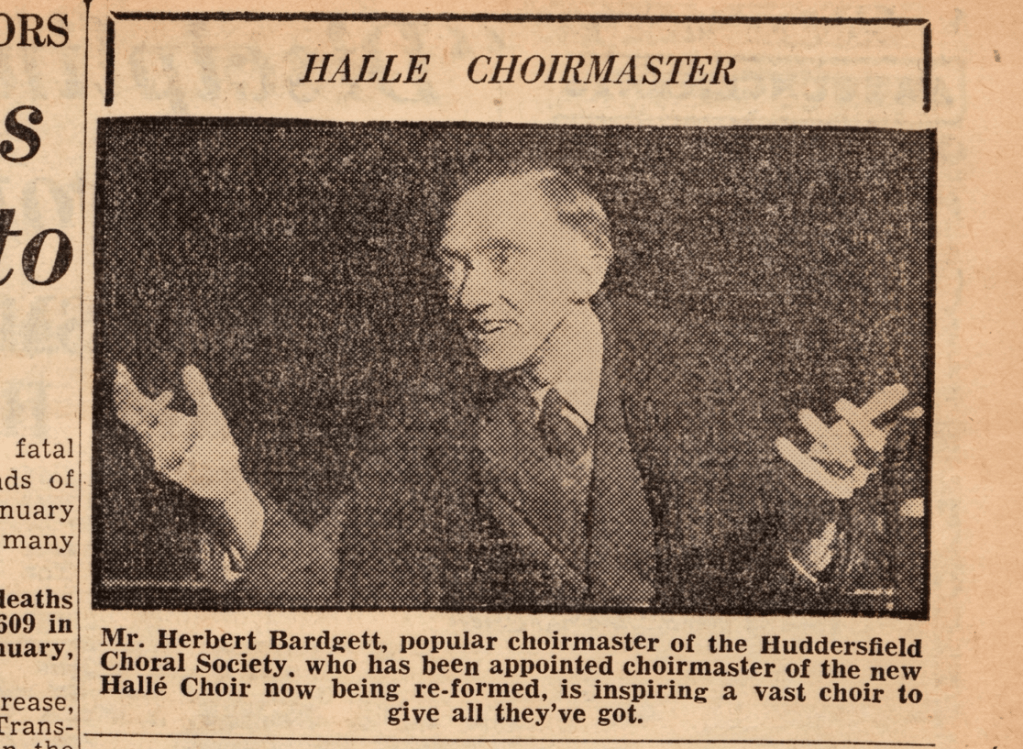
Scottish-born Herbert Bardgett had prepared the choir for the previous year’s Messiah, and was already choirmaster for both the Huddersfield Choral Society and the Nottingham Harmonic Society, as well as being a music master at Leeds Grammar School and a celebrated organist. He would be a busy man. For comparison his salary would be around £5,000 in today’s money and the choir subscription a mere £20 a year.
Bardgett wasted little time in pulling together a new choir. Old members were notified and advertisements were placed for new members, and as the Manchester Evening News reported on March 1st, there would be over 400 auditions, commencing on April 16th, with the aim of creating a balanced choir of around 200 voices. Any idea of the new choir being a ‘small efficient choir’ had obviously fallen by the wayside. The article described the audition process:
Three minutes will be given for each audition, which will consist of a scale, a specified test piece, and a short sight reading test. The auditions will be held each day from 10 a.m. to 9.30 p.m.
From the Manchester Evening News, 1st March 1945 (British Newspaper Archive)
This was not dissimilar to the structure of the current Hallé Choir audition, though nowadays there are slightly more vocal exercises than a simple scale and the auditionee is able to choose their own test piece.
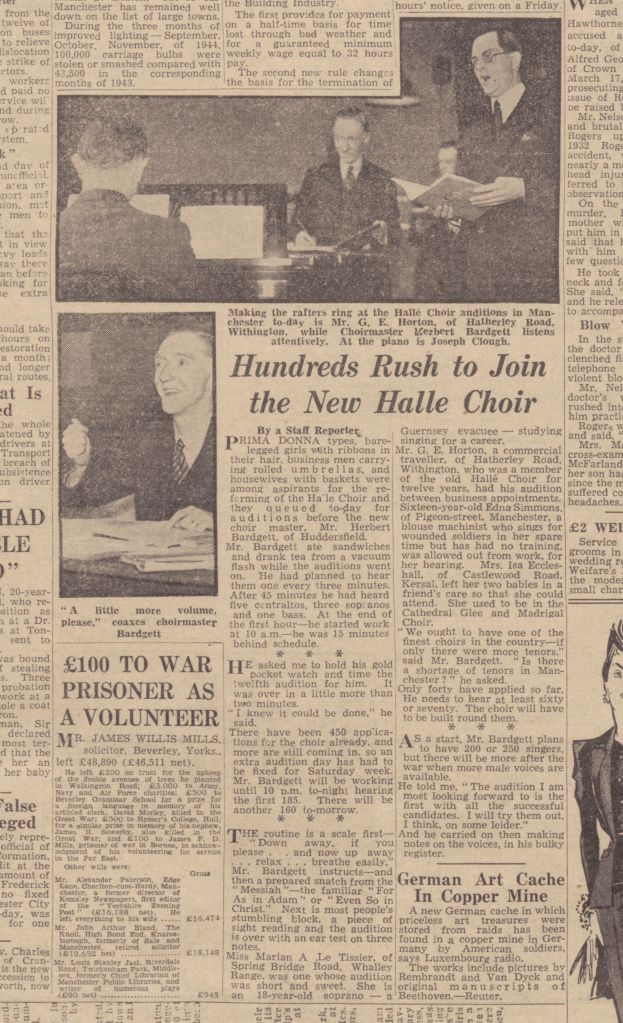
A reporter from the Manchester Evening News was at the auditions on April 16th and an illustrated article appeared in the paper that very evening, giving insights into Bardgett’s audition process and into the lives of some of the ordinary people auditioning for him. As an aside, it is impossible to imagine the Manchester Evening News or any other local print or on-line media devoting this amount of coverage to a simple choir audition process today.
The Choir Secretary Arthur Gregson reported to the Executive Committee two days later that 350 auditions had already been held with some final auditions still to be held. The minutes report that Bardgett would be given 25 guineas for his work at the auditions and 12 guineas would be given to Joseph Clough who had played the piano at the auditions. Clough would also be offered an annual honorarium of £40 plus £20 expenses to act as the permanent choir accompanist.
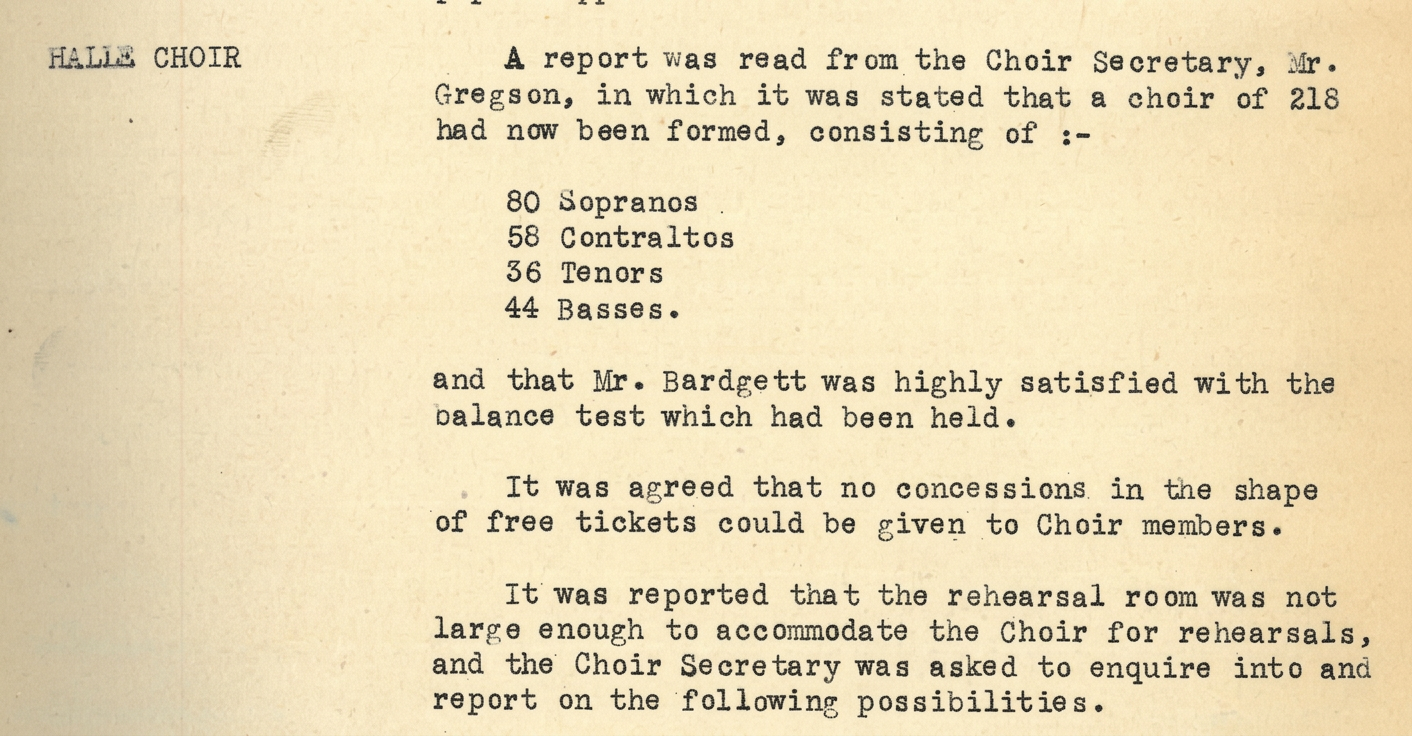
In May the war in Europe had ended though hostilities with Japan would continue until August. By the time of the Executive Committee meeting of June 6th the audition process was complete. Arthur Gregson reported that the new choir would consist of 218 voices, though other sources report that further auditions were to be held as those currently on active service returned to military life, so that number had potential to grow.
Sadly the minutes of the June 6th meeting also report that choir members would not be given concessionary concert tickets, though a more pressing problem was that the current rehearsal room in Hewitt Street was not big enough for such a large choir. Gregson was asked to look into solutions, both in terms of more efficient use of space in the current rehearsal room and in terms of finding a brand new venue. Various alternative venues were suggested including the Lecture Theatre at the Central Library, the Y.M.C.A., the Queen’s Hall and the Manchester Royal College of Music.
In the minutes for the meeting on July 18th Gregson reported that the first three of these were not available and that even with new stackable chairs the Hewitt Street rehearsal room would not be large enough. He asked to look into yet more potential venues, namely:
Adult Education Centre
Reynolds Hall Technical School
Central Hall, Oldham Street
Onward Hall, Deansgate
Milton Hall, Deansgate
Chemistry Theatre, University
Whitworth Hall
Lesser Albert Hall
Manchester Royal College of Music
As the war against Japan entered its final fateful phase in August of 1945, so the Executive Committee were still discussing rehearsal space. At the meeting on August 1st the Hallé General Manager reported that the current rehearsal probably would now be big enough to accommodate the choir but that £400 would need to spent on new chairs. Finally it was agreed that the Onward Hall in Deansgate would be used for choir rehearsals with a review after twelve months.
By the autumn of 1945 the choir were back rehearsing for the annual Messiah. Although the war was now over, rationing was still in place and the difficulty this caused in finding suitable materials had an effect on that thorniest of choir issues, the female dress code. The Executive Committee minutes for October 17th report how this problem was resolved:
Hallé Choir: The Committee discussed the question of appropriate uniform dress for the female members of the Choir.
IT WAS RESOLVED THAT until the coupon position be eased there should be no enforced uniformity but that as far as possible all the ladies should wear white blouses and dark skirts and them dark suits and white collars.
From minutes of Hallé Concerts Society Executive Committee meeting, 17th October 1945 (Hallé Archive)
The new choir’s first concert was to be a grand affair. Now reconstituted to its full size and joined by Huddersfield Choral Society and Sheffield Philharmonic Chorus, the choir would be part of a chorus of 600 voices singing Messiah in the King’s Hall on December 9th, once again under the baton of Malcolm Sargent. The soloists comprised Isobel Bailiie and Peter Pears, who had sung the previous year, Norman Walker, restored to health following the previous year’s absence, and as the contralto soloist, Kathleen Ferrier. This would be the much loved Lancashire-born singer’s first appearance with the Hallé Choir. She would go on to sing Messiah nine times with the choir, including in their appearance at the Edinburgh Festival in 1952. Her last Messiah with the choir would be in December 1952, ten months before her tragically early death from cancer in October 1953.
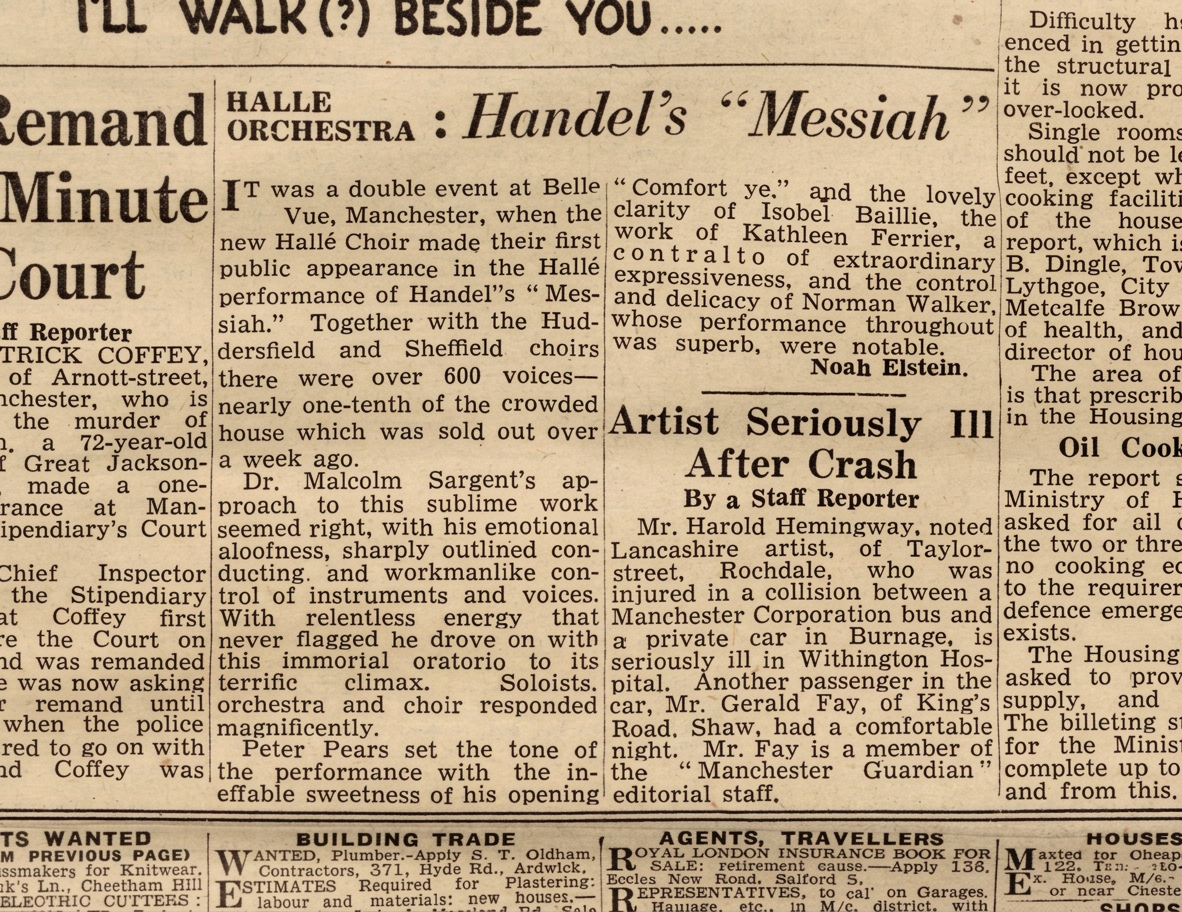
Granville Hall’s review of the concert in the Manchester Guardian made great play of the massive forces involved and the worry that ‘against a choral force of some six hundred voices the instrumentation of Handel and Mozart would occasionally be swamped’. Whilst he did note an occasional instance of the choir overpowering the orchestra, his overall review was wholly positive, praising the ‘magnificent results achieved by the Hallé Chorus, the Huddersfield Choral Society, and the Sheffield Philharmonic Chorus’ and all four soloists. Isobel Baillie had ‘the charm and pose of a true lover of oratorio’, Kathleen Ferrier’s ‘tone and expression were beautifully modulated’ and the two male soloists escaped the criticisms of the previous year: ‘Both Mr. Peter Pears and Mr. Norman Walker sang with a spontaneity of feeling that yet allowed for the claims of “period” style in the music.’
The Hallé Choir had obviously survived the Second World War in a strong and healthy condition but the shadow of the conflict would still have hung over the choir. In February of 1946 the Executive Committee minutes reported that the National Federation of Music Societies had invited the choir to ‘send thirteen members to take part in a Choral Festival of Thanksgiving to be held in London on April 20th’. The festival was organised by the newly formed Arts Council of Great Britain ‘to commemorate the devoted work of amateur choral singers during the war.’ I could not find any record of whether any choir members did participate but if they did the minutes report that they would have to have done so at their own expense.
Before I leave this period in time I need to make mention of one final historic moment in the choir’s history that took place in the April of 1946. You will have noticed that Granville Hall’s review of the 1945 Messiah talked of the ‘Hallé Chorus’. Whilst from the choir’s founding in 1858 through to the 1890s they were simply referred to as ‘a choir’ of however many voices, from that time onwards they were known interchangeably in programmes, advertisements and reviews as either the ‘Hallé Chorus’ or the ‘Hallé Choir’. With the advent of the reconstituted choir the time had obviously come to resolve the issue of nomenclature once and for all. The Executive Committee minutes for the meeting of 24th April 1946 make the following definitive statement:
Hallé Choir: The meeting discussed the relative merits of the title “Hallé Choir” and “Hallé Chorus” and IT WAS RESOLVED that the title “Hallé Choir” be adopted in future as the official title of this organisation.
From minutes of Hallé Concerts Society Executive Committee meeting, 24th April 1946 (Hallé Archive)
Postscript: 1995
The final end of the Second World War was precipitated by the dropping of the first atomic bombs on the Japanese cities of Hiroshima and Nagasaki in early August 1945, killing at least 150,000 people and maybe as many as 250,000. This and the subsequent development of the hydrogen bomb have cast their own shadow over the post-war world, one that still looms large today. Those bombings were the last in a series of bombings throughout the war that deliberately targeted civilians, including the London Blitz, the bombing of Manchester that destroyed the Free Trade Hall, the bombing of Coventry and the Allied bombing of Hamburg and Dresden. The German bombing of Coventry destroyed much of the medieval centre of the city, including the cathedral. To mark the opening of the new Coventry Cathedral alongside the ruins of the old cathedral in May 1962 Benjamin Britten was commissioned to write his War Requiem. In it he set the words of the Latin Requiem Mass and interspersed them with settings of poems by the First World War poems of Wilfred Owen, thus bringing together the horrors of that war and Christian ideas of remembrance with the most tragic events of the Second World War.
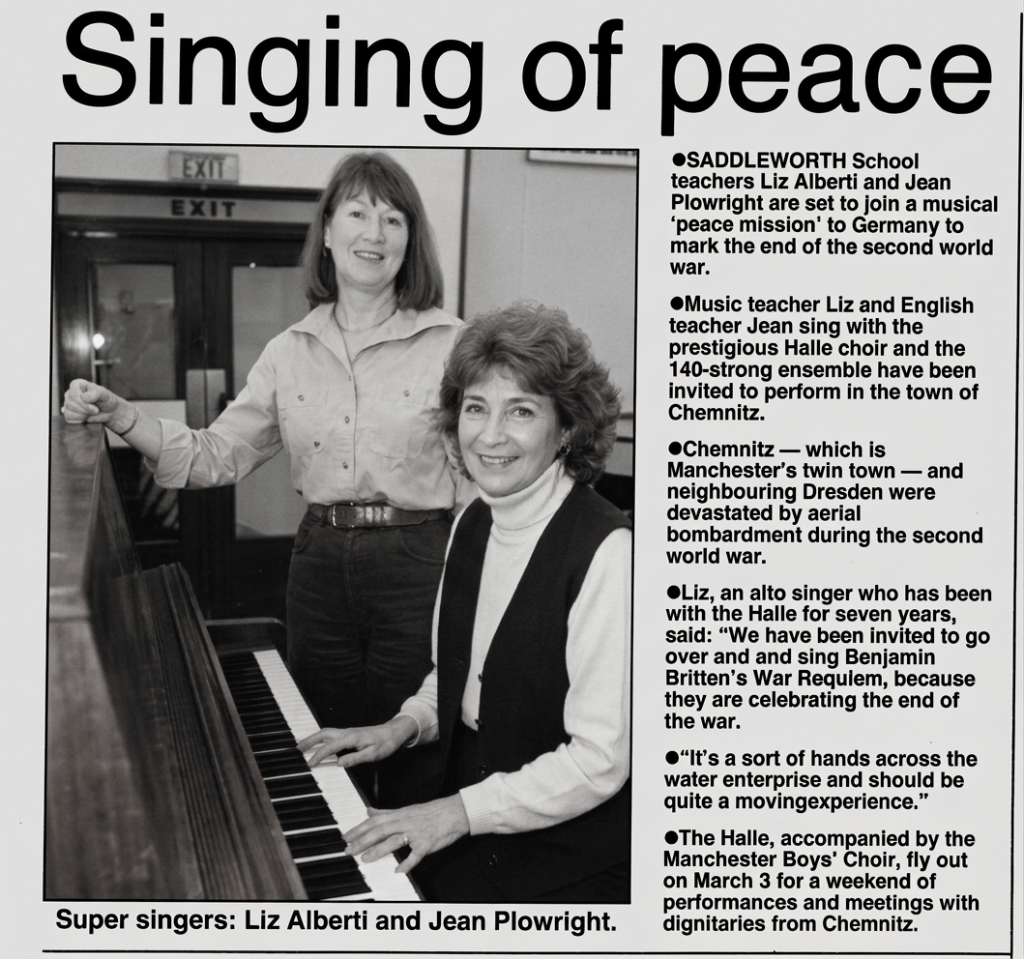
1995 marked the 50th anniversary of the ending of the Second World War. Though the Hallé Choir did not perform the War Requiem in Manchester at that time, they and the Manchester Boys’ Choir were invited to travel to Chemnitz in the eastern part of the newly reunified Germany to sing War Requiem with the local orchestra. Chemnitz is close to Dresden and the same Allied bombing that destroyed that city left most of Chemnitz also in ruins. It was a fitting place therefore for a concert of remembrance and reconciliation, summed up by an article in the Oldham Advertiser prior to the choir’s departure in which two choir members, Liz Alberti (still a member of the choir) and Jean Plowright, talked of their hopes for the concert.
The last word comes from Lord Howe of Aberavon, the former Chancellor of the Exchequer Geoffrey Howe, who attended the concert in Chemnitz and made reference to it in a speech in the House of Lords recorded in Hansard in May 1995. As the world in 2026 continues to teeter on the edge of major conflict they are wise words:
With Kurt Biedenkopf in Chemnitz, Saxony, last Sunday, I listened to a deeply moving performance by Saxony’s Robert Schumann Philharmonie and Manchester’s Hallé Chorus and Boys’ Choir of Benjamin Britten’s “War Requiem”. The stunned silence at the end of the performance suddenly exploded into a spontaneous standing ovation—far longer and far more spontaneous than any that has ever been achieved by any of my noble friends. If our peoples are capable of and, indeed, anxious for reconciliation and partnership of that quality, I pray with all my heart that our leaders can find the confidence and courage to achieve the same.
From Hansard for 8th March 1995 (www.parliament.uk)
References
Extracts from Manchester Guardian from Guardian Archive courtesy of Manchester Libraries
Other newspaper extracts from British Newspaper Archive courtesy of Hallé Concerts Society
Hallé programme scans and Hallé Concerts Society Executive Committee minutes from the Hallé Archive
Geoffrey Howe quote from Hansard (8th March 1995). https://publications.parliament.uk/pa/ld199495/ldhansrd/vo950308/text/50308-04.htm
Michael Kennedy, The Hallé Tradition: A Century of Music (Manchester: Manchester University Press, 1960).
Information on World War Two from the Imperial War Museum website (www.iwm.org.uk):
‘The Manchester Blitz’. https://www.iwm.org.uk/history/second-world-war/blitz/the-manchester-blitz
‘The Vital Role Of Women In The Second World War’. https://www.iwm.org.uk/history/second-world-war/home-front/womens-roles
‘Manchester Took It Too’. (Cooperative Wholesale Society Film Unit) from the North West Film Archive at Manchester Metropolitan Museum. https://www.nwfa.mmu.ac.uk/viewVideo.php?token=9890agw871Hq218904xZYm8224b49H
‘The Evacuation of Children during the Second World War’. (The History Press) https://thehistorypress.co.uk/article/the-evacuation-of-children-during-the-second-world-war
‘Odeon Manchester’. (Cinema Treatures) https://cinematreasures.org/theaters/2430/photos/434107
‘Sir John Barbirolli: Music Director, 1936–41’. (New York Philharmonic) https://www.nyphil.org/about-us/artists/sir-john-barbirolli?url=%2Fabout-us%2Fartists%2Fsir-john-barbirolli%2F


Leave a comment