Introduction
Within this blog I have touched occasionally on how the two great wars of the 20th century impacted the Hallé Choir. In my post about the legendary choirmaster R.H. Wilson I wrote about how Elgar’s wartime elegy The Spirit of England was embraced by the choir (indeed, as we will see later in this post, part of it was performed at the concert that celebrated the Armistice). In the post celebrating the choir’s annual performances of Messiah I mentioned the performance that took place in a Manchester cinema the evening before the heaviest bombing that Manchester suffered in the whole of the Second World War, and in one of the posts about the lives of members of the semi-chorus I outlined James Challoner Heaton’s service during the First World War.
What I have not done is to investigate how the choir itself actually lived through the two World Wars, what contributions it made to the war effort, both collectively and in terms of its individual members, and what effect the wars had on its structure and organisation. This is the first of two posts that will attempt to remedy that. I will take two different approaches in the two posts. All minutes of the Hallé Concerts Society’s deliberations during the First World War have been lost, so I have had to rely on second-hand reporting of the society’s deliberations in newspapers and on accounts of the choir’s activities and those of its members in the same journals. For the Second World War those minute books do exist and give a fascinating picture of how a very different approach was taken to managing the choir during that conflict. But more of that in the next post; for now let us look at World War 1 and how the choir stood in 1914 at the start of the conflict.
1914
In her excellent recent article on the Hallé Orchestra and World War 1 the Hallé archivist Eleanor Roberts sums up the state of the orchestra prior to the outbreak of war in July 1914. The German conductor Michael Balling had succeeded Hans Richter as chief conductor in 1912 and though he had succeeded in galvanising the orchestra in the wake of Richter’s departure there were some criticisms of his choice of repertoire, particularly the lack of English repertoire, and even before the anti-German sentiments that the war ignited, an over-reliance on Germanic repertoire. As was usual with the Hallé, there were also financial worries – there was a deficit on the 1913/14 season of £1,649, £170,000 in today’s money. The icing on the cake was that having fulfilled his commitments for the season Balling had returned home to German in April 1913 and was stranded there when war broke out.
In the late summer of 1914 the Hallé Concerts Society therefore had three urgent problems to consider, how to replace Balling as chief conductor; how to resolve the financial issues; and the existential question of whether they should be putting concerts on at all. Seven weeks after the outbreak of war the music-going public had their answer to these problems. As the Manchester Guardian reported on 16th September in a piece headlined ‘Hallé Concerts To Continue’:
Musical Manchester has been concerned as to the fate of the Hallé Concerts, so long a feature of every winter. Yesterday a special meeting of the guarantors of the Hallé Concerts Society met in the Accountants’ Hall, Manchester, to consider the proposals of the Executive Committee for the coming concert season, and these, which were that the concerts should be continued, were adopted with unanimity.
Excerpt from a report in the Manchester Guardian, 16th September 1914
The report went on the address the other two issues facing the society. In terms of conducting resources, the society hoped that conductors such as Edward Elgar, Frederic Cowen, Thomas Beecham, Granville Bantock, Landon Rudd, Hamilton Harty and the choirmaster R.H. Wilson could be engaged, and this indeed proved to be the case. Beecham would also act throughout the war as a musical advisor. As far as the finances were concerned, to avoid any possibility of depriving the orchestral musicians of their entire winter engagement and the possibility of them ‘applying for public relief’, ‘they had approached the members of the band with an offer to accept reduced terms for the next season, which would give each individual a fixed weekly wage during the twenty winter weeks.’ The report does not mention this, but Eleanor writes that in addition many of the conductors engaged either accepted a reduced fee or waived their fee entirely, and R.H. Wilson took no fees at all for the whole season.
The most important news as far as the Hallé Choir was concerned came further on in the report: ‘It was proposed to give the following choral works, viz:-“The Creation”. “Hymn of Praise”, Rossini’s “Stabat Mater”, “Omar Khayyam”, “The Messiah”, and another work not yet definitely fixed upon.’
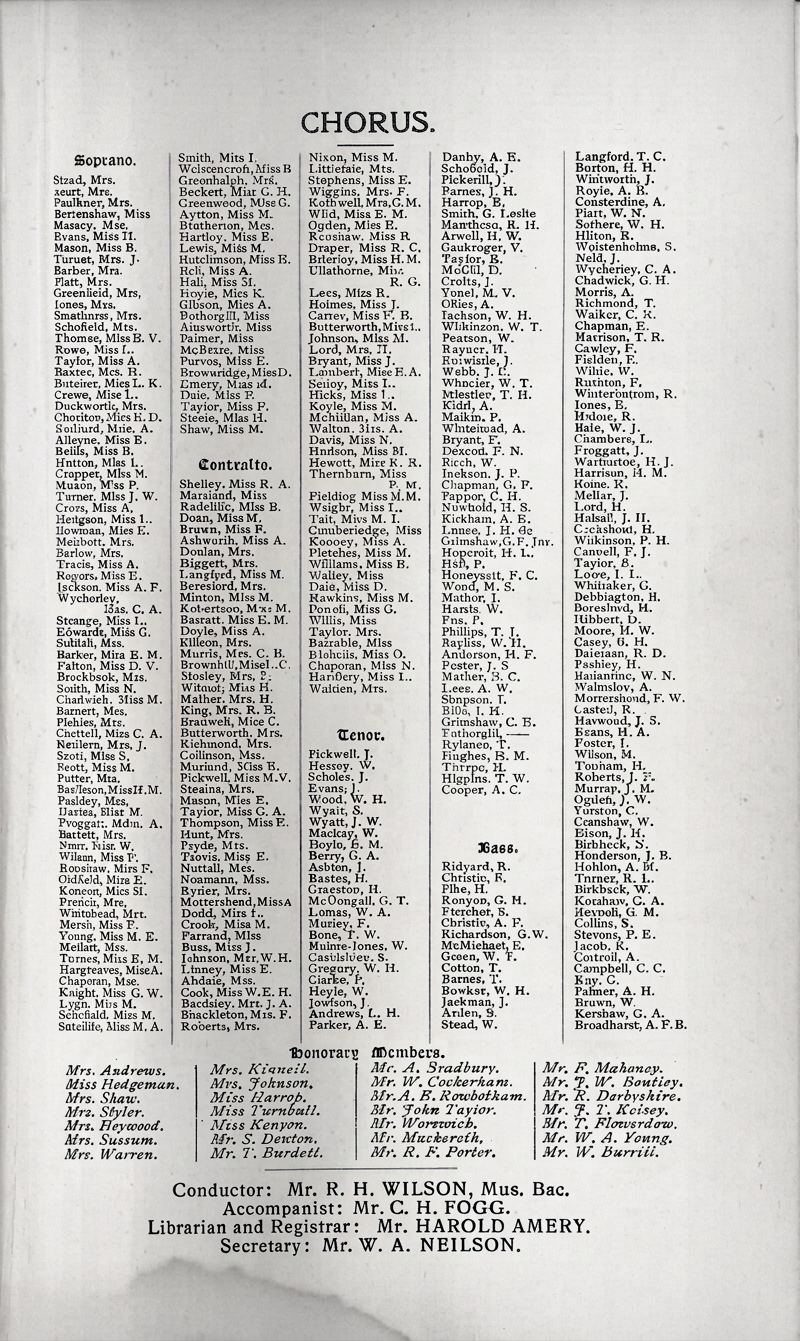
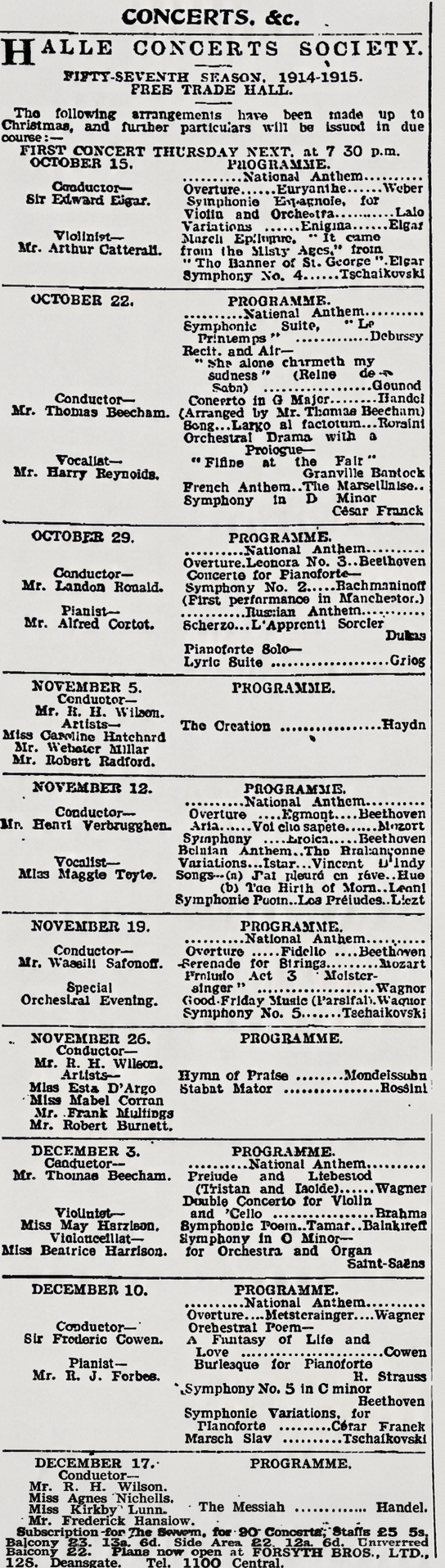
As can be seen from the above choir list taken from a programme for the 1913/14 season, the choir was in good health in all departments when war broke out. Take note of three names that will be mentioned later, namely R. Castell and J.S. Harwood in the bass section and the secretary W.A. Neilson. There is also one other member of the choir who will be mentioned but I was not able to name for reasons that will become apparent.
It is certain that soon after the outbreak of war the ranks of the choir would have begun to shrink, not just in the tenor and bass sections where men volunteered for active service, but also in the soprano and alto section where women volunteered for auxiliary roles. This makes the amount of repertoire the choir got through in just the first few months of the 1914/15 season somewhat praiseworthy.
As can be seen from the programme of concerts up until Christmas advertised in the Manchester Guardian on October 10th, though the choir did not get involved until the beginning of November when they performed Haydn’s Creation, between then and the end of the year they also performed Mendelssohn’s Hymn of Praise, Rossini’s Stabat Mater and Handel’s Messiah.
And that was not all. The war was already beginning to influence programming and though they are not mentioned in the advertisement, in the concert on November 12th conducted by the Belgian violinist and conductor Henri Verbrugghen, the choir sang both the British and Belgian national anthems. The correspondent of the Yorkshire Post reported this favourably though felt moved to add that ‘one could not but regret that our brave Allies are misrepresented by such an essentially feeble and commonplace melody as “La Brabançonne”‘! Another reminder of the presence of war in the background was the appeal made by the conductor at the beginning of the concert in aid of Belgian relief funds, which raised £74, around £7,600 in today’s money.
Perhaps most remarkable was that on 25th November the choir were able to travel down to London and perform in a Philharmonic Society concert at the Queen’s Hall conducted by Thomas Beecham, performing a short piece by Arnold Bax, Fatherland, and the much more substantial Te Deum by Berlioz. The choir had performed the Te Deum in the Free Trade Hall the previous year and would perform the Bax piece in Manchester the following January but it was still a lot to ask of the choir and the review by ‘F.B.’ in the Guardian suggests evidence of that. They describe the Bax piece as requiring ‘tremendous enthusiasm and an exceptional suddenness and decision of attack’, which qualities they felt the choir had ‘though not in a superior degree’. The performance therefore was deemed ‘creditable rather than inspiring’. The Te Deum received more praise. Though there were comments about orchestral/choral balance and one slight intonation problem the singing ‘showed again the fine power of the Manchester singers.’ ‘A.K’, writing in the London Daily News was much less ambivalent:
The Hallé Choir is a fine body of voices – if recollection serves, the tone is fuller and more brilliant than when it was last heard here, and the balance is better. The singing was full of enthusiasm and the diction good. It is not altogether a flattering reflection that London has to go to the North for a choir to perform such a work [Te Deum], which must have been unknown to the majority of Londoners.
From a review by ‘A.K.’ in the London Daily News, 25th November 1914
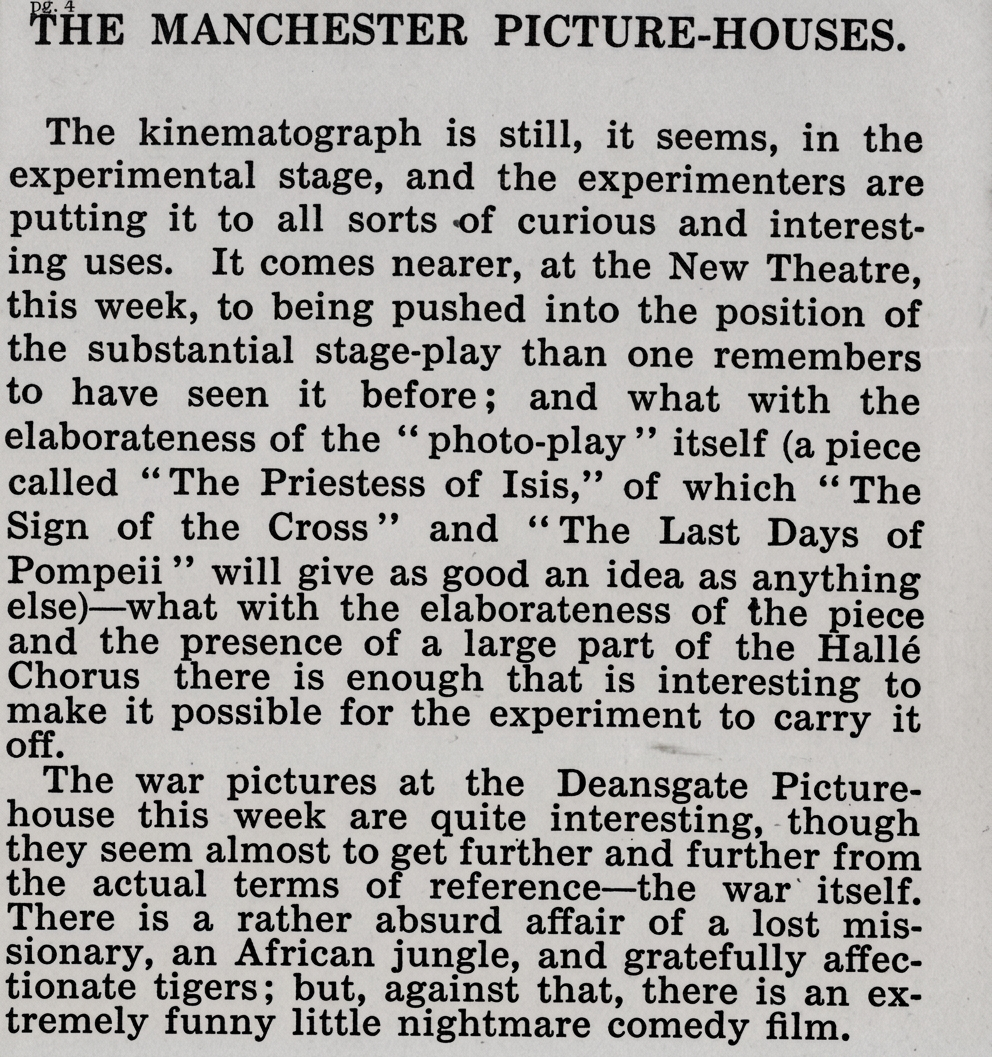
One final appearance from the choir at this time is well worth reporting. Over the last few years members of the Hallé Choir have taken part in showings of films where the orchestra and choir play and sing the musical soundtrack to the film, most recently for showings of Home Alone in Manchester and Birmingham in December 2025. However, there is nothing new under the sun. It would appear that members of the Hallé Orchestra would regularly accompany silent films at cinemas in Manchester. As can be seen by the following report in the Guardian, shortly before the London visit members of the choir were at the New Theatre with members of the orchestra to accompany a showing of what I believe must have been the 1913 Italian silent film Jone, ovvero Gli ultimi giorni di Pompei (‘Jone or the Last Days of Pompeii’). Note the reference at the end to films of the war also being shown.
1915
The new year saw no slowing down in the choir’s activities. A special performance of Mendelssohn’s Elijah on January 6th in aid of Belgian charities which raised over £234 (2026 equivalent: £24,000) was followed the very next day by repeat performances of the pieces by Bax and Berlioz that the choir had performed in London, and only two weeks later they performed Granville Bantock’s Omar Khayaám. 11th February saw performances of Brahms’ Schicksalslied (‘Song of Destiny’) and Sullivan’s The Golden Legend, the last time the choir would perform what had been a staple of their repertoire. Only two weeks later the men of the choir sang in a performances of Mozart’s Kleine Freimaurer-Kantate (‘Little Masonic Cantata’), and were joined by the women in a performance of Borodin’s Polovtsian Dances. March the 11th saw the choir performing in a ‘Grand Wagner Operatic Evening’, and the 18th saw the choir’s first performance of Frederick Delius’ Sea Drift and the women performing the Sirènes section of Debussy’s Nocturnes.
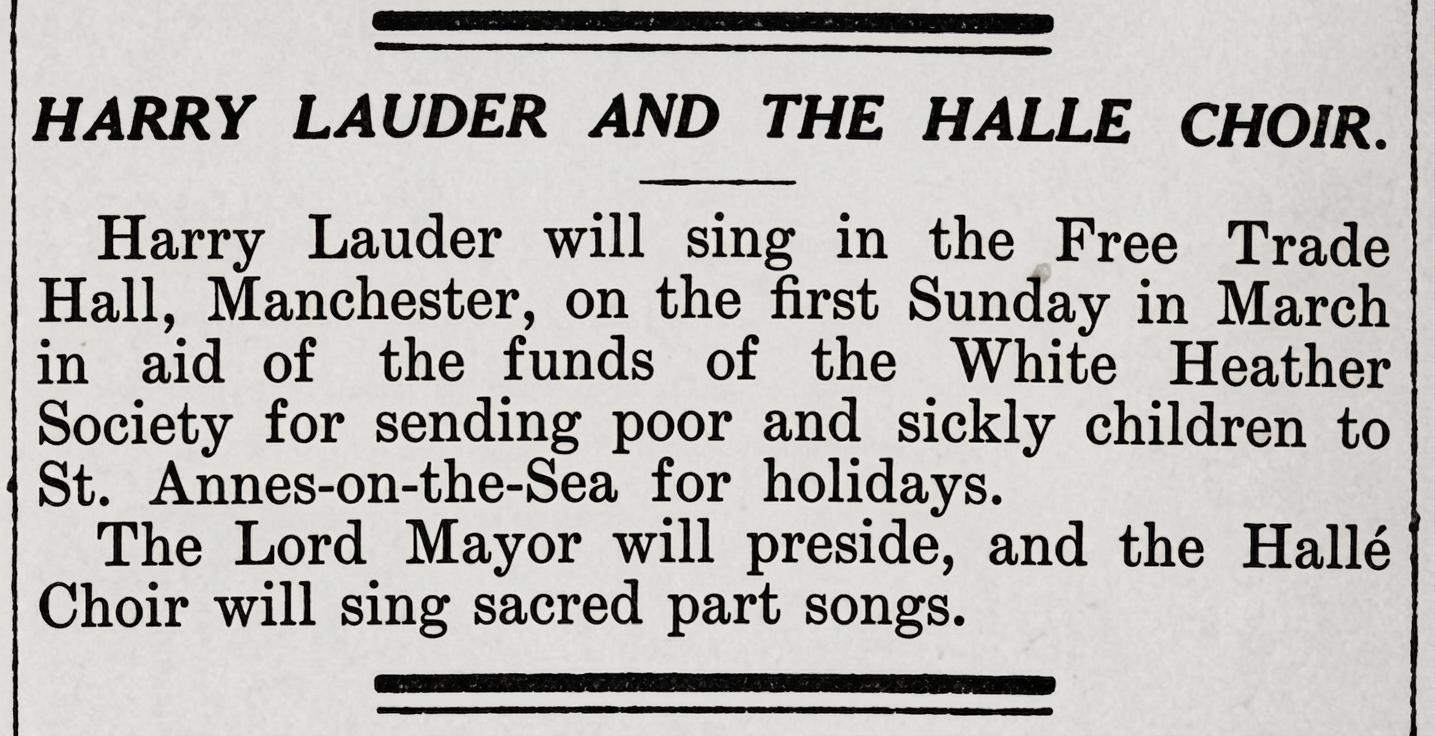
The pièce de résistance undoubtedly came on March 7th in the Free Trade Hall, when the choir performed part songs alongside the acclaimed Scottish singer, comedian and actor Harry Lauder, the Billy Connolly of his day. The event was organised to raise money for the White Heather Society who provided funds to send children from the more deprived areas of Manchester on holiday to places like Colwyn Bay, or in this case St Annes. The report of the concert in the Guardian stated that since its formation the previous year the organisation had raised £17,000, £1.75 million in today’s money. The report also states that one of the vocal soloists was ‘Bella Baillee’, who was surely the Manchester-raised soprano Isobel Baillie, then two days shy of her 20th birthday and 10 years away from her first performance with the Hallé Choir, in Messiah, in 1925.
For all the choir’s activity during the 1914/15 season, however, the war was beginning to make its presence felt, and tragedies both at home and abroad were not far away. An article in the Manchester Courier on 20th February entitled ‘Choirs and the War’ included the following snippet:
No attempt has yet been made to estimate the effect the war has had on the personnel of our musical organisations, though it is known that the Hallé Choir, for one, has provided a fair proportion of its male members for the colours.
From ‘A Musician’s Note-Book’ in the Manchester Courier, 20th February 1915
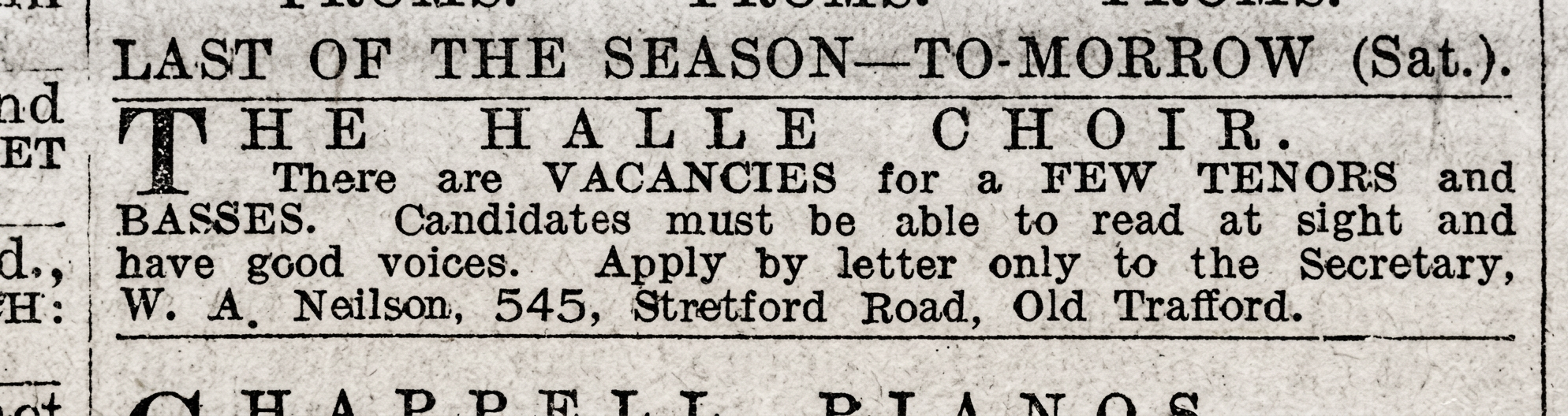
It was therefore probably no surprise that in March the secretary of the Hallé Choir, W.A. Neilson, put an advertisement in the Manchester Evening News, asking specifically for ‘a few tenors and basses’, a familiar plea today, especially as far as tenors are concerned, but surely a much more urgent plea back then. Neilson’s day job was at Forsyth’s music shop, though his job as secretary to the choir was probably more involved than being a simple minutes secretary and was probably more akin to the present day choir administrator role.
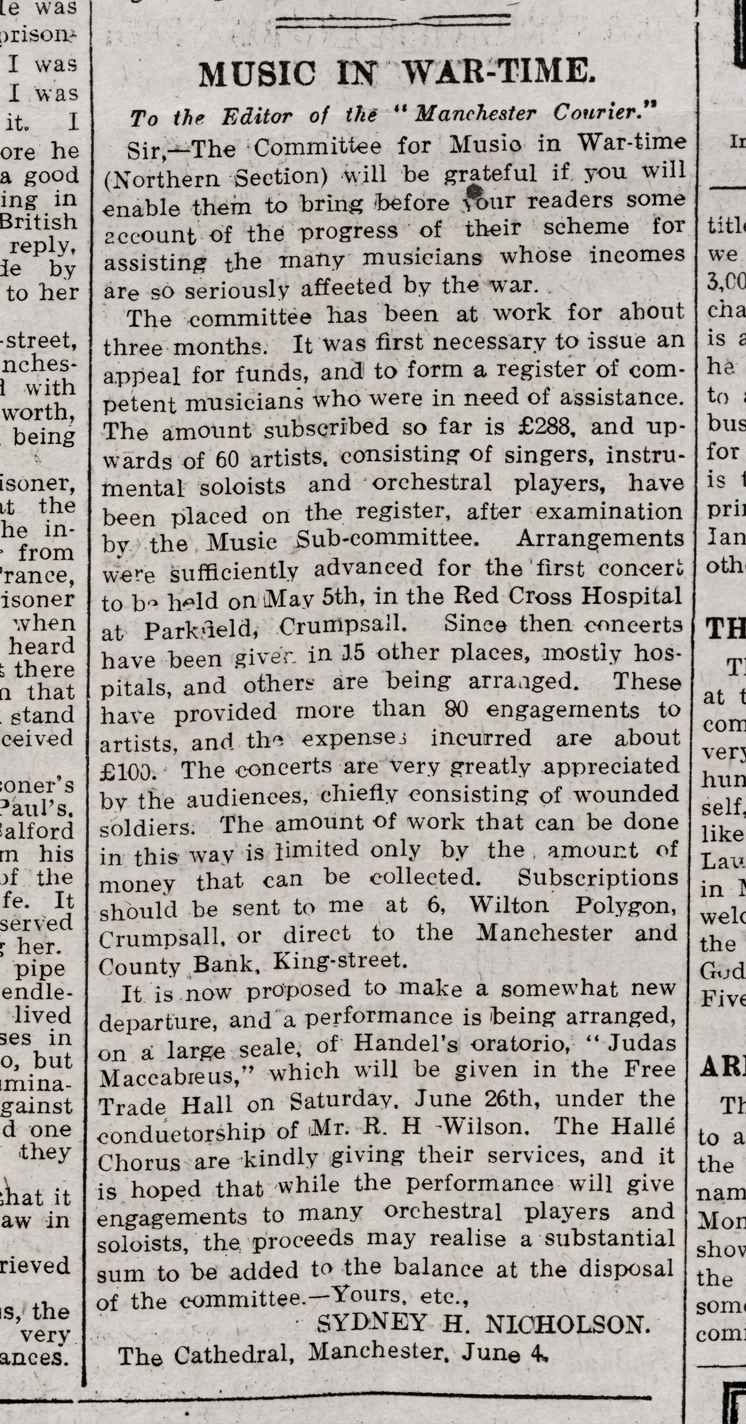
Music continued through the summer with the Director of Music at Manchester Cathedral, Sydney Nicholson, organising a performance of Handel’s Judas Maccabaeus at the Free Trade Hall on 26th June under the auspices of ‘The Committee for Music in War-Time (Northern Section)’. The committee were keen to assist musicians who were struggling to obtain work because of the war, exactly the exigency the Hallé Concerts Society had foreseen the previous September. The writer of the ‘Drama and Music’ column in the Manchester Guardian emphasised that the needs of such musicians should not be forgotten, even as people were remembering the dead and wounded on the Western Front:
The public would not grudge the music the Committee supplies for the delight of our wounded soldiers if it could witness their appreciation. The secondary of object of keeping musicians happily and healthily employed in their art during the wartime is no less laudable.
From the ‘Drama and Music’ column in the Manchester Guardian, 19th June 1915 (Guardian Archive)
The concert took place on 26th June. Four days earlier the list of those soldiers killed and wounded in the Manchester Evening News contained one of the two soldiers I was able to find who were specifically linked to the Hallé Choir, though I’m sure there were many more. He was Robert Castell, whose name you will remember me pointing out earlier and who you can see at the bottom of this list.
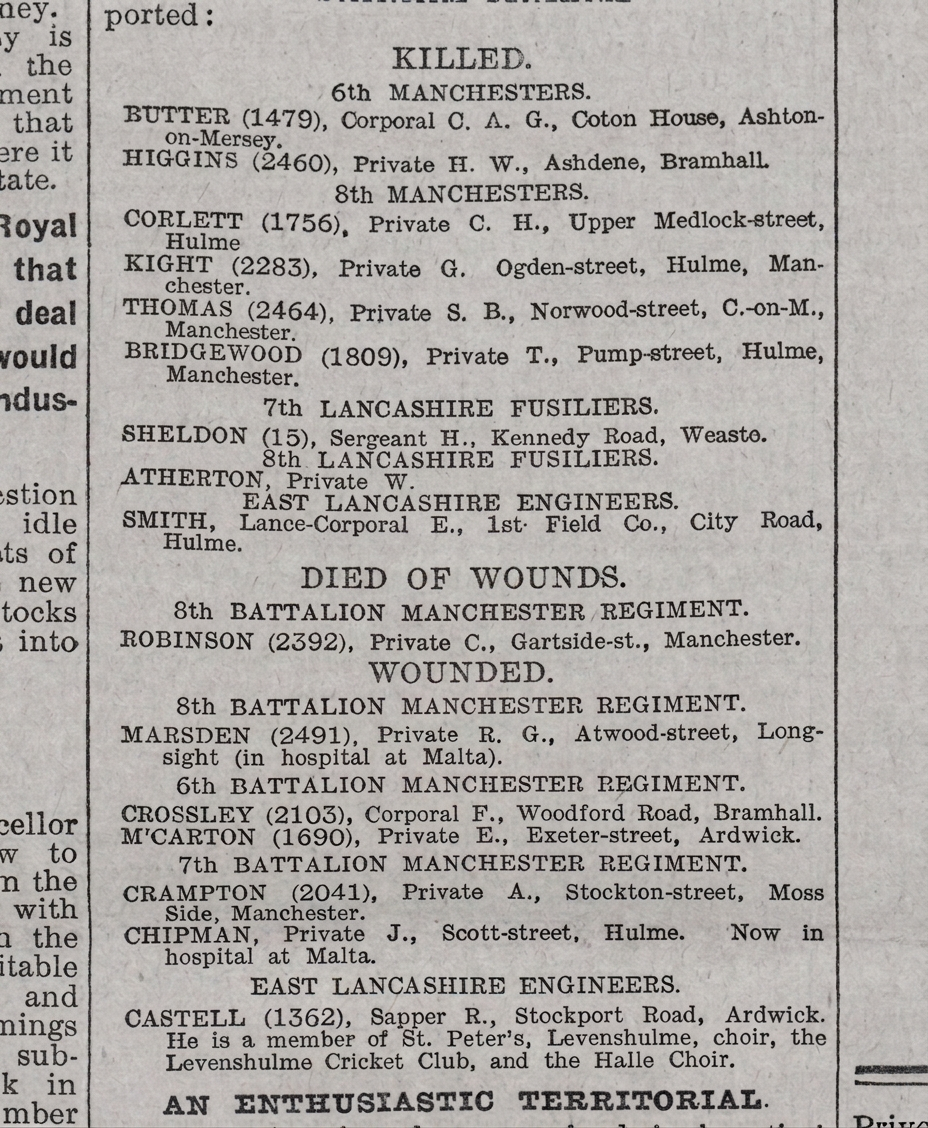
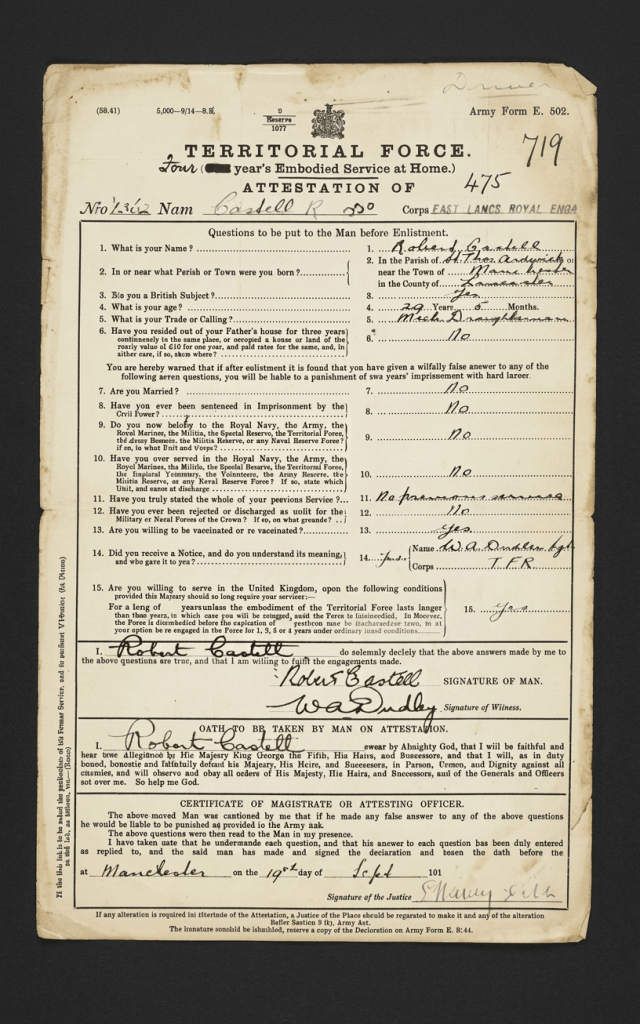
Robert Castell was born in Manchester in 1885 and at the time of the census in 1911 was living in Chorlton-on-Medlock with his father Daniel, who had come up from London to work on the railways in Manchester, his Bolton-born mother Margaret and his older sister, also Margaret, who worked as an overlooker in the clothing industry. Robert was a salesman for an engineering firm, and as we can see from the 1913 choir list and also the notice above he was also a proud member of the Hallé Choir and of the choir of St Peter’s Levenshulme, as well as Levenshulme Cricket Club. It also appears he was active in local Conservative Party politics.
He was one of those Hallé Choir members who very early on rallied to the cause and volunteered, as can be seen from his Attestation form from September 1914. Given his background in engineering it was probably no surprise that he joined the East Lancashire Royal Engineers as a Sapper, responsible for helping maintain the infrastructure of war, digging trenches, maintaining supply routes, clearing minefields and the like. His specific role was that of a ‘Field Lineman Dismounted’, so responsible for the maintenance of communication cables and telephone wires.
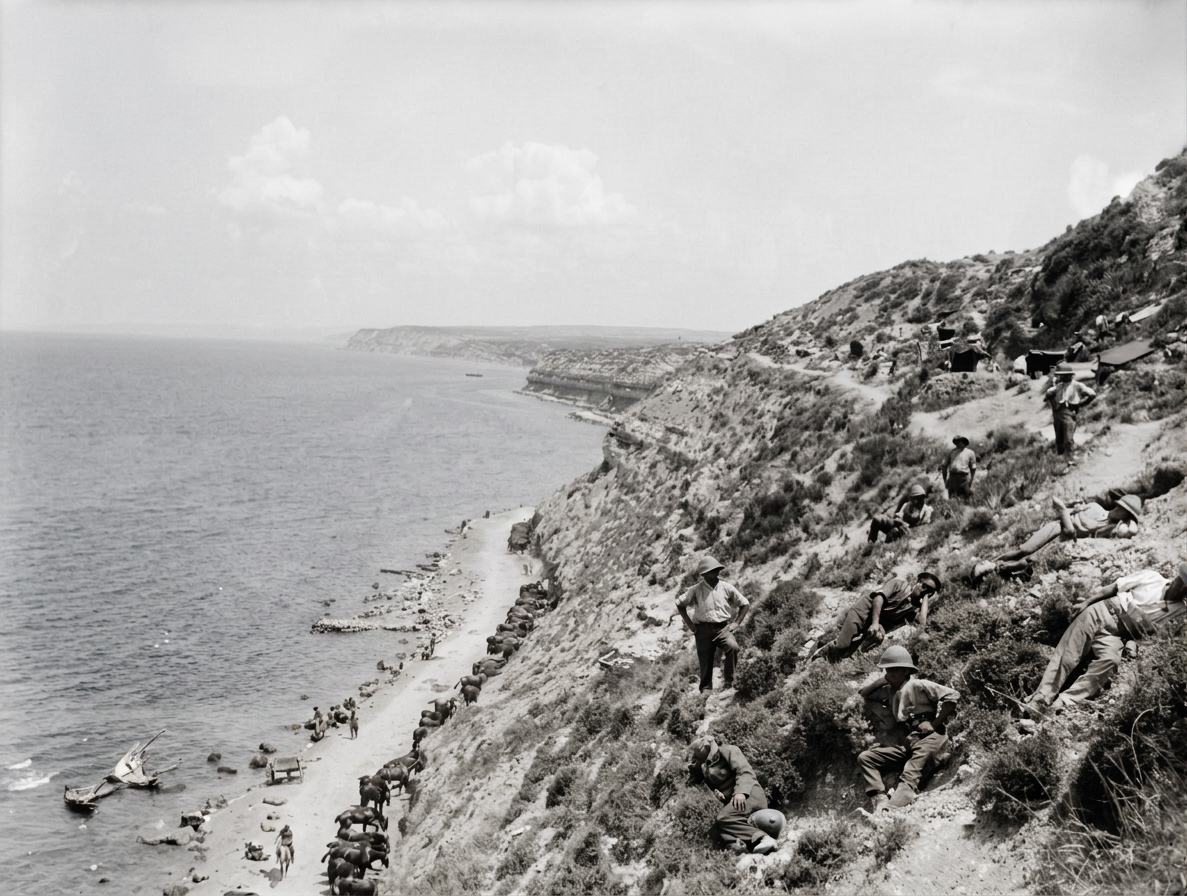
Robert first saw active service in 1915, not on the Western Front but arguably somewhere even worse, Gallipoli. Largely at the instigation of Winston Churchill, then First Lord of the Admiralty, in April 1915 Allied forces, including soldiers from Britain, Australia and New Zealand, attempted to take the Gallipoli peninsula guarding the Dardanelles Straits in north-western Turkey from the occupying Turkish forces. It was soon obvious it was a foolhardy mission, and indeed it soon led to Churchill’s fall from grace. As an article on the Imperial War Museum website explains:
The military aims of the campaign were not achieved and it was eventually called to a halt; the final Allied troops were evacuated in January 1916. There were heavy casualties, not only from the fighting, but from the extremely unsanitary conditions. Of the estimated 213,000 British casualties, 145,000 were from illness. Surviving combatants also recalled the terrible problems with intense heat, swarms of flies, body lice, severe lack of water and insufficient supplies.
From ‘Why was Gallipoli one of the worst fighting fronts of the First World War? on iwm.org.uk
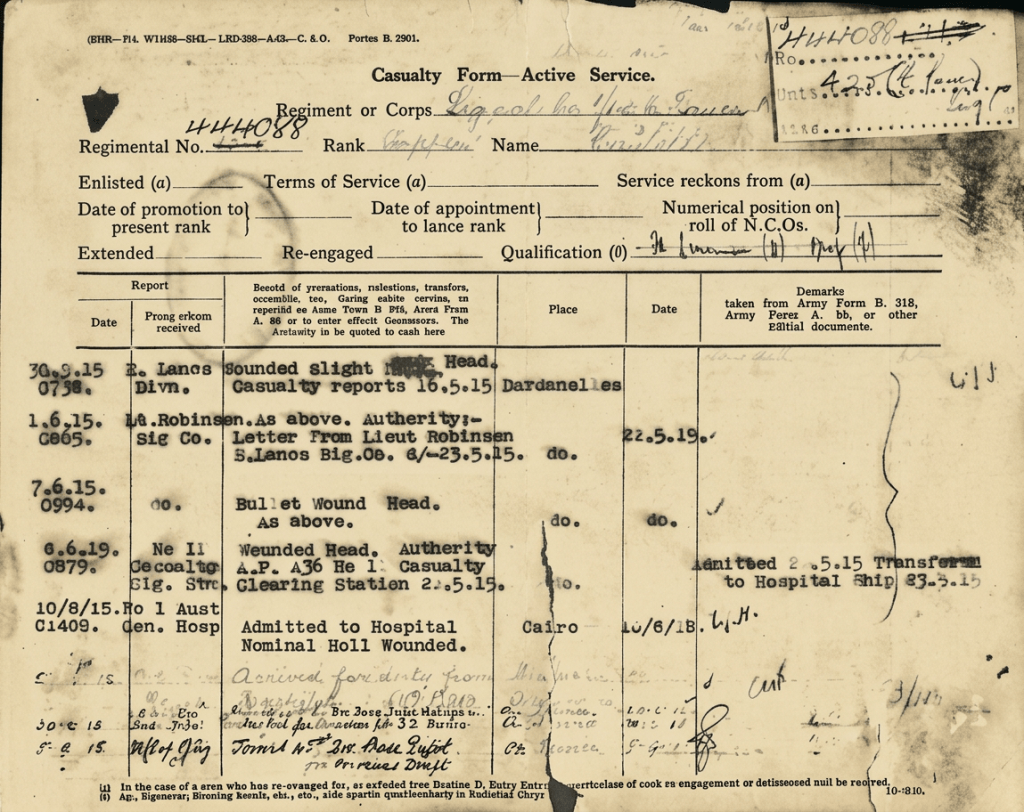
Robert arrived at Gallipoli on the 4th of May, 1915 and 12 days later on May 16th was hit in the head by a stray bullet. He survived, but was evacuated to an army hospital in Cairo where he recuperated. As such, he was one of those lucky enough to escape alive from the hell-hole that was Gallipoli.
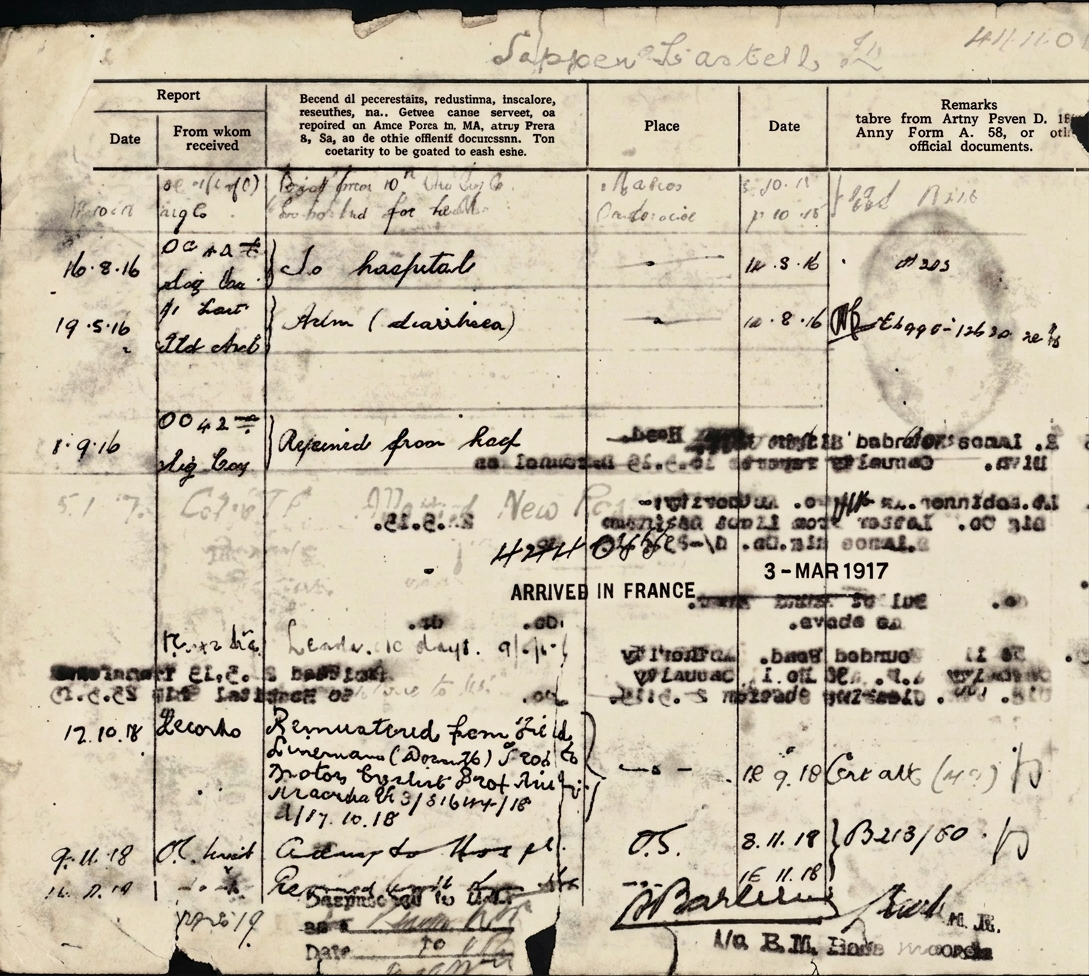
Robert returned to active service but the record is unclear as to where he served next, though he was admitted to hospital again in August 1916 suffering from diarrhoea, presumably a symptom of dysentery caused by the conditions in which he was serving. It is clear from his medical record that by March of 1917 he was serving in France on the Western Front. In September 1918 he gained a proficiency qualification as a Motor Cyclist, and served the rest of the war as such carrying orders up and down the line. There was still time for him to be wounded again, landing up in hospital on November 9th, two days before the Armistice was signed. He was released from hospital on the 16th and finally demobilised on 27th January 1919. Despite many hardships he had survived intact, luckier than many, and the 1921 census seems him aged 36 still living with his parents and his sister in Levenshulme and again working as a travelling salesman for an engineering company.
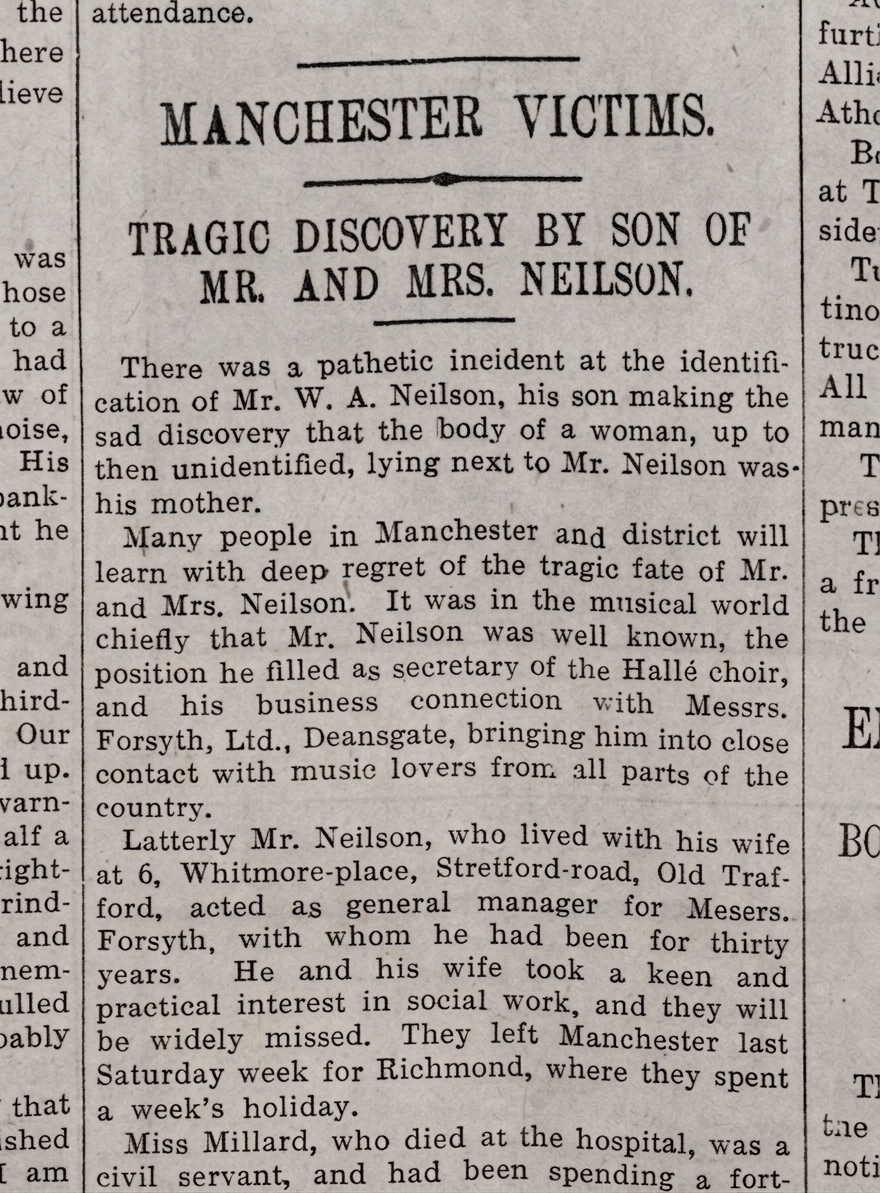
Robert Castell was wounded at Gallipoli in May 1915. Three months later there was an incident on the home front that impacted directly on the Hallé Choir. In early August 1918 W.A. Neilson, the secretary of the Hallé Choir who had submitted that plea to the local newspapers for more tenors and basses and few months earlier, travelled down to Richmond with his wife for a week’s holiday. As they were travelling back up north on the Euston to Holyhead Irish Mail train on August 14th, tragedy struck. The Manchester Courier gave the following report of what happened:
As the second part of the down Irish mail, worked by two engines, was running out of Stowe Tunnel between Blisworth and Weedon, the leading engine came into contact with the connecting rod of the engine of an up train, which had apparently broken. The two engines of the Irish mail became derailed and parted from the train, and several passenger coaches were thrown to either side of the line.
From a report in the Manchester Courier, 16th August 1915 (British Newspaper Archive)
Nine people were killed in the accident, and sadly two of those were Mr and Mrs Neilson, as the Manchester Courier reported in detail, mentioning both his Forsyth’s connection and his Hallé Choir connection.
The Manchester Guardian of 20th August carried a lengthy report of their funeral in Stretford Cemetery which was ‘attended by many musical and other friends of Manchester and the neighbourhood’. These included deputations from Forsyth’s and the Hallé Choir, and during the service R.H. Wilson conducted the Hallé Choir in Louis Spohr’s Blest are the Departed and the hymn Through the Night of Doubt and Sorrow. Remarkably the choir consisted of 200 voices.
With tragedy at home and seemingly never ending tragedy unfolding tragedy continuing on the various war fronts abroad, life had to continue for the Hallé Choir as the Hallé Concerts Society continued to promote concerts for the Manchester public. While it is fair to say that the number of choral concerts per season slowly declined through the course of the war, in the autumn of 1915 the choir still had plenty to sing.
On 4th November the choir were indeed given the spotlight in what was billed as ‘A Great Choral Evening’ that included The King Shall Rejoice by Handel, Verdi’s setting of the Stabat Mater, Debussy’s The Blessed Damozel (performed most recently in the BBC Proms in 2019 as La Damoiselle Élue), Komm, Jesu, Komm by Bach, a setting of Psalm 13 by Liszt and two part-songs by Ethel Smyth that I wrote about at length in this blog. On November 25th the choir sang scenes from Mussorgsky’s opera Boris Godunov along with Borodin’s Polovtsian Dances. The regular performance of Messiah in December rounded off 1915.
1916
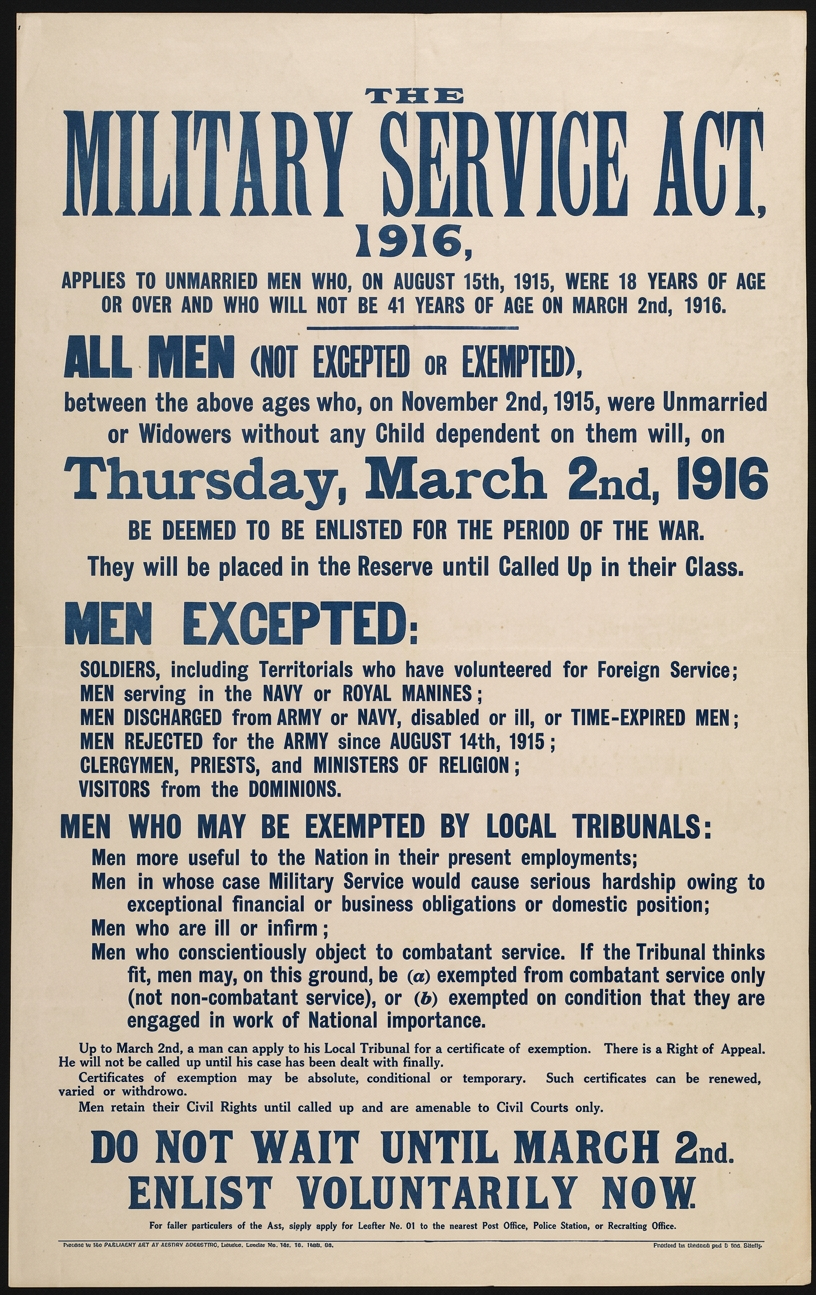
There was not universal support for the war amongst the general population, especially given the ambiguity surrounding the reasons for war, the apparent disregard amongst the military for leaders for the mass slaughter of their soldiers (‘lions led by donkeys’) and the simple moral and religious objections of many to having to participate. The Imperial War Museum estimates that around 16,000 men refused to fight during the First World War for these various reasons.
In January 1916 the No-Conscription Fellowship, founded in 1914 by the anti-war activist Fenner Brockway, managed to get a clause inserted into the new Military Service Act allowing for conscientious objectors to argue their case for exemption from military conscription at special tribunals. However, this clause only applied to ‘unattested’ men, i.e. those who had not yet formally registered for service, as Robert Castell had in the form reproduced above.
The Act did not come into force until March of 1916. In February a tribunal sat at Manchester Town Hall to hear 37 claims for exemption from attested men, men who had registered for service. As can be seen from the Military Services Act poster, amongst the grounds for exemption listed in the act were ‘Men more useful to the Nation in their present employments’ and ‘Men who conscientiously object to combatant service’. As the Manchester Guardian reported, one individual was obviously aware of these clauses and based his claim for exemption on two of them:
Some surprise was expressed when the claim of an attested conscientious objector was examined. He did not appear in person. In a written statement he said that he worked as a clerk, and thought he would have been reserved as his employer was engaged on Government work. He had “strong conscientious objection to combatant service”. He did not wish to slack, and was serving in the special police. He was a trained baritone vocalist, a member of Hallé’s choir [sic], and had sung at most of the military hospitals near Manchester. He put forward his reasons, he added, in good faith and loyalty. He attested quite expecting to be exempted. The claim was disallowed.
From a report in the Manchester Guardian, 18th February 1916
I have not been able to ascertain who this individual was as this is the only mention of this particular case I could find, but I am assuming he was one of the members of the bass section in the choir listing shown at the beginning of this post. Whoever he was, it is impossible not to feel sympathy with him, especially given the levity with which both the tribunal and the writer of the article treated the case (‘Some surprise’ etc.). What we will never know is whether as an unattested individual he would have gained exemption under the new rules. What we will also never know since we do not know his name is what subsequently happened to him when he entered military service and whether he ever got to sing again with the Hallé Choir. Sadly, we do know what happened to the other bass I mentioned by name above, J.S. Harwood.
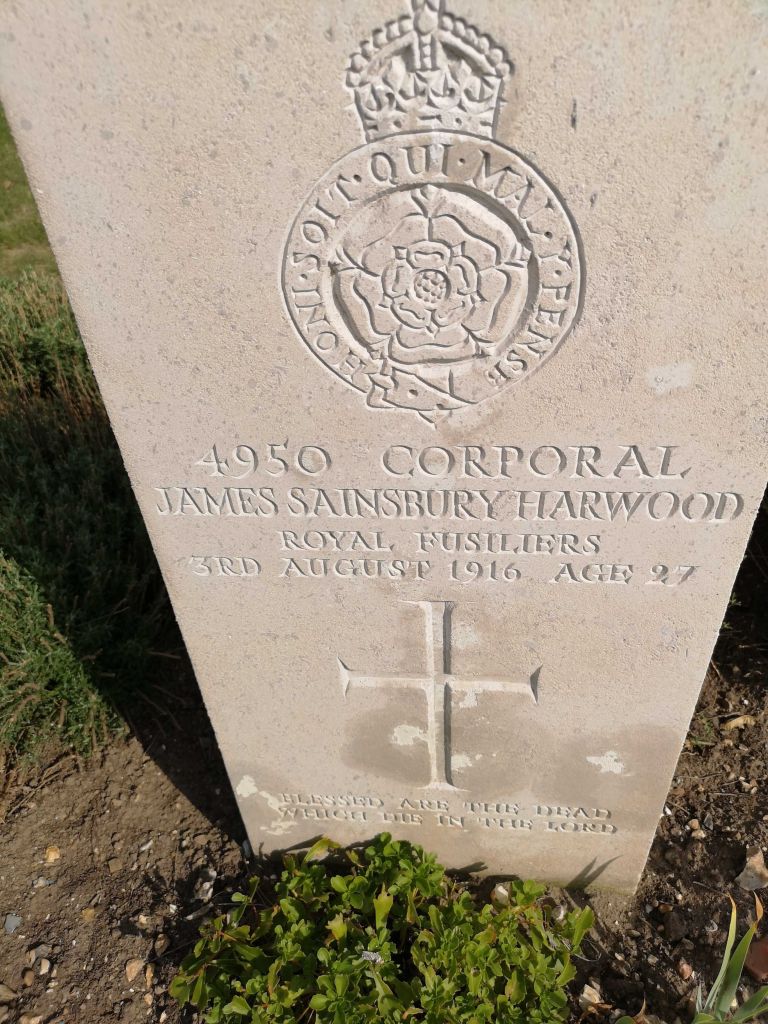
James Sainsbury Harwood was born in Rawalpindi in 1890, now a major Pakistani city but then part of British India. His father was a Bandmaster with the British Army. The family returned to live in southern England and no doubt because of his father’s army connections James received an education at Shoreham Grammar School, a public day school now known as Shoreham College. However, his father died in the first decade of the 1900s and in the 1911 census he was living in the Old Trafford area of Manchester with his mother Alice, his aunt Mary and his brothers Joseph and Claude. The fact that he was working as a Prices Clerk for Bradford Dyers in Manchester and that his brothers were working as a Shipping Clerk and an Office Boy suggests that with the death of his father they were now having to make ends meet.
The early period of the First World War saw the formation of many so-called ‘pals’ regiments, such as the famous 11th (Service) Battalion (Accrington), East Lancashire Regiment, known colloquially as the Accrington Pals. These regiments were formed to ensure that soldiers would serve with people from a similar area or background. The down side to this came when such regiments suffered heavy losses and certain communities suffered disproportionately to others as a result.
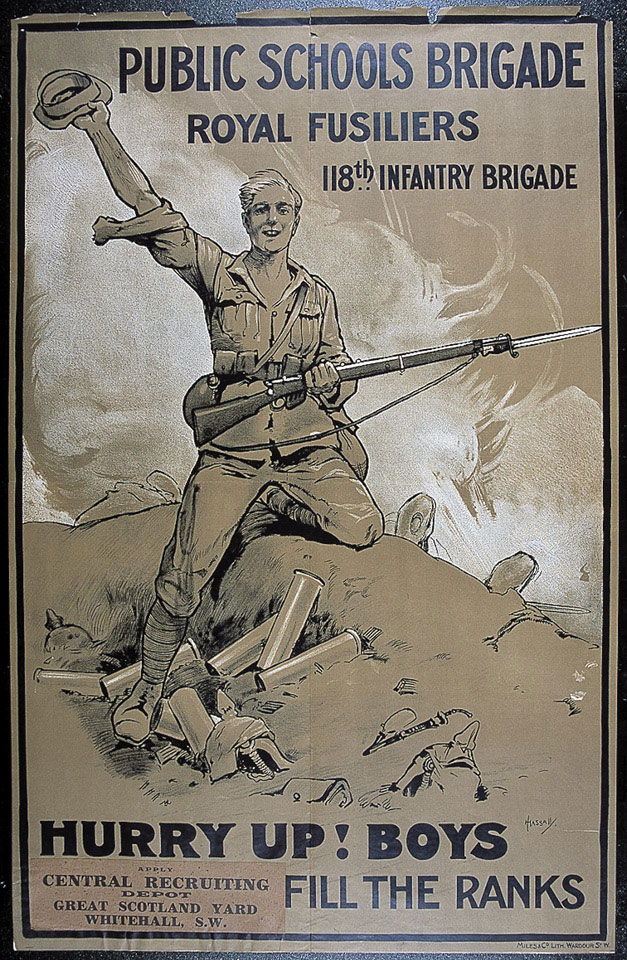
In a similar fashion the Public Schools Battalion was formed in the early years of the war so that those who went to school together could serve together. As an old boy of Shoreham Grammar School James was eligible and he signed up in August 1914, one month before Robert Castell.
James was attached to the 20th (Service) Battalion, Royal Fusiliers (3rd Public Schools), who recruited many from the Manchester area. By July 1916 he had been on active service on the Western Front for 10 months and found himself in the middle of one of the bloodiest battles of the entire war, the first Battle of the Somme. The first day of the battle alone, July 1st, saw 19,240 British soldiers killed with no significant breakthrough achieved and the battle soon became a war of attrition with frequent British attacks and German counter-attacks. One of the more significant of these attacks was the attempt to capture the strategic area known as High Wood which continued on and off through to September. James’ battalion was engaged in fighting here on July 20th and on the 21st found themselves bivouacked at Mametz Wood. It was here on this day that James Harwood received a gunshot wound in his leg.
When news of this first came back to Britain at the end of the month the signs were hopeful as James was listed as wounded. Here is the report in the Manchester Guardian of 29th July:
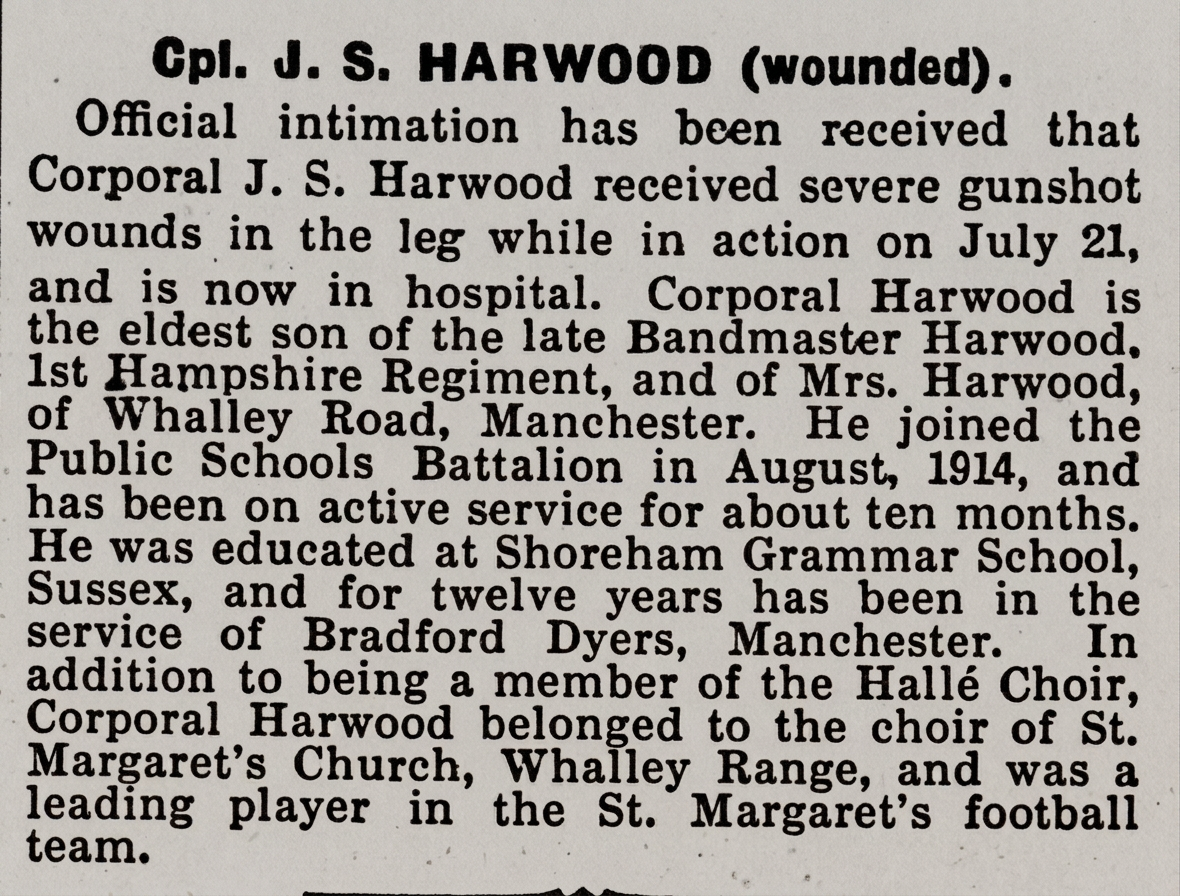
To me it is significant that the report saw fit to mention his singing, both in his church choir and in the Hallé Choir. It is perhaps a measure of its significance both to himself and his family.
James was moved to a hospital in Rouen where he struggled for life over the next two weeks. Sadly, the Manchester Evening News had the following notice on August 7th:
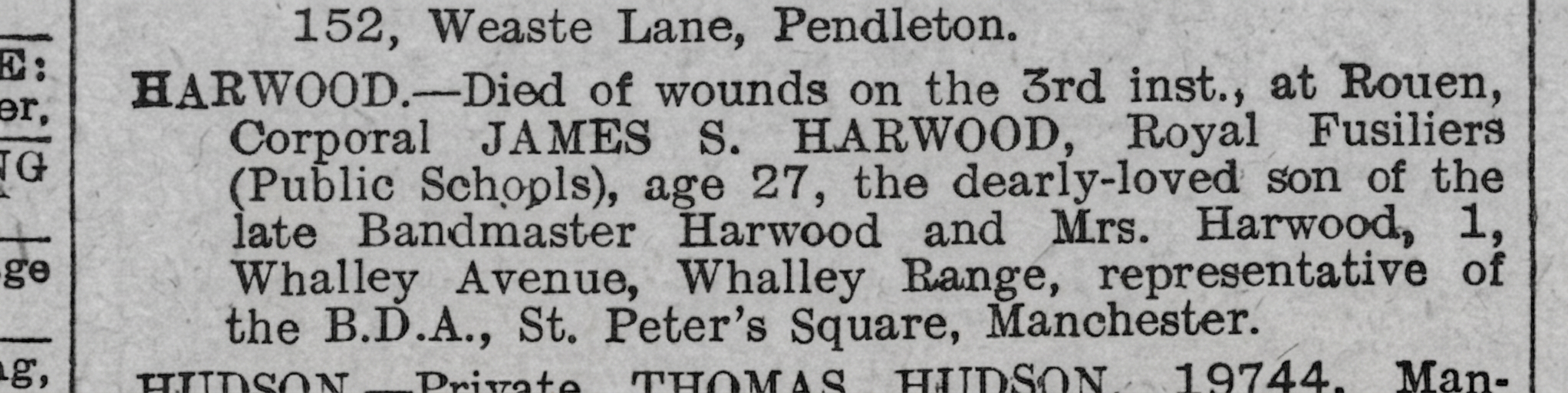
The news of his death reached Sussex on the same day, with the Sussex Daily News reporting it under the heading ‘Old Shoreham Grammar Schoolboy’s Death’. What I have not been able to ascertain yet is how many other Hallé Choir members paid the ultimate sacrifice during World War 1, but there will have been others. I hope James’ story can act as a memorial for all of them. He was buried at the Saint Sever cemetery near Rouen where his grave can be seen today.
As the horror continued to unfold on the Western Front through the second half of the 1915/16 season and beyond, so work had to continue for the choir. January saw a performance of Part 1 of Bantock’s Omar Khayaám and the women performing Wagner’s Venusberg music and some Brahms part-songs and on February 17th the choir sang Cherubini’s Requiem (not to be performed again until 2010) and Berlioz’ Romeo et Juliette. Another Wagner operatic evening ended the choir’s season in March.
On 15th September an article in the Manchester Guardian announced details of the 1916/17 season and there was a significant announcement hidden within:
At the suggestion of Mr. R.H. Wilson a select choir has been formed for the performance of choral works of slight or intricate texture. The Orpheus Choir, which had its origin chiefly among the members of the Hallé Chorus when the competition festivals began to assume importance, will also this year lend its assistance in the main chorus to supply the place of members absent with the army.
From an article in the Manchester Guardian, 15th September 1916 (Guardian Archive)
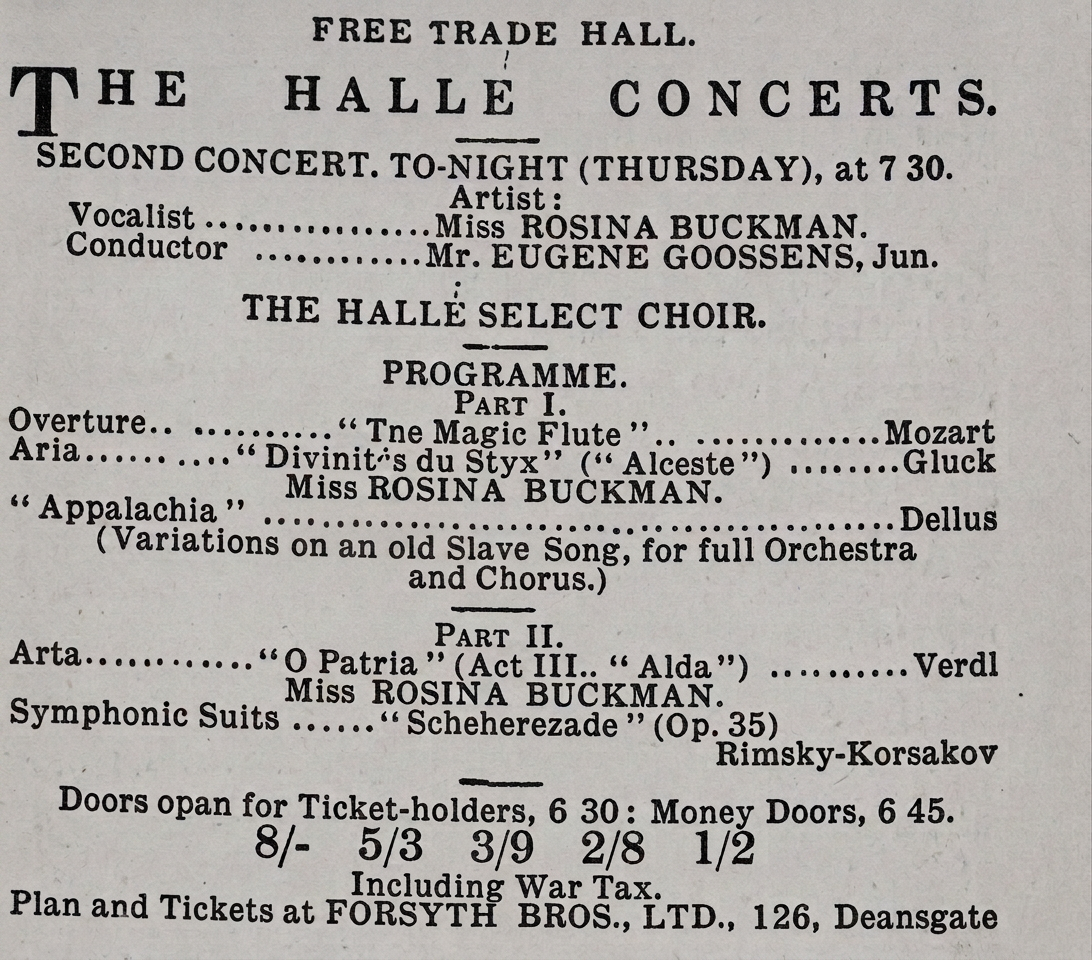
This is the first direct acknowledgment I’ve been able to find from the Hallé Concerts Society of the difficulties being faced by the choir. I would imagine Wilson’s suggestion was more a case of choosing repertoire to fit the resources available, and the quality of those resources, and the issue of bolstering the choir is something that we will see again in the Second World War, as I will cover in my next post.
The second concert of the season saw the first outing for what was billed as ‘The Hallé Select Choir’ in a performance of Appalachia, written in 1903 by Frederick Delius and based on his time spent working on a plantation in Florida. It consisted of a set of variations on old slave song which include a choral element. The review of the concert in the Manchester Evening News was complementary about the ‘new ‘ choir: ‘The new select choir gave a good account of itself, singing with fine spirit and excellent intonation in the difficult unaccompanied section.’
The rest of 1916 was, however, taken up with choral big hitters, a performance of Dream of Gerontius in November conducted by Elgar himself, the usual Messiah in December but also earlier that month, the first performance, conducted by R.H. Wilson, of For the Fallen, the final section of Elgar’s Spirit of England, settings of poems by Lawrence Binyon related to the war. This particular poem is now perhaps best known from its appearance at the annual Festival of Remembrance at the Royal Albert Hall.
Samuel Langford’s review of the concert concentrated almost entirely on the performance of For the Fallen, the significance of which in the midst of war had obviously not escaped anyone. It is possibly the most heartfelt review I have yet found of a Hallé Choir performance, so much so that I make no apologies for quoting it here in full, even if he occasionally drowns in his own syntax:
When, a few weeks ago, Sir Edward Elgar conducted in Manchester a singularly impressive performance of “The Dream of Gerontius,” one felt it was not completely just to his genius that this poignant expression of the sharpness of death to the single soul should be heard at the present time apart from the work, very short and yet its perfect complement, the hymn “For The Fallen,” a setting for tenor or soprano solo, chorus, and orchestra of one of the poems written by Laurence Binyon for the “Times” in the earlier days of the war. Last night that injustice was made good, and we were able to see with what softened eyes the composer of “Gerontius” was able to view death when consecrated by the fellowship of our country’s cause and, as the poet ventures to put it, the cause of the free. To this particular poet, as to the composer, England has always been a theme of inspiration, and the inspiration fails neither of them here, but is ennobled, first by the mystery and solemnity of the occasion, and not less by their union. Verse and music are almost twin-born, and are as harmonious as if they were the product of a single mind. There is a relationship of poetic idea between the poem and the unfinished play “Deidre of the Sorrows” by Synge. Synge’s lovers were keen to put a safe an swift end to their happiness by death, to set the seal of immortal youth upon it ere the decay of age came. So Binyon sings of the fallen-
They shall not grow old, as we that are left grow old; Age shall not weary them, nor the years condemn,
and concludes-
To the end, to the end, they remain.
The issues of the war have not grown less grave or less perplexed since Binyon wrote.
Elgar has sounded a greatly mellowed note in his music. Here as everywhere his strength is that of ponderous masses, slowly lifted and solemly swung in heavy sequences of interlocked harmony and melody. His tenderness, also, is, as everwhere, that of melody which has the swallow’s wing, the consciously poised, undulated sequence and curve, turning on itself sharply, and then lengthening out its flight in a strong current of rich harmony. The performance last night was, for a first performance, surprisingly good, and was much the most creditable achievement that Mr. Wilson as chorusmaster-conductor has had. In every instrument and voice one felt the conviction of what was due to the work, to its subject, and to the occasion. There was one shortcoming. The work was received with the subdued but long-continued applause which best indicates a true satisfaction. But the work is eminently one which demands a more ceremonious and, in the fullest sense, a public hearing. There is something in it for the consolation of everyone. We do not know whether the suggestion is a practicable one, but we feel that if it could be given at the opening of the Messiah Concert to the kind of serious and yet general public that gathers for that oratorio its message would be more fully and more fittingly delivered. It is not a work for the few.
From Samuel Langford’s review of For the Fallen in the Manchester Guardian, 15th December 1916
Even today, over 100 years after the end of the First World War, I am personally moved by this work in its full three-section entirety and consider it one of Elgar’s finest. How much more moving it must have been to hear it while the Battle of the Somme was still raging.
1917
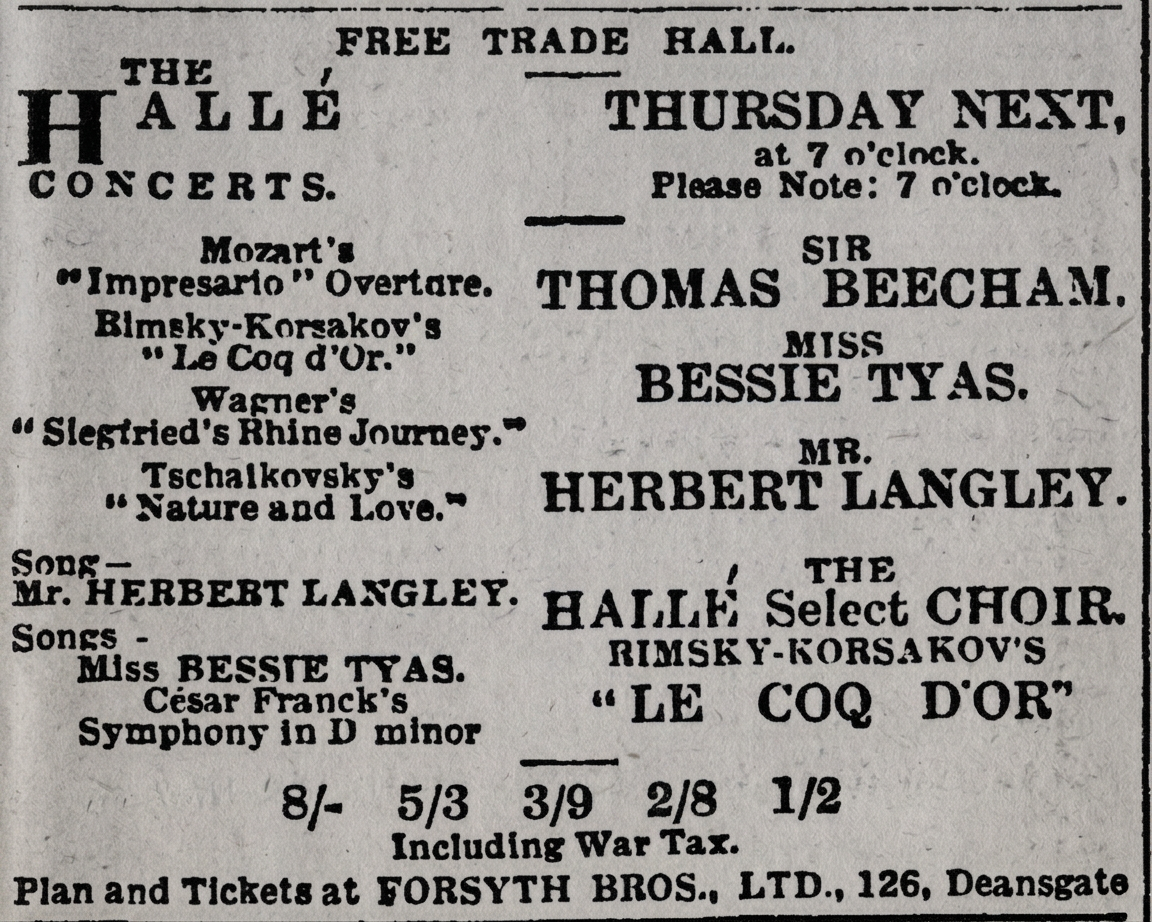
The Hallé Select Choir made a reappearance at the beginning of 1917 in a concert conducted by Thomas Beecham that included a couple of rarities, Tchaikovsky’s part-song Nature and Love for female voices, and selections from Rimsky-Korsakov’s final 1906 opera Le Coq d’Or (‘The Golden Cockerel’). Samuel Langford in the Guardian was not as kind to the chorus as he had been for For the Fallen: ‘The select choir sang only fairly well at the close of the operatic selection, but did somewhat better with the pleasing chorus by Tschaikovsky for ladies’ voices and orchestra.’ This is a shame as this appears to have been the last time the select choir sang together – it had no further appearances during this season and the idea seemed to have been abandoned for the next season.
The 1916/17 season concluded for the choir with two concerts in February and one in March. On February 8th the full choir performed the Verdi Requiem with Thomas Beecham and one week later the women reprised Debussy’s The Blessed Damozel along with Wagner’s Venusberg music with Eugene Goosens conducting in place of an indisposed Beecham. Finally on March 15th there was yet another Wagner operatic evening – we may have been at war with Germany, but we were not at war with Wagner.
Samuel Langford in the Guardian was impressed with the choir’s performance of the Requiem, even though his complements were slightly double-edged:
The chorus at last are beginning to give the sense that not only their entries and notes but also the expression and style of their singing are under the sway of the conductor. There were many beautifully ethereal phrases and many golden cadences and climaxes of glowing tone.
From Samuel Langford’s review of the Verdi Requiem in the Manchester Guardian, 9th February 1917
As the war ticked over into its fourth year, there were changes for the 1917/18 season of concerts. To accommodate the members of the orchestra taking part in Thomas Beecham’s opera engagements and the Brand Lane concerts, the total number of concerts in the season was reduced to 15 and the choir would only be involved in four of those. As previously stated, the idea of the select choir was abandoned.
After a performance of Berlioz’ The Damnation of Faust in October the big event would be the first Hallé performance of all three sections of Elgar’s The Spirit of England, which was to take place on December 15th, four days before the annual Messiah concert which would close the year. The concert was to have been conducted by Elgar himself but in the event Thomas Beecham had to step in to conduct all but the performance of the Elgar piece, which was conducted by R.H. Wilson.
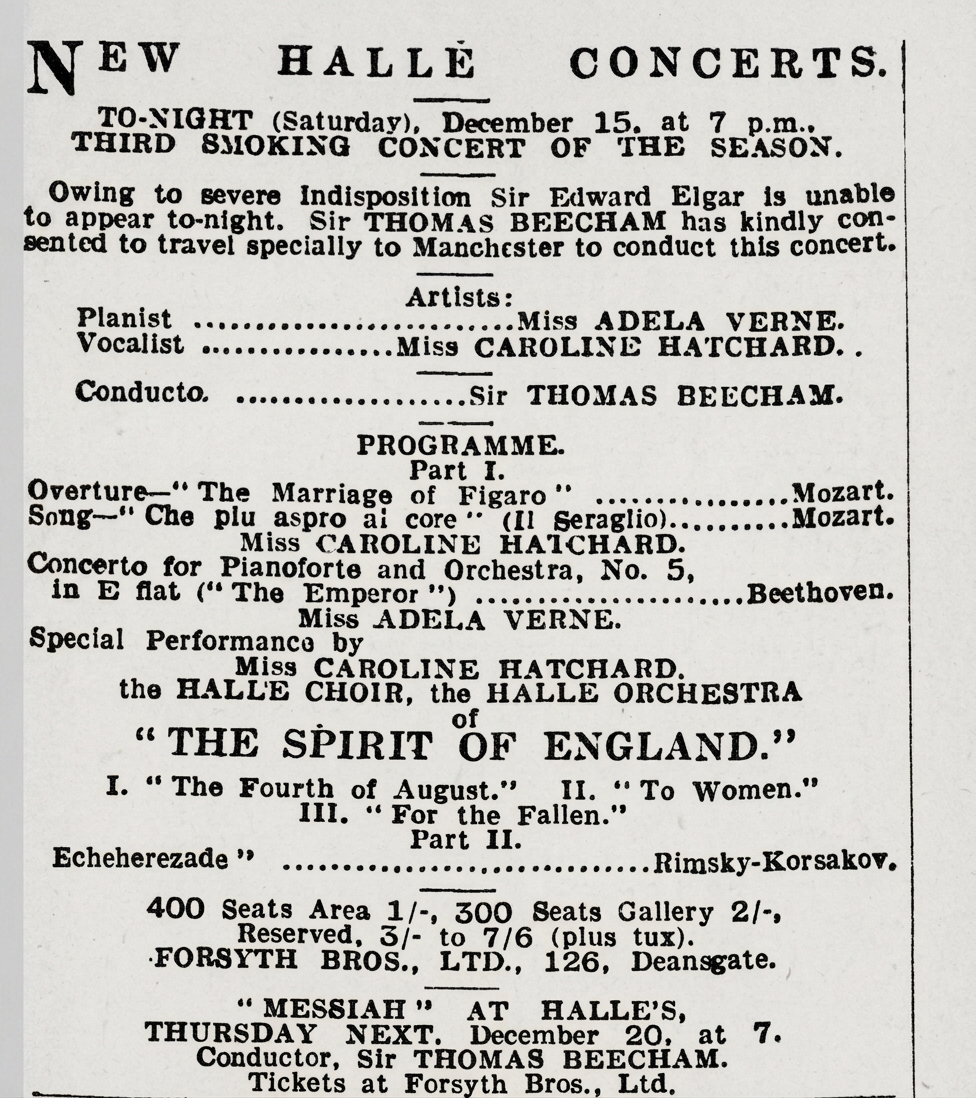
In his review in the Guardian, Samuel Langford this time played on the particular resonances of The Spirit of England and how its essential melancholy might not have been what was needed at that particular point in the war:
To be in every sense satisfying now, during the fourth year of the war, these pieces are too purely, or at least too nearly, a philosophy of fortitude in defeat. We have thought too long in this strain to have any further delight in it, and have need for something more assured. The chorus has so much experience of Elgar’s music that its style has become almost instinctive to the singers even the allusiveness of the present pieces being everywhere given with relish and point.
From Samuel Langford’s review of the The Spirit of England in the Manchester Guardian, 17th December 1917
1918
Only one concert remained during the rest of the of the 1917/18 season, a performance of Mendelssohn’s Elijah in March 1918, but as the war dragged ever so slowly on to its conclusion, members of the choir found time to help the war effort in other ways.
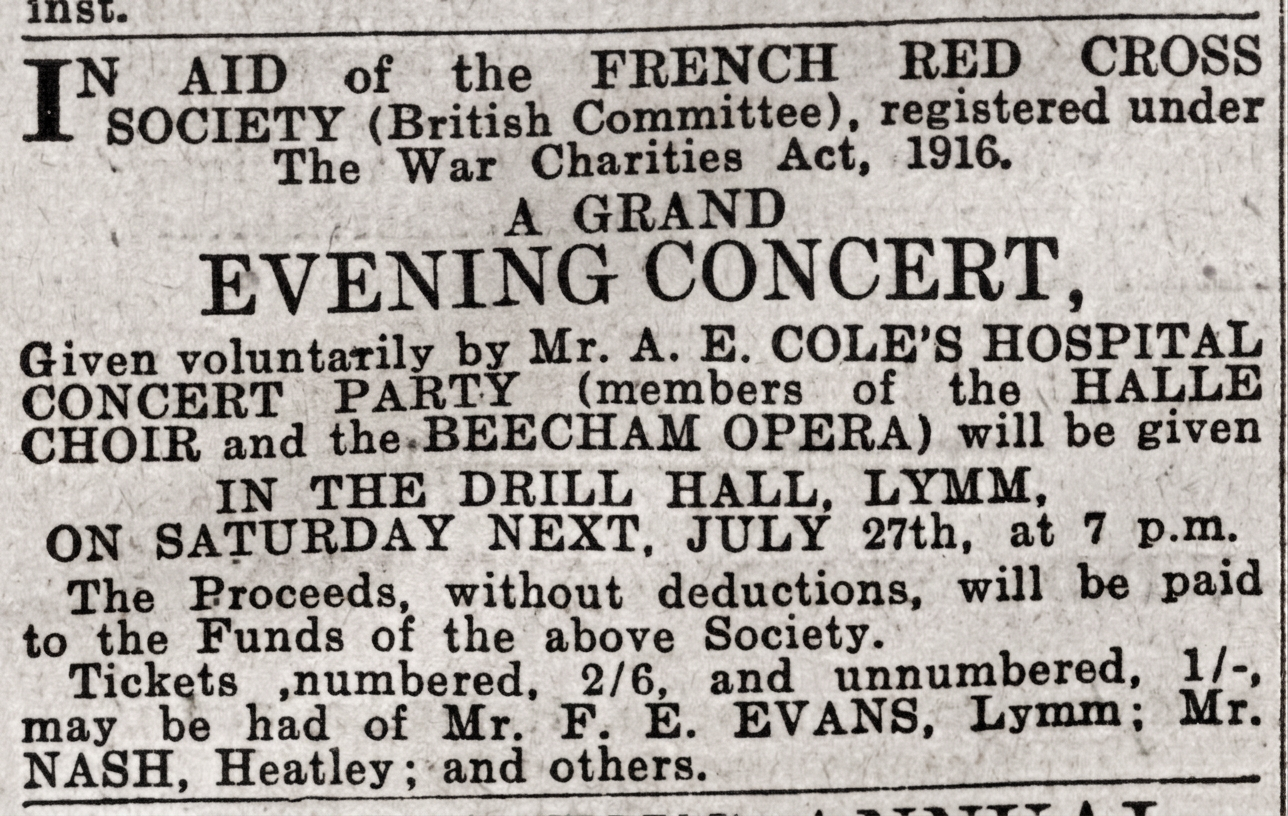
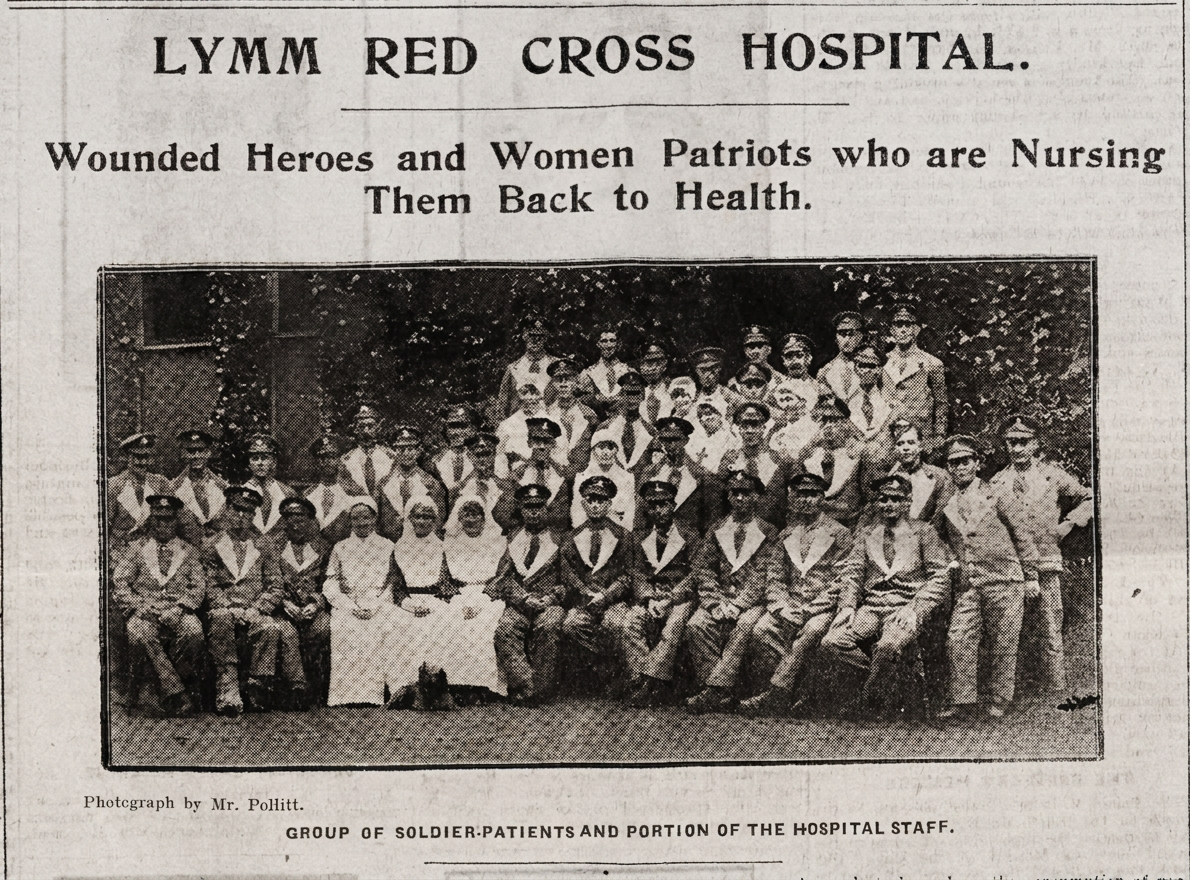
In July we see a group of singers taking part in a concert at the Drill Hall in Lymm, Cheshire, joining members of Thomas Beecham’s opera company. They would entertain soldiers convalescing at the nearby British Red Cross Society hospital. Funds from the concert would also aid the French Red Cross Society. The brief report in the Runcorn Examiner the week after the concert talked of a ‘highly appreciative audience’ and of it being ‘a delightful concert’. Below the report there was a picture of patients and VAD staff from the hospital, some of whom may have been part of the appreciative audience.
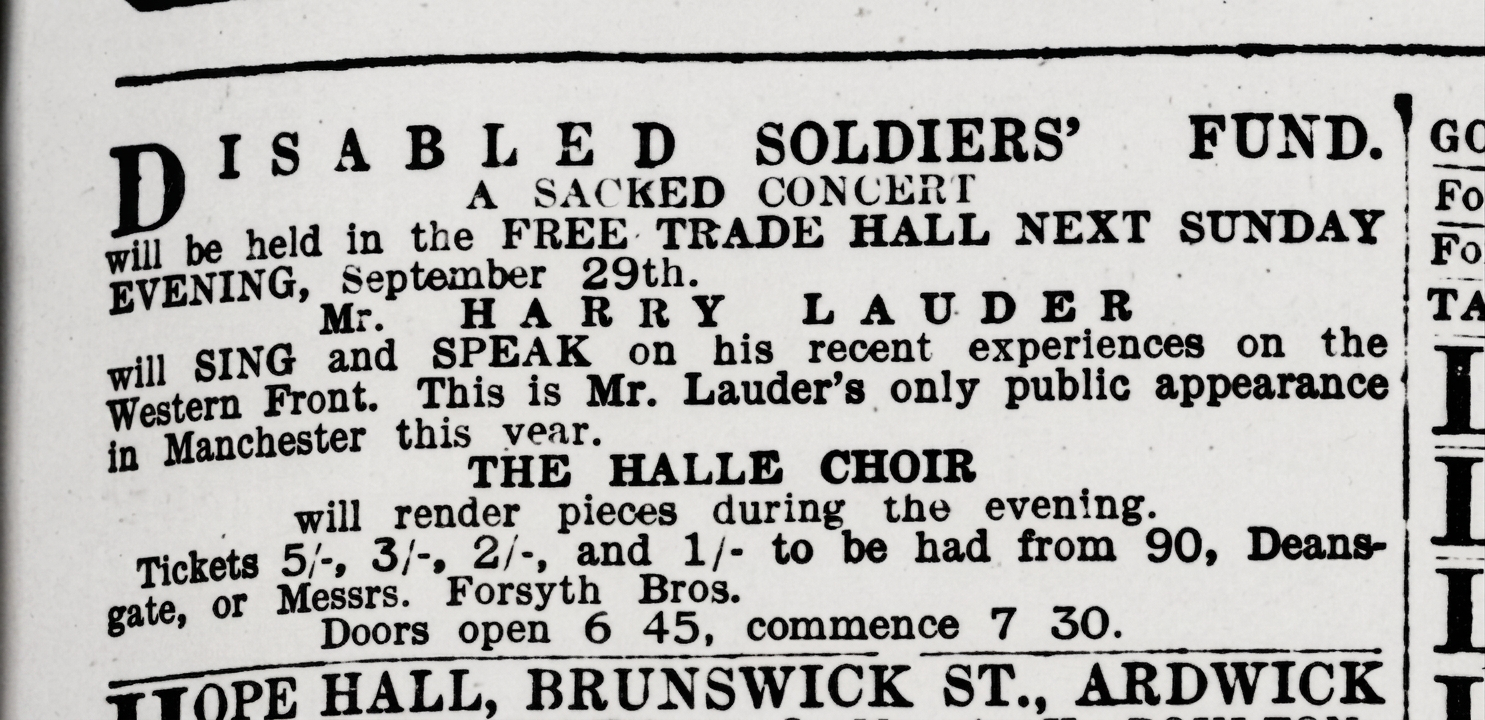
In September the choir renewed its acquaintance with Harry Lauder as they joined him in a concert in the Free Trade Hall in aid of disabled soldiers. Lauder also spoke to the audience about his recent visit to the Western Front; although the Armistice was near, the state of the war and conditions on the front were as bad as ever, as Robert Castell would testify. The Manchester Evening News called the concert ‘an unqualified success’. Lauder ‘sang in his own inimitable style, and the programme was also contributed to by the Hallé Choir, conducted by Mr. R.H. Wilson’. £80 was collected from the audience, £4,000 in today’s money.
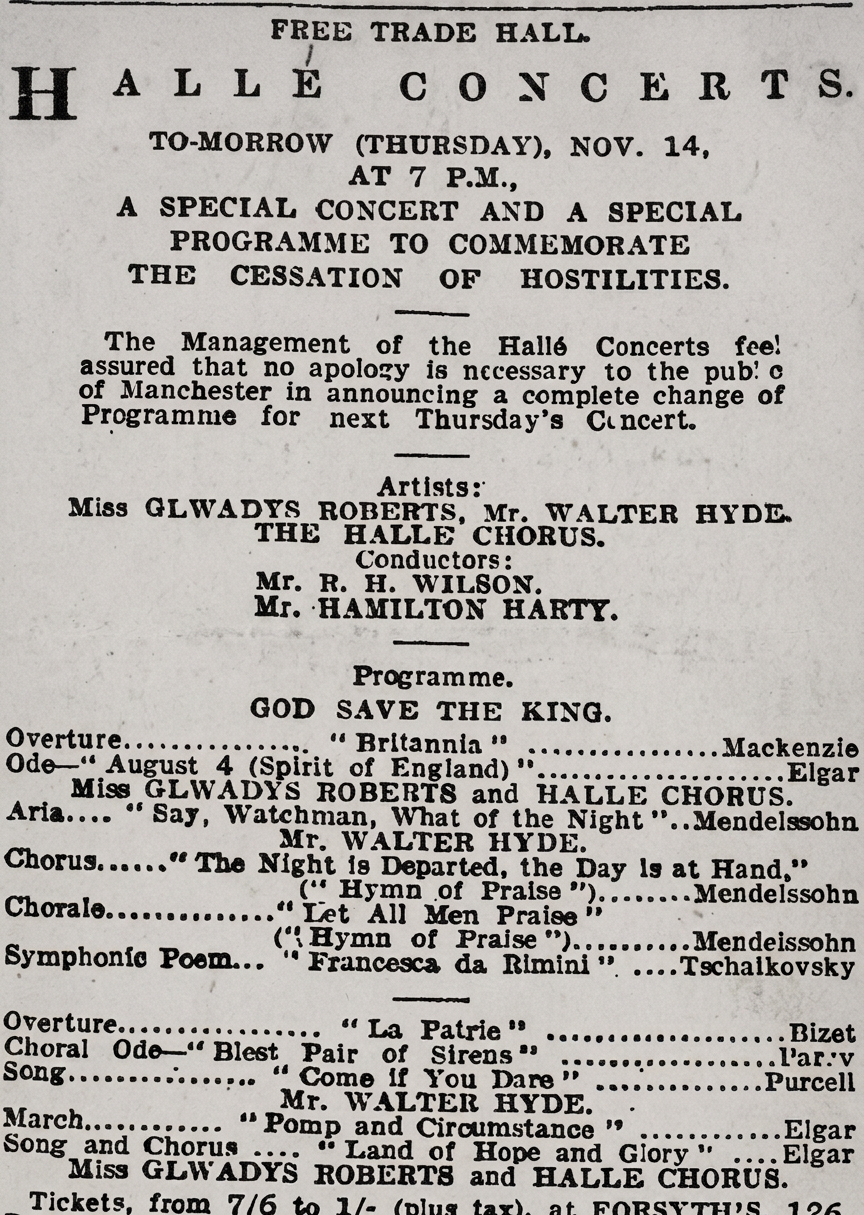
The Hallé Choir had two concerts scheduled in the 1918/19 season before the end of the year, one on 14th November and the normal Messiah performance in December. But events were progressing across the channel. By the autumn Allied forces had finally gained the upper hand over Germany and though fighting continued, the German forces were exhausted and ready for surrender. Though a peace treaty was not signed until the following year, at Versailles, a formal armistice was agreed on November 11th. The Germans laid down their weapons and hostilities ceased.
At extremely short notice, so short that Gwladys Roberts’ name was misspelled in the hastily pulled together advertisement in the press, the Hallé Concerts Society scrapped the planned concert for November 14th and replaced it with a special concert ‘to commemorate the cessation of hostilities’. Hamilton Harty, who would become the Hallé’s new chief conductor two years later, would share conducting responsibilities with R.H. Wilson, and the programme would be a mixture of items (mostly) appropriate to the occasion. The choir would sing the Fourth of August section of Elgar’s The Spirit of England, The Night is Departed the Day is at Hand and Let All Men Praise from Mendelssohn’s Hymn of Praise (‘Lobgesang’), Blest Pair of Sirens by Parry, Come if you Dare from Purcell’s King Arthur, and Elgar’s Land of Hope and Glory.
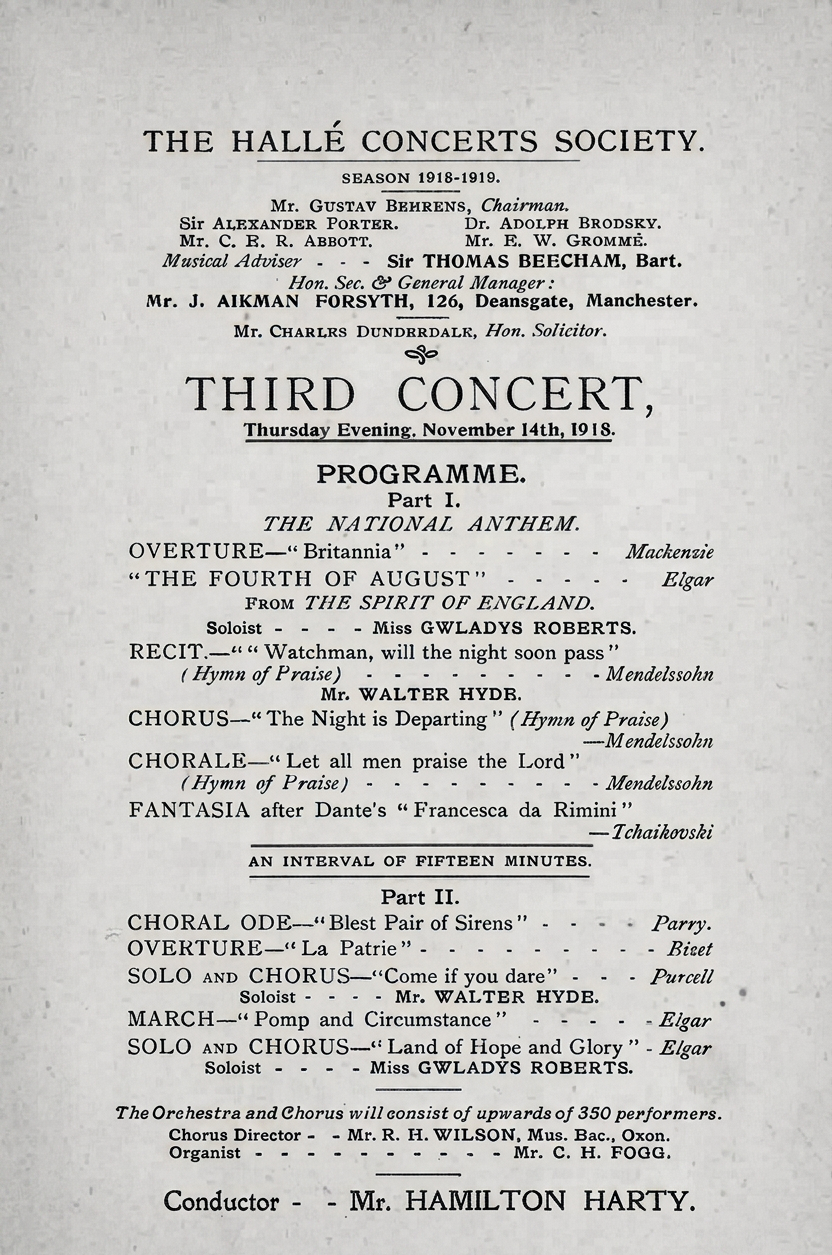
Samuel Langford, writing in the Guardian, was at his most ambivalent when reviewing the concert. One comment is interesting: he notes that ‘the concert already planned would probably have attracted a larger and more representative audience, and would have been musically more worthy of a great moment.’ This suggests that the hall was not full. Maybe a population weary of war and of course wary of the burgeoning Spanish Flu were not quite ready yet to celebrate. Langford was of the opinion that Beethoven’s Choral Symphony or even Messiah would have been more appropriate to the occasion. Of the choral items that were sung he wrote of The Fourth of August that it ‘was hardly a sufficient excerpt… to do justice to our feeling now, though, as it touched directly the matter of the present time, it was in a sense appropriate and was rather well given’. He felt one of the excerpts from Hymn of Praise ‘missed a great deal of its appropriateness by a wholly misguided translation.’ Blest Pair of Sirens ‘was no doubt wonderful, if we could have heard what it was about’. Altogether then, a somewhat curmudgeonly review given the occasion.
The anonymous review in the Manchester Evening News, subtitled ‘Peace and Music’ capture the spirit of the occasion in a more giving manner: ‘The management of the Hallé Concerts deserve congratulations on the transformation of the programme after the news of Monday last.’ When assessing The Fourth of August, the choir received special praise: ‘The Hallé chorus have never surpassed the sustained emotional delivery of the choral section which they achieved last night.’
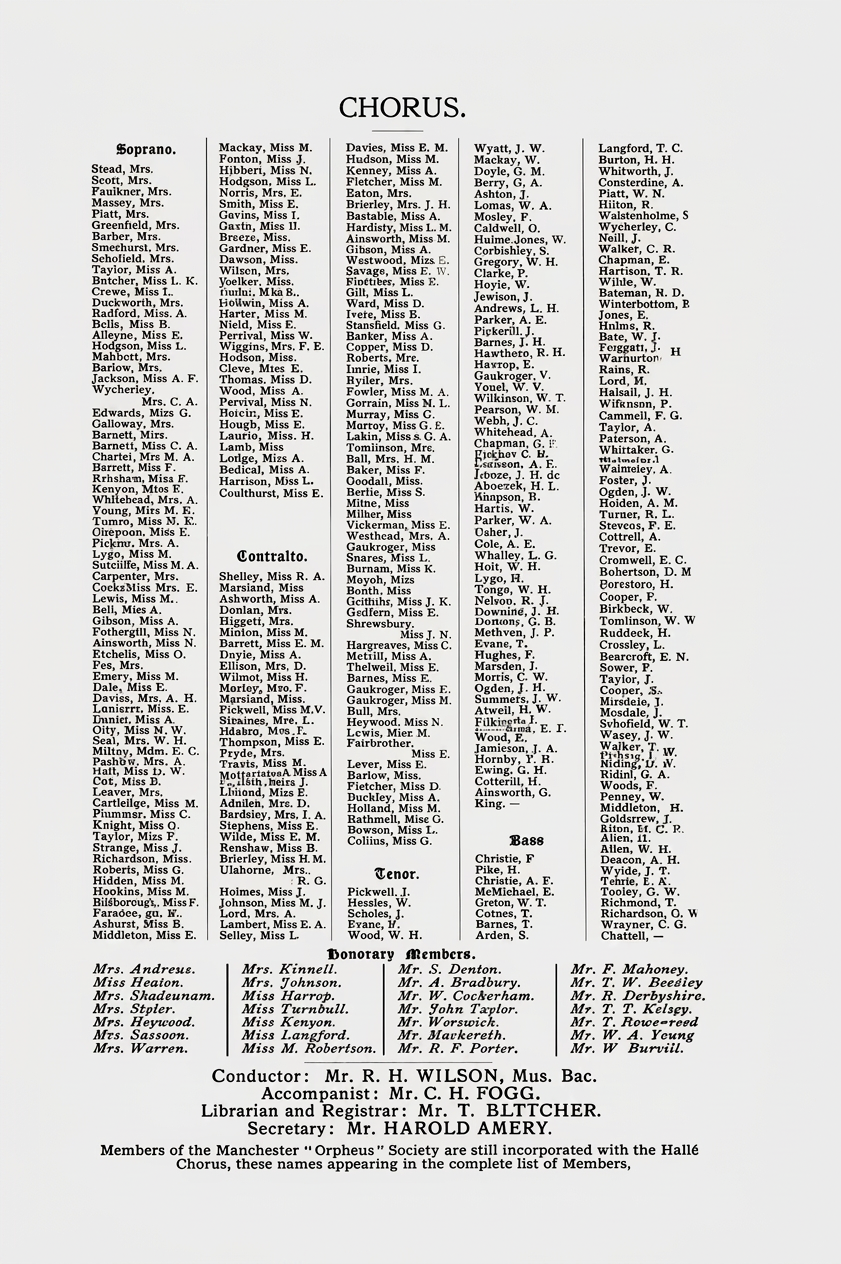
As had been the case for this and previous seasons, the choir were bolstered by members of the Manchester Orpheus Society, and the list of singers is reproduced above. There were however, many names missing from that list, those men like Robert Castell who were still on active service and those women who were working in the Voluntary Aid Detachment or in essential industries. And there were those who would never return, for example W.A. Neilson and members like James Harwood who had paid the ultimate sacrifice and would lie forever in some corner of a foreign field.
Lest we forget.
References
Extracts from Manchester Guardian from Guardian Archive courtesy of Manchester Libraries
Other newspaper extracts from British Newspaper Archive courtesy of Hallé Concerts Society
Hallé programme scans from the Hallé Archive
Information on Robert Castell and James Harwood from Ancestry courtesy of Cheshire Libraries
Information on World War One from the Imperial War Museum website (www.iwm.org.uk):
‘Why was Gallipoli one of the worst fighting fronts of the First World War?’. https://www.iwm.org.uk/history/first-world-war/gallipoli/why-gallipoli-was-one-of-the-worst-fighting-fronts
‘Voices of the First World War: Conscientious Objection’. https://www.iwm.org.uk/podcasts/voices-of-the-first-world-war/ep-37-concientious-objection
‘Battle of the Somme’. https://www.iwm.org.uk/history/first-world-war/somme
‘The Armistice and the end of the First World War’. https://www.iwm.org.uk/history/first-world-war/armistice
Futher information on the Public Schools battalions from:
‘Battle of the Somme Roll of Honour: 20th Battalion Royal Fusiliers (3rd Public Schools)’. https://somme-roll-of-honour.com/Units/british/20th_Royal_Fusiliers.htm
‘Public Schools Brigade, Royal Fusiliers, 118th Infantry Brigade, 1914 (c)’. https://collection.nam.ac.uk/detail.php?acc=2001-06-121-5
Chris Baker, ‘The Battles of the Somme, 1916’, The Long, Long Trail: Researching soldiers of the British Army in the Great War of 1914-1918. https://www.longlongtrail.co.uk/battles/battles-of-the-western-front-in-france-and-flanders/the-battles-of-the-somme-1916/
Michael Kennedy, The Hallé Tradition: A Century of Music (Manchester: Manchester University Press, 1960).
Eleanor Roberts, ‘The Hallé Orchestra in the First World War’. Nineteenth-Century Music Review. Published online 2026:1-13. doi:10.1017/S1479409825100943


Leave a comment