Introduction
On August 17th of this year, the Usher Hall in Edinburgh will host Sir Mark Elder’s final concert as Principal Conductor and Music Director of the Hallé Orchestra, nearly 24 years after his first concert in the role at the beginning of the 2000/01 season. That night the final choir to sing under his baton will be the Edinburgh Festival Chorus, with a performance of Lili Boulanger’s doom-laden Psaume CXXX, a work that the Hallé Choir will also perform early in the 2024/25 season under Sir Mark’s erstwhile assistant conductor Delyana Lazarova. Sir Mark’s final appearances with the Hallé Choir in Manchester will take place on May 31st and June 1st with the choir performing Sir James MacMillan’s setting of words from John Dryden’s Alexander’s Feast, a joint commission with the Cincinnati Symphony Orchestra that the composer entitled Timotheus, Bacchus and Cecilia, a work that is a celebration of the power of music. The choir will reprise these performances on July 21st at the BBC Proms in London.
What is most noteworthy about MacMillan’s work was that it was written not just for the Hallé Choir but also for the Hallé Youth Choir and the Hallé Children’s Choir, and celebrates the revolution in choral singing in Manchester that Mark Elder has overseen during his near quarter century in Manchester. Within this blog I will cover Elder’s early years with the choir from his first introduction to the choir in 1981, through his taking the reins in 2000 to the end of his second season and then cover the astounding growth in choral singing that occurred within the Hallé subsequent to that. For much of the blog I will be using as a resource the Hallé’s own newsletter/magazine that, under various names, it sent out to friends of, and subscribers to, the orchestra from 1946 through to the beginning of digital newsletters in 2017. This will be supplemented largely by articles and reviews from The Guardian, the newspaper that at least in the early days of Elder’s tenure still covered music making in Manchester extensively despite long having moved from Manchester to London, and the Manchester Evening News, which now appears to have forgotten the Arts completely but which back in 1999 still had an extensive Arts brief.
Mark Elder meets the Hallé Choir
Mark Elder was born in 1947 in the small Northumberland market town of Hexham, where his father was a dentist. As a boy he displayed great prowess as a bassoonist, eventually joining the ranks of the National Youth Orchestra, an orchestra I much later saw him conduct at the BBC Proms. When he went up to study at Corpus Christi College, Cambridge it was as a choral scholar, presumably employing the fine light baritone voice that the members of the Hallé Choir have become very familiar with over the years. Taken to Glyndebourne at an early age he also developed an early enthusiasm for opera that he was able to develop when at the age of 25, and mentored by conductor Sir Edward Downes, he spent a couple of years at the Sydney Opera House in Australia, eventually conducting a number of performances:
At 10, I was taken to rehearsals for three operas at Glyndebourne. I loved the smell, the atmosphere, the theatricality – and I became aware of the role of the conductor. But it wasn’t until I went to Sydney in 1972 that I started to conduct.
From interview with Laura Barnett in The Guardian, October 1st 2013
Returning from Australia in 1974 he began conducting at English National Opera, where Charles Mackerras was at that time the Artistic Director. He took over from Mackerras in 1979, staying in post up until 1993. For the first 20 years of his conductor career, therefore, opera took up by far the biggest proportion of his conducting time and he oversaw what were extremely successful years for ENO, especially when compared with the perilous state of the company in 2024. He also conducted opera at Glyndebourne, Covent Garden, Chicago Lyric Opera, the Metropolitan Opera in New York, at the Bayreuth Festival and elsewhere
. He did find time, however, for conventional conducting engagements, serving as Principal Guest Conductor of the London Mozart Players from 1980 to 1983, of the BBC Symphony Orchestra from 1982 to 1985, and of the City of Birmingham Symphony Orchestra from 1992 to 1995. He was also Music Director of the Rochester Philharmonic Orchestra in upstate New York from 1989 to 1994.
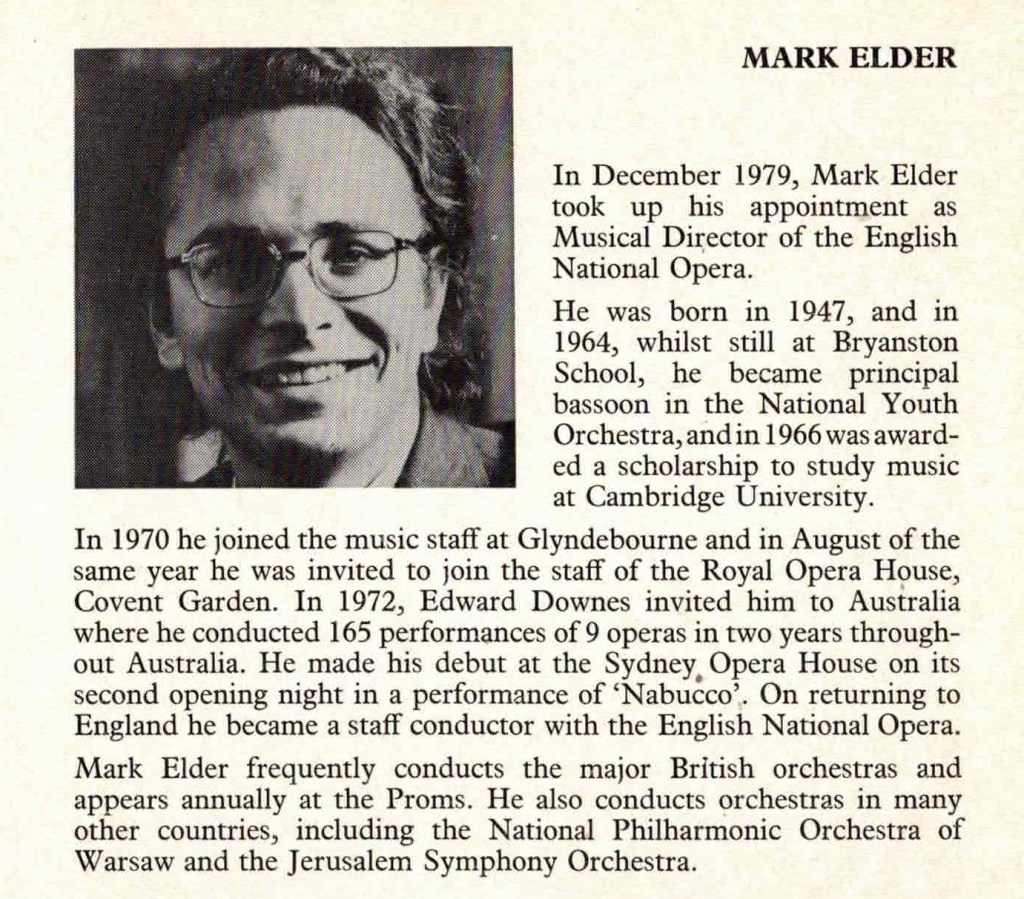
His first appearances with the Hallé Orchestra and the Hallé Choir came at the Free Trade Hall in an ‘Opus One’ concert performed three times at the end of April and the beginning of May 1981, in other words less than two years into his tenure at ENO and when, as can be seen from his biography in the programme, he was still a relatively fresh-faced (and bespectacled!) 34 year old. This was during James Loughran’s tenure as Music Director, and the December 1980 issue of Hallé – magazine for music lovers, as the Hallé newsletter was called at that time, shows that these were interesting times for the choir, as they had recently appeared at the Proms singing Beethoven’s Choral Symphony (and would indeed appear at the 1981 Last Night of the Proms) and were about to appear on television, an event I will cover in more detail in a later blog:
On 12th September, 1980 at the Royal Albert Hall, James Loughran conducted the Hallé Orchestra and Choir in the traditional performance of Beethoven’s Choral Symphony on the second-last night of the Henry Wood Proms. The Hallé Choir was the first choir from outside London to be invited to give this concert, and it was received with great enthusiasm by a large and exuberant “Prom” audience. A further out-of-town date for the choir is a recording for Yorkshire Television in Lincoln Cathedral on Tuesday 2nd December. The programme of Christmas music will be broadcast on Sunday 21st December.
from ‘Hallé notes’, Hallé Vol 2 No. 14, December 1980
The concert diary from the same issue of Hallé showed that this was also busy time musically for the choir, very much reflecting the early years of the choir under Charles Hallé, as in the first four months of the year the women of the choir were rehearsing for a performance of The Planets, the men for two performances of Liszt’s Faust Symphony, and the whole choir not just for the performances with Elder but for performances of Haydn’s Nelson Mass with the Manchester Camerata and The Dream of Gerontius with Maurice Handford conducting.
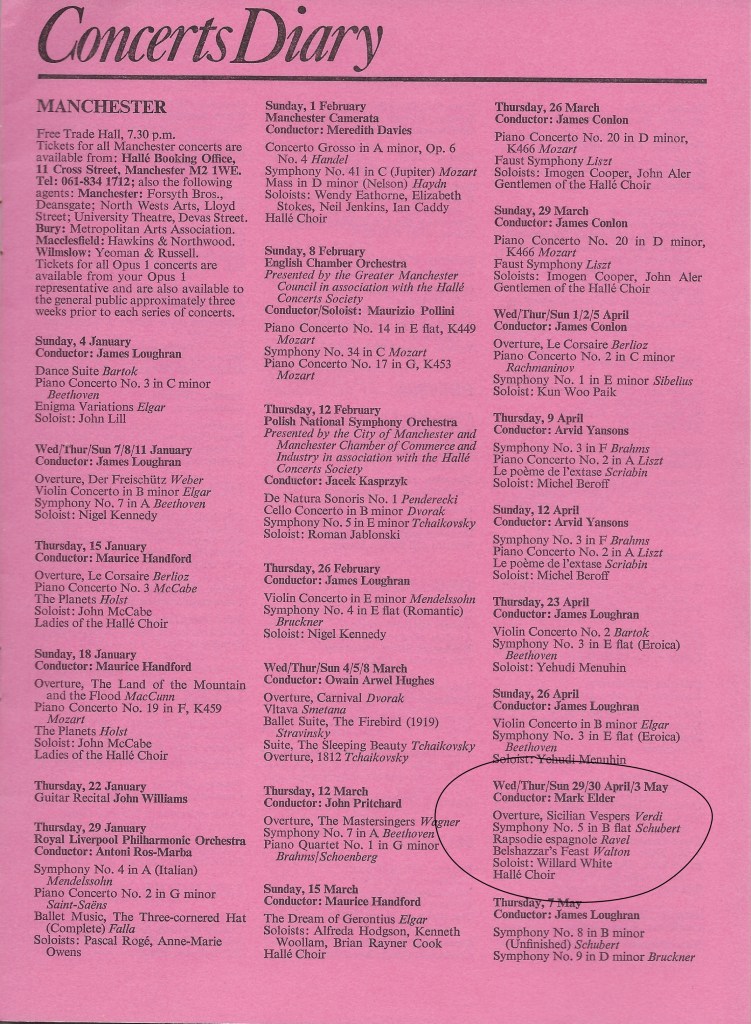
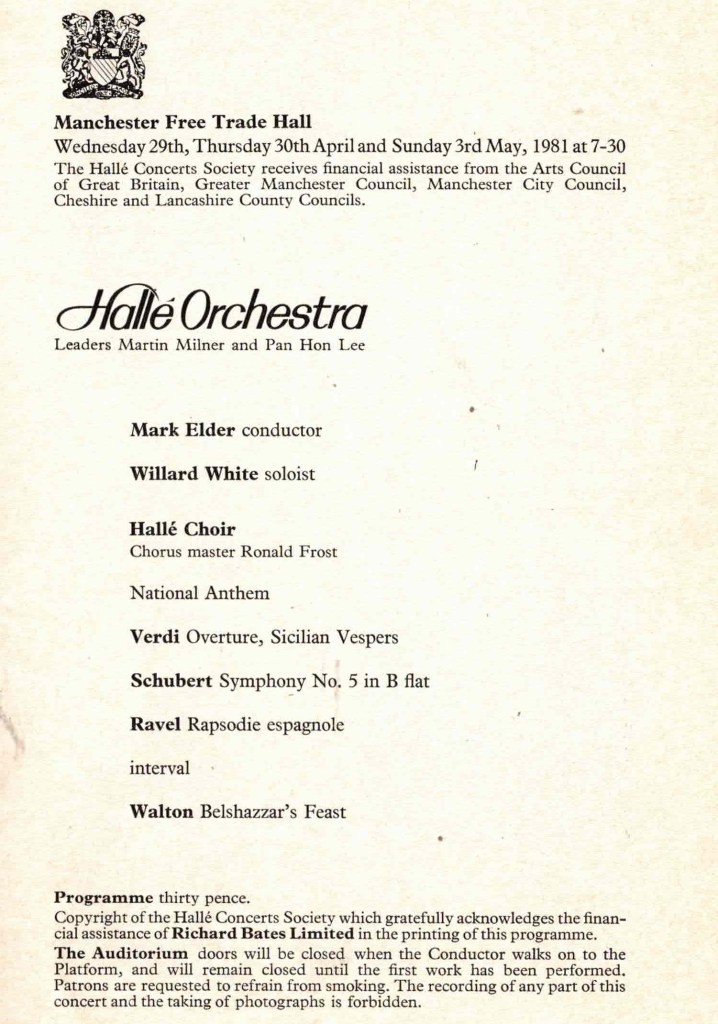
The piece chosen for Mark Elder’s first performances with the Hallé Choir was William Walton’s vividly sparkling oratorio Belshazzar’s Feast. At the time this was very a party piece for both choir and orchestra. During the 1970s alone, the Hallé Choir performed the piece with the orchestra four times, and the orchestra with other choirs a further three times, and as recounted in a previous blog, the choir made a recording of the work under James Loughran for Classic For Pleasure in 1973. The choir then gave a further four performances of the work up to 1990, which with the three performances under Elder gave a total of 11 performances in less than 20 years. I’m sure that by 1990 most of the choir were note perfect!
The programme shows that the soloist for the three concerts was the great Jamaican baritone Willard White who went on to perform the piece a further two times with the choir during the 1980s. He had worked with Elder at English National Opera in the 1970s and began a trend Elder continued when he took over as Music Director of the Hallé in 2000 of working with singers that had achieved success with ENO , singers such as Lesley Garratt, Brindley Sherratt and David Kempster. Sadly, and probably due to the ubiquity of Belshazzar’s Feast in the choir’s repertoire at the time, neither the Guardian nor the Manchester Evening News saw fit to review any of the three performances.
It is clear though that this first encounter with the Hallé Choir resonated with the conductor and informed his decision making nearly 20 years later when he took up the reins in Manchester. As he said to Tom Service in an interview in the May 2024 issue of BBC Music Magazine when describing the choral developments he had overseen: ‘…and then there’s the main choir. My very first concert with the Hallé was Belshazzar’s Feast in the early 1980s, so the choir has always been central to me.’
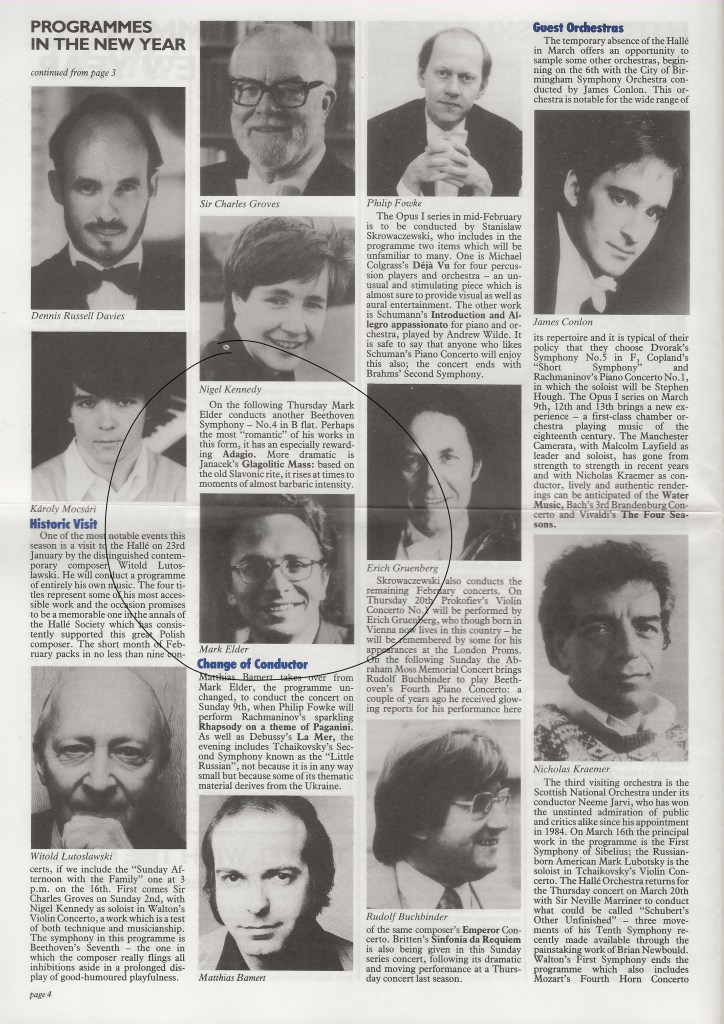
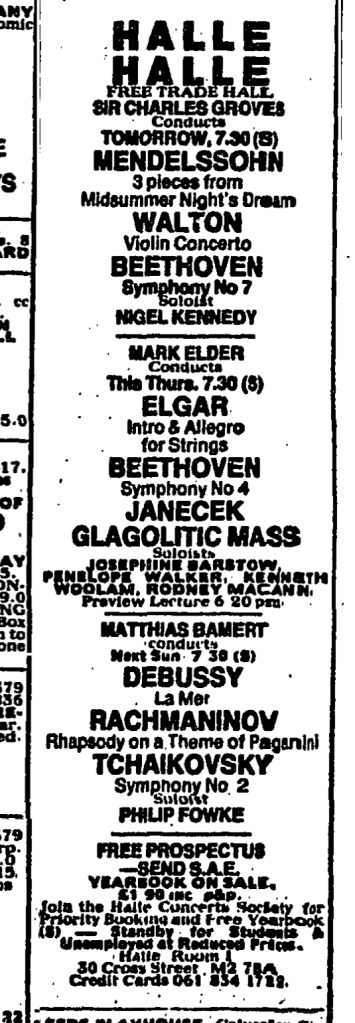
The same bespectacled photograph of Mark Elder appeared in the Hallé newsletter for December 1985, now re-branded Hallé News, advertising the conductor’s next appearance with the Hallé Choir, conducting Leos Janácek’s stirring Old Church Slavonic setting of the mass, the Glagolitic Mass, but the choir’s relationship with Elder properly began to flourish in late 2000 following his appointment in 1999 as Music Director of the Hallé.
The New Broom
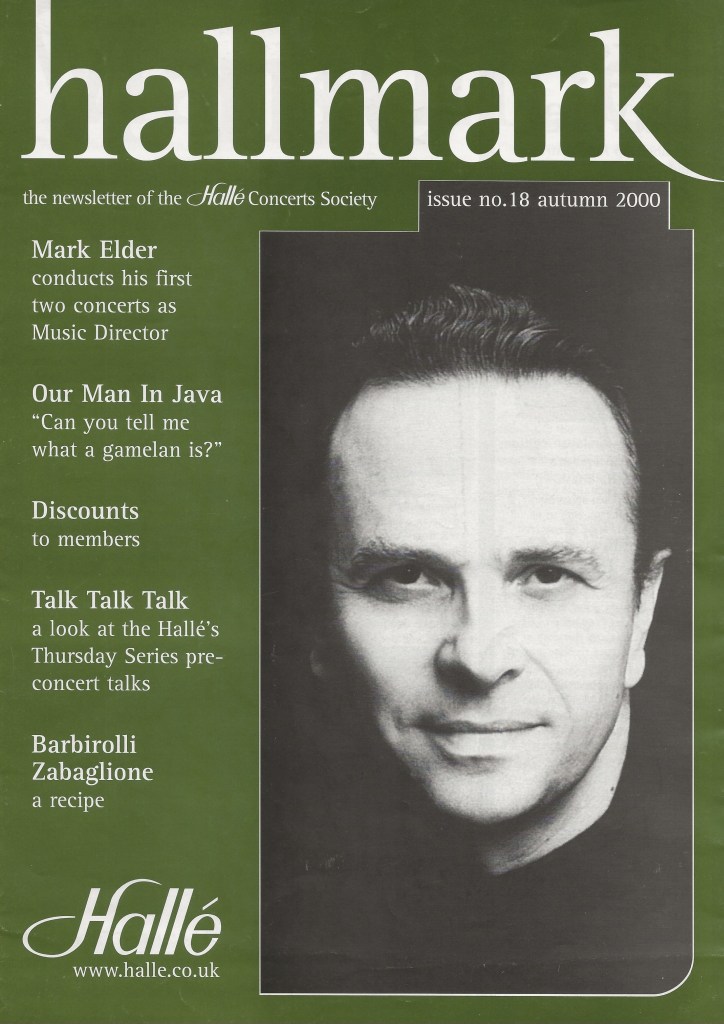
As mentioned in an earlier blog, 1999 was a critical time for the Hallé Orchestra. Kent Nagano’s time with the Hallé had seen artistic successes but these had come at a huge cost as Nagano’s ambitions for the orchestra moved beyond the Hallé Concerts Society’s ability to pay for them. Rachel Pugh’s interview with Mark Elder, published in the Manchester Evening News four days after his appointment to succeed Nagano was announced, itemised some of the issues facing the orchestra, the most recent of which were listed as:
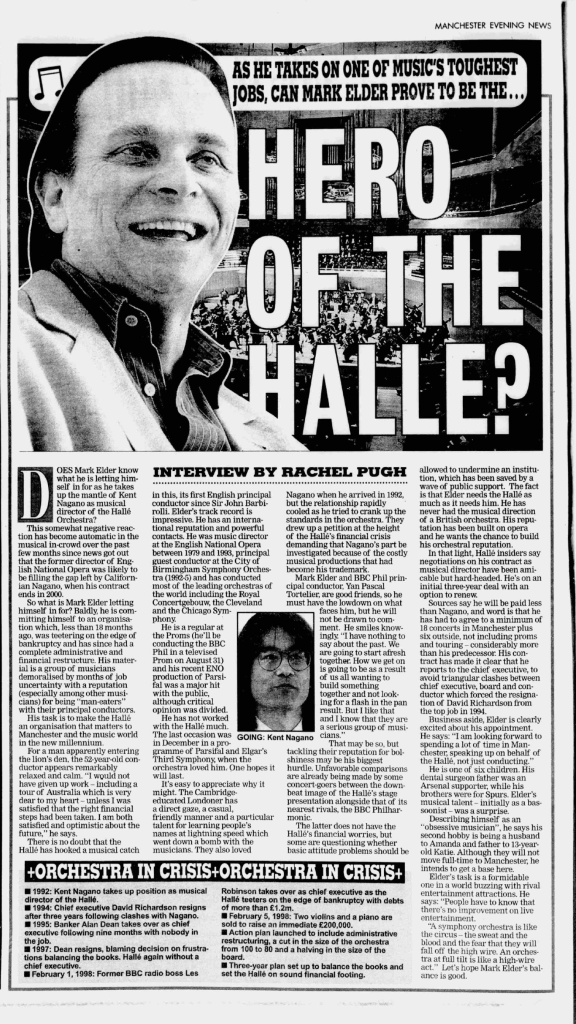
- February 1st 1998: Former BBC radio boss Les Robinson takes over as chief executive as the Hallé teeters on the edge of bankruptcy with debs of more than £1.2m
- February 5th 1998: Two violins and a piano are sold to raise an immediate £200,000
- Action plan launched to include administrative restructuring, a cut in the size of the orchestra from 100 to 80 and a halving in the size of the board
- Three-year plan set up to balance the books and set the Hallé on sound financial footing
Elder was diplomatic when assessing the task ahead:
I have nothing to say about the past. We are going to start afresh together. How we get on is going to be the result of us all wanting to build something together and not looking for a flash in the pan result. But I like that and I know that they are a serious group of musicians.
From interview by Rachel Pugh in Manchester Evening News, June 8th 1999
The crisis facing Elder was echoed in a piece by Fiachra Gibbons in the Guardian, in which an ‘insider’ was quoted as saying ‘The only way is up for Elder, it cannot get any worse.’ The same piece reported that Les Robinson was stepping down as CEO and it was in partnership with the new CEO, John Summers, that Elder set about rebuilding the orchestra artistically and financially. The title of the piece summed up the hopes: ‘Miracle man to stir Hallé giant – Once-great orchestra pins hopes of rescue on a new conductor.’
The first concerts
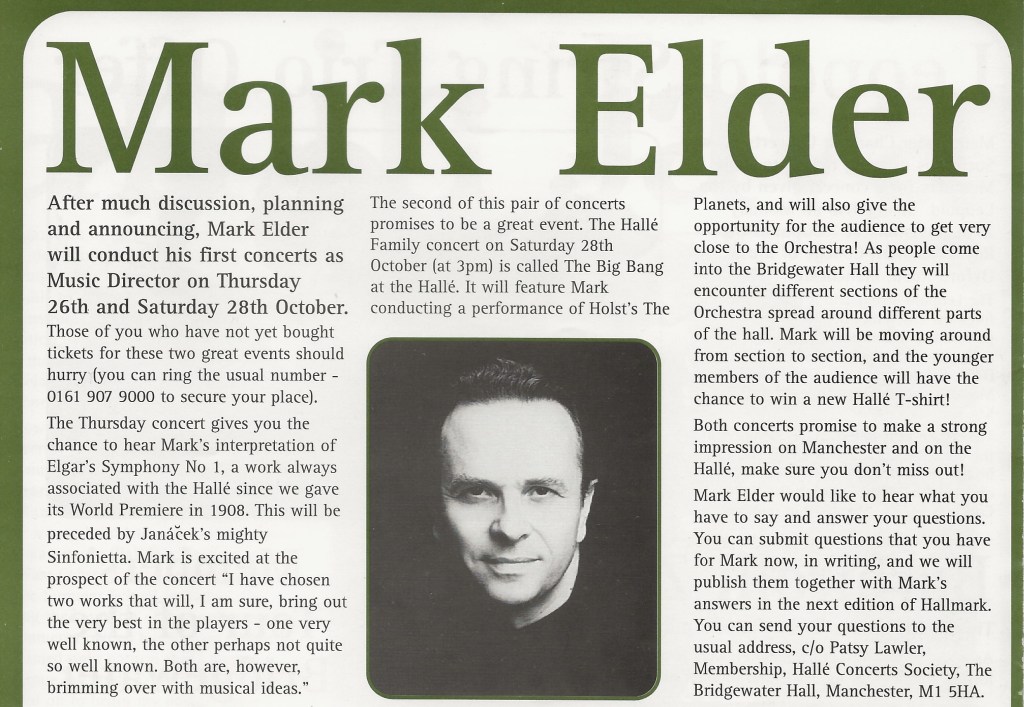
The Hallé Choir were always an integral part of Mark Elder’s plans for the Hallé and this is reflected in the choice of programmes for the first few seasons. These highlighted three strands that would become a trademark of Elder’s approach to programming, namely the placing of British music front and centre, particularly the music of Edward Elgar, a big emphasis on concert performances of operas, particularly those of Verdi and later of Wagner, and the creation of themed mini-festivals, often in collaboration with the BBC Philharmonic.
This first strand was evident from his first pair of concerts in late October 2000. They were promoted in the Autumn 2000 issue of Hallmark, the latest incarnation of the Hallé newsletter, which had remained relentlessly upbeat in its mood through the 1990s despite the gathering financial clouds. The second concert was the first to involve the choir, albeit it was just the backstage wordless chorus in The Planets. The first concert, though it didn’t involve the choir, was a real statement of intent, including as it did a performance of Elgar’s First Symphony, first performed by the Hallé under Hans Richter in 1908 and thus showing Elder looking back to the Hallé’s past in order to move forward. It is worth quoting David Fallows review of the concert in the Guardian at length as it illustrates the first example under Elder’s directorship of his revelatory approach to Elgar:
A new conductor is usually warmly welcomed but Mark Elder’s first concert as music director of the Hallé was an occasion of overwhelming enthusiasm. The audience was ecstatic; more importantly, the orchestra played with a verve and skill that conveyed absolute commitment… However, the true revelation of the concert – and reason for unbounded confidence in the future – was Elgar’s First Symphony. Elder was plainly concerned to eliminate any thought of this being a piece of imperialistic bombast… With the most careful balancing of the textures he drew out details of the orchestration that can scarcely ever have been heard.
From review by David Fallows, The Guardian, October 28th 2000
In the Winter 2001 edition of Hallmark an article by David Young of the Elgar Society looked at the relationship between the Hallé and the music of Elgar over the years and his final paragraph proved to be remarkably prescient (though his wish for performances of Caractacus and King Olaf remains unfilled!):
And what of Mark Elder? His stated intention is to promote more English music. Certainly, the performances of the Elgar-Payne ‘Symphony No. 3’ (December 1998) and Elgar’s 1st Symphony, earlier this season, were very well received – and there is a ‘Gerontius’ to come! Dare we hope for ‘The Apostles’ and ‘The Kingdom’, a ‘Caractacus’ or ‘King Olaf’ ere long? With a bust of Sir John Barbirolli – a man to whom Elgar’s music meant more that any other, now keeping a beneficent yet watchful eye on matters at the Bridgewater Hall, the portents must be good for yet another Elgar revival!
From ‘Elgar and the Hallé’ by David Young, Hallmark, Issue 19, Winter 2001
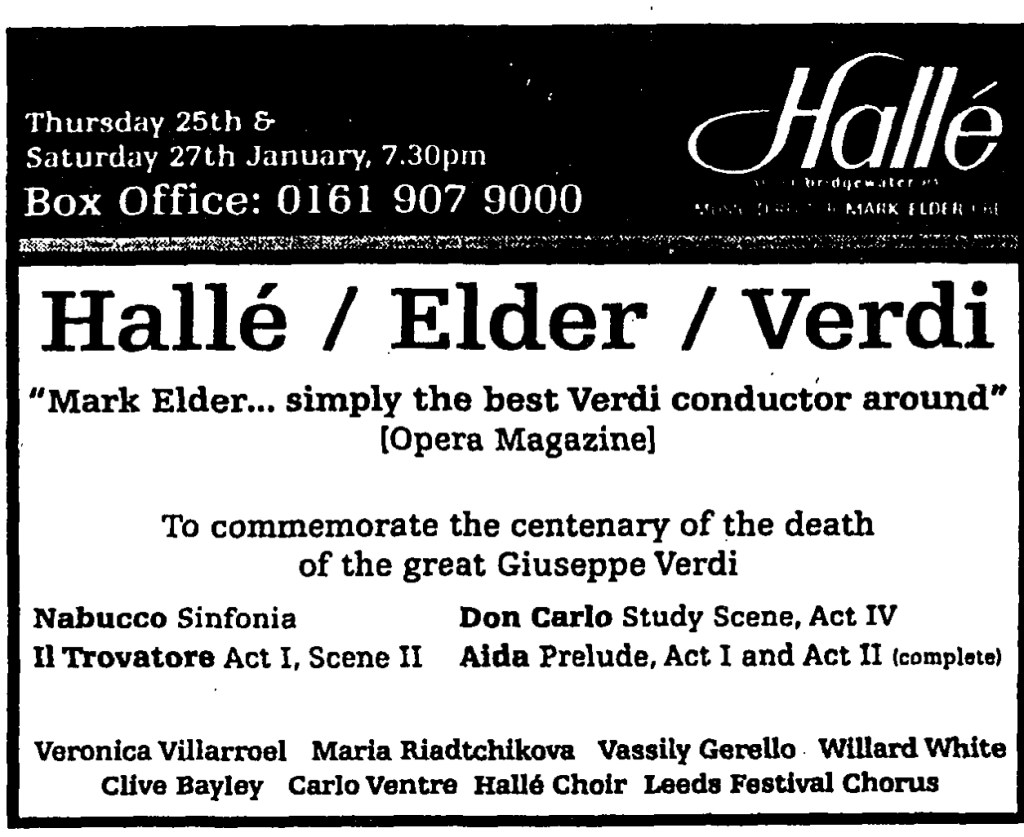
The full choir had to wait some time for its first performances with Elder, but when it arrived it became part of the second, opera, strand of Elder’s grand vision, comprising two performances in late January 2001 of a gala programme celebrating the music of Giuseppe Verdi on the occasion of the 100th anniversary of his death, the main part of which was a complete performance of Act 2 of Aida for which the choir was joined by the Leeds Festival Chorus.
Alfred Hickling in the Guardian gave the concert a rare five stars, calling Elder ‘the most distinguished Verdi interpreter in the country’ and writing that ‘it was only a matter of time before he brought his operatic pedigree to the concert platform… What was less predictable is that the result should be such a revelation.’ Whilst praising the excellence of the soloists, Hickling also wrote about the effect of taking the opera chorus off the stage and onto the platform: ‘In search of extra volume, the Hallé Choir double up impressively with the Leeds Festival Chorus, creating a wall of sound more sturdily built than on any operatic stage.’
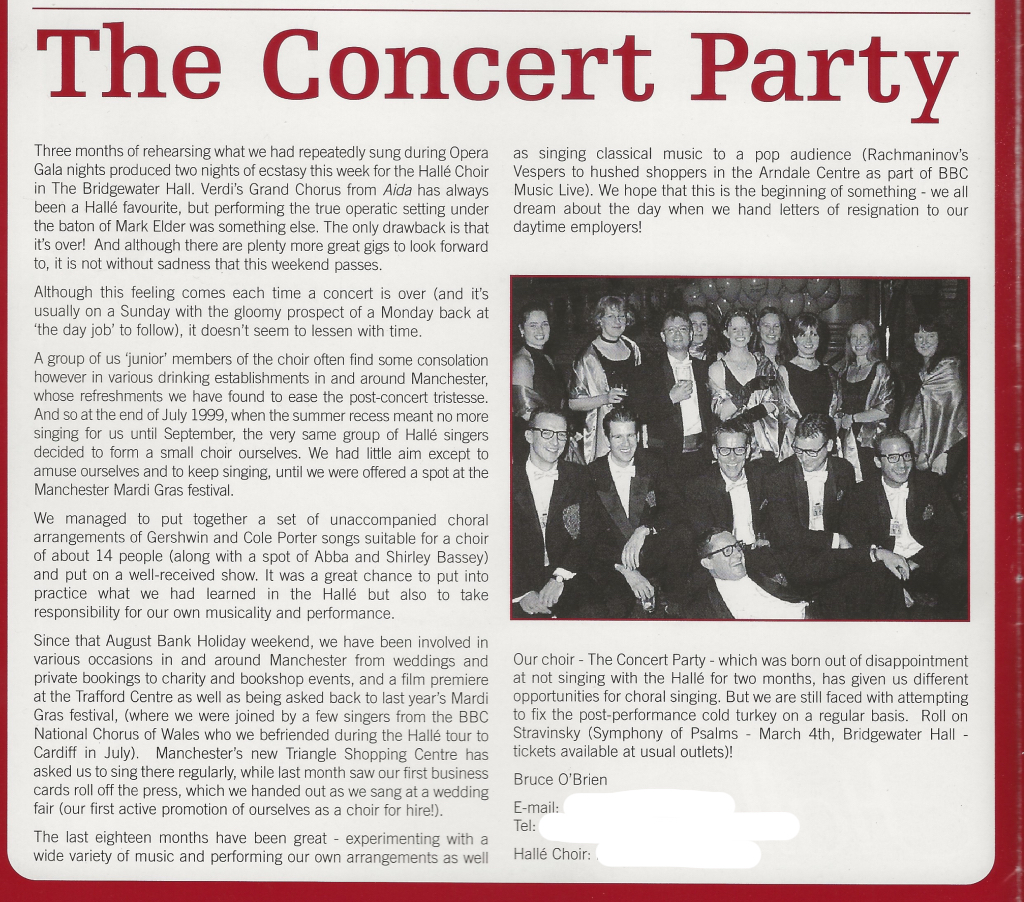
It is noticeable that in these early Elder era set-piece concerts the choir were often joined by a second choir for added volume. Though this still happens occasionally for the really big projects such as the Proms, the choir soon became better able to fight for itself on the bigger stages, for reasons that will be explained soon. The choir were obviously enjoying themselves, however, as the article below from the Winter 2001 edition of Hallmark about extra-curricular activities during rehearsals for the Verdi concert demonstrates!
The end of the 2000/01 season saw the clearest indication yet of the direction in which he would like the Hallé Choir to go, with the first of many performances under Mark Elder of a piece inextricably linked with the Hallé from the time of Hans Richter onwards, namely Elgar’s The Dream of Gerontius. As with the Verdi gala, the choir was bolstered by another choir, this time the City of Birmingham Symphony Chorus, and it was yet another concert that set the seal on Elder’s vision for the Hallé. David Fallows review for the Guardian, whilst effusive, also indicated that a degree of rehabilitation was needed for works like Gerontius. That phrases such as ‘incense-laden Victorianism’ would nowadays be unlikely to be applied to the work indicates that to a large extent Elder has achieved just such a rehabilitation, placing Elgar firmly in a European Late Romantic context rather than something more parochial:
The Dream of Gerontius is now 100 years old and may no longer count as the central masterpiece of Elgar’s output… It may be that its incense-laden Victorianism needs careful performance if it is to survive. So Mark Elder’s performance characteristically swept away much of the inherited tradition. He kept the music moving wherever possible, avoiding the interruptions of the beat that have for so long been treated as central to a truly Elgarian style…
What Elder substitutes is a marvellously clear architecture, one that gives full value to the astonishing orchestration and the rock-solid musical design of the work. The grand climaxes, with the combined choirs of the Hallé and the City of Birmingham Symphony Chorus, were of shattering splendour.
Review by David Fallows, The Guardian, 5th May 2001
The following season, 2001/02 saw the first example in the Elder era of programming concerts together under a common theme. Sometimes this would be to celebrate the anniversary of a particular composer, such as festivals curated around the works of a particular composer, such as performances of the complete symphonies of Gustav Mahler in 2010, and Ralph Vaughan Williams in 2022, both cycles being performed in collaboration with the BBC Philharmonic and both strongly featuring the Hallé Choir, and a celebration of the music of Dmitri Shostakovich in 2006 that included a performance by the choir of his Third Symphony, ‘The First of May’, a work recently recorded by the choir with the BBC Philharmonic and John Storgårds for the Chandos label. Others were curated around a more general theme, such as the celebration of William Shakespeare that went by the title ‘Such Sweet Thunder’, a two day festival of South Asian music in 2008, and in 2016 ‘Echoes of a Mountain Song’, a celebration of music inspired by Northern Europe that included a performance by the choir of Frederick Delius’ Song of the High Hills.
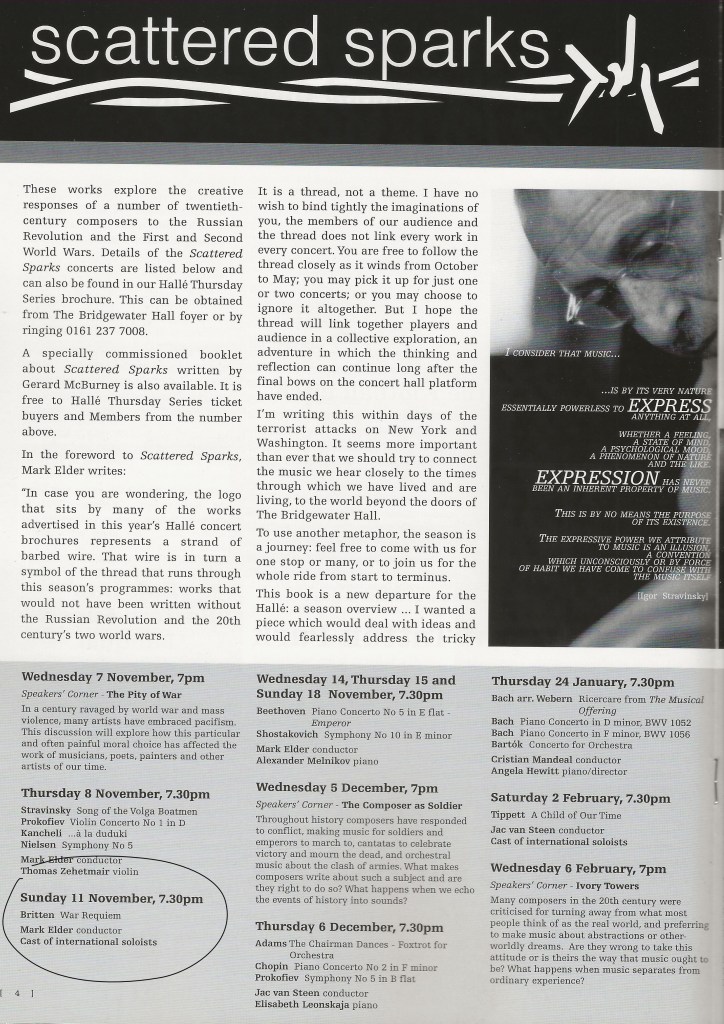
The theme chosen for the 2001/02 season was ‘Scattered Sparks’. To quote from the description in the Autumn 2001 issue of Hallé, as the Hallé newsletter had been renamed, the works chosen for ‘Scattered Sparks’ ‘explore the creative responses of twentieth-century composers to the Russian Revolution and the First and Second World Wars.’ In a tragic echo of those conflicts, the themed concerts began on November 7th 2001 less than two months after the tragic events of September 11th, when Saudi-based terrorists brought down the World Trade Centre in New York and triggered conflicts that we are still experiencing the consequences of today, a coincidence not lost on Mark Elder when he wrote about the season in the Guardian on October 5th:
Whenever I conduct a piece of music, it is important for me to understand the circumstances that brought it to life… This past three weeks, looking at the pictures in the papers of the rubble that was the World Trade Centre, I have found myself wondering what else those attacks will leave us. How will our creative life respond, over the next years, to what happened there?
From ‘The Music of War’ by Mark Elder, The Guardian, October 5th 2001
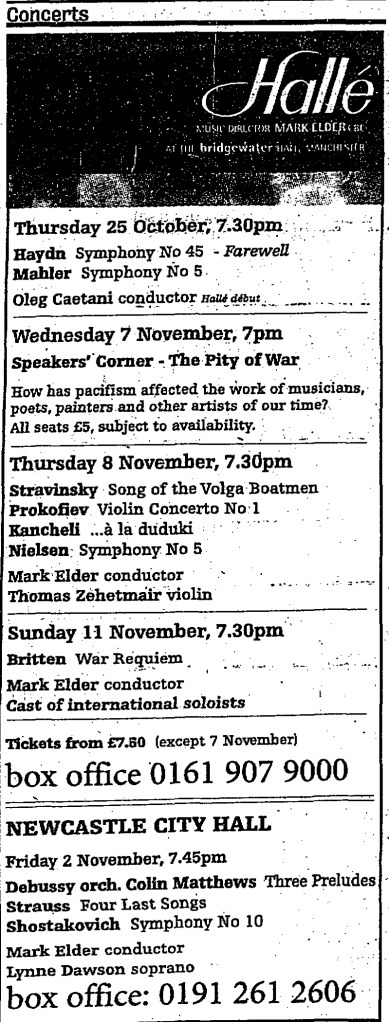
The Hallé Choir made three contributions to the ‘Scattered Sparks’ thread which ran through the whole 2001/02 season, with performances of Prokofiev’s rarely heard Cantata for the 20th Anniversary of the October Revolution and Elgar’s poignant The Spirit of England, a setting of three First World War poems by Lawrence Binyon which the choir recorded some years later. Possibly most apposite to the theme, however, was the performance of Benjamin Britten’s War Requiem on Armistice Day 2001. Once again the choir was joined by an outside choir, in this instance the Leeds Festival Chorus, and although 9/11 was not mentioned in Pauline Fairclough’s review for the Guardian, it seems clear that for her its shadow hung over the performance, as when she wrote ‘Its anti-war message is as tragically relevant today as it ever was, rejecting the idea of good versus evil to insist on our humanity.’ Her review encapsulated the approach Mark Elder always seems bring to such big projects, informed no doubt by his vast operatic experience. In his hands such concerts always seem to become an ‘event’:
The theatricality and vast forces of the Requiem need expert handling. Mark Elder’s keen dramatic instincts and effortless control of those forces, including the superb Hallé and Leeds Festival Choruses, made compulsive listening.
From review by Pauline Fairclough, The Guardian, November 15th 2001
Thus in his first two seasons Mark Elder introduced the three strands that would repeat throughout his time with the Hallé, the emphasis on British music, the emphasis on opera and the desire to create a narrative within his programming that connected disparate pieces of music in a way that chimed with the contemporary world.
The growth of the Hallé choral family
For the remainder of this blog I will outline briefly the other legacy of Mark Elder’s time with the Hallé, the huge growth in opportunities for choral singing within the wider Hallé family that has occurred over the last 20 years.
For all of the Hallé Choir concerts up to the end of the 2000/01 season the choral director was Keith Orrell, who had taken over the role in 1994 after a degree of turmoil following the departure of the long-serving Ronald Frost. Orrell had led the choir through a number of ambitious projects with Kent Nagano, including the Mahler and Britten recordings I mentioned in a previous blog, and indeed directed the choir for its first recording with Mark Elder, a recording of Holst’s The Planets that included the additional Pluto section commissioned by Kent Nagano from Colin Matthews and which was the only Hallé recording on the Hyperion label before the Concerts Society started issuing their own recordings.
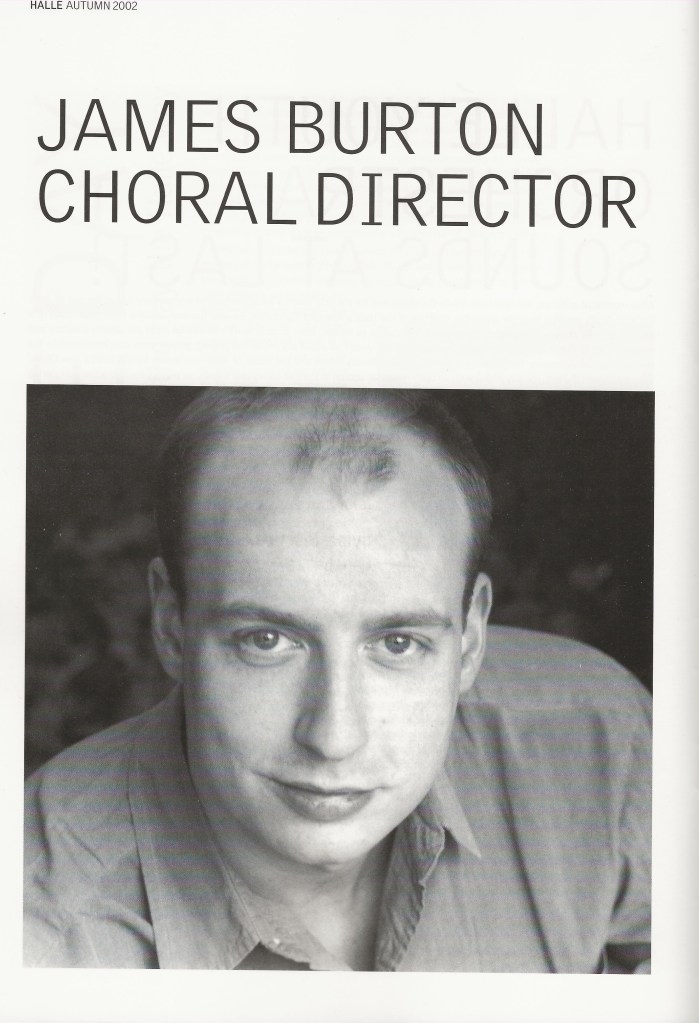
However, Keith Orrell would not be the person to take the choir forward into the bright new choral future envisioned, as for the beginning of the 2002/03 season he was replaced as Choral Director by James Burton, known to all and sundry from then on as Jamie. He came to the Hallé Choir with an interesting pedigree. After time as a Westminster Abbey chorister and at St John’s College, Cambridge where he first began conducting, he moved to America to pursue his conducting studies at the Peabody Conservatory. During his time in the States he also had a sideline writing symphonic arrangements for the music of Arlo Guthrie, son of the iconic American folk singer Woody Guthrie and perhaps more famous over here, at least to people of a certain age, as writer of the song ‘Alice’s Restaurant’ and writer of and actor in the subsequent feature film.
Returning to the UK he gained experience of training the chorus for the St Endellion Music Festival in Cornwall and the National Youth Choir in various projects, but before joining the Hallé Choir he had not had experience of training such a large choir on a permanent basis. He did, however, have a very specific vision – to raise the standard of the choir to compete with the best symphonic choirs in the country and to bring the joy of choral singing within the umbrella of the Hallé to a wider range of people both in terms of age and ability. This mission is more than clear in the interview he gave to Patsy Lawler for the Autumn 2002 issue of Hallé:
I am looking forward to building on the Choir’s considerable talents and experience: we are introducing a varied approach to choral training including individual and group vocal coaching to further develop our sound. I am looking to build a flexible ensemble that consistently performs with power and conviction, and has the expertise to explore a wide range of challenging accompanied and acapella choral works… As the Hallé provides a focus for musical activity in the Greater Manchester region, I feel we have a responsibility for youth music development… The Hallé Youth Orchestra has begun rehearsals and will be appearing for the first time in December, and we will be looking in detail at developing a Hallé Youth Choir and children’s choir as potential additions to the Hallé family.
From interview with Patsy Lawler, Hallé, Autumn 2002
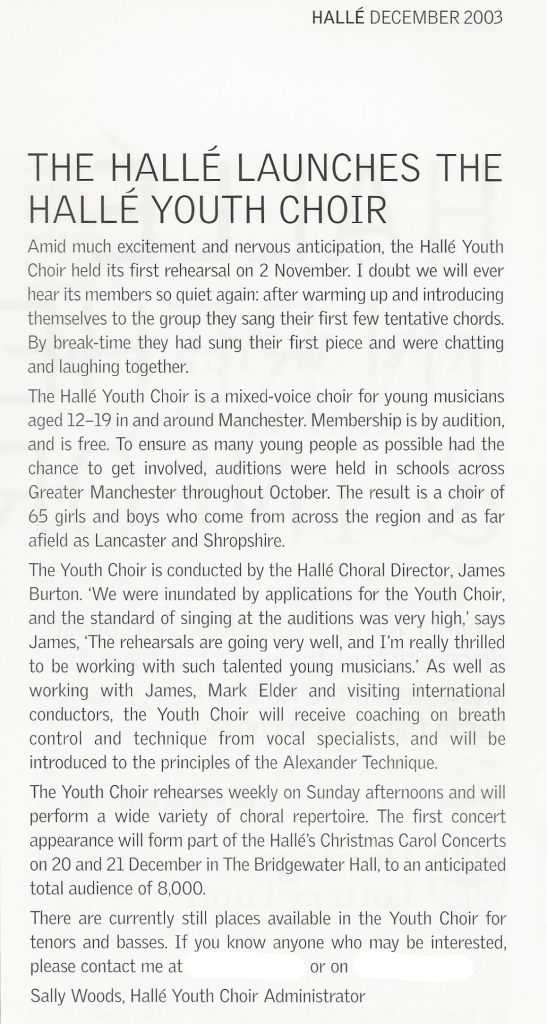
Soon after his appointment in May 2003 he re-auditioned every member of the choir which resulted in many established singers sadly being let go, but the aim of producing a choir of the highest quality was paramount.
The next step in the development of the Hallé choral family came in November 2003 with the establishment of the Hallé Youth Choir for young singers aged from 12 to 19. To ensure it had a sound footing, Burton initially took responsibility for training the new choir, but after a few years the Youth Choir gained its own choral director, initially Greg Batsleer and subsequently Richard Wilberforce and the current incumbent Stuart Overington.
The development of the choir was so rapid that within two years Mark Elder was confident that the Youth Choir could take on the extremely exposed role of the semi-chorus in The Dream of Gerontius, a role they successfully undertook at concerts in Manchester and at the BBC Proms in 2007 and on a subsequent award-winning CD recording. Having the Youth Choir as an extra resource also benefitted the Hallé Choir itself, meaning less reliance on outside choirs to augment the choir for the big concerts. The Youth Choir have therefore subsequently appeared with the main choir on recordings of Elgar’s The Apostles, Holst’s Hymn of Jesus and Emily Howard’s The Anvil, each time singing a specific semi-chorus part. The effect of young singers singing the semi-chorus in such works can be magical, particularly so in the recording of The Apostles.
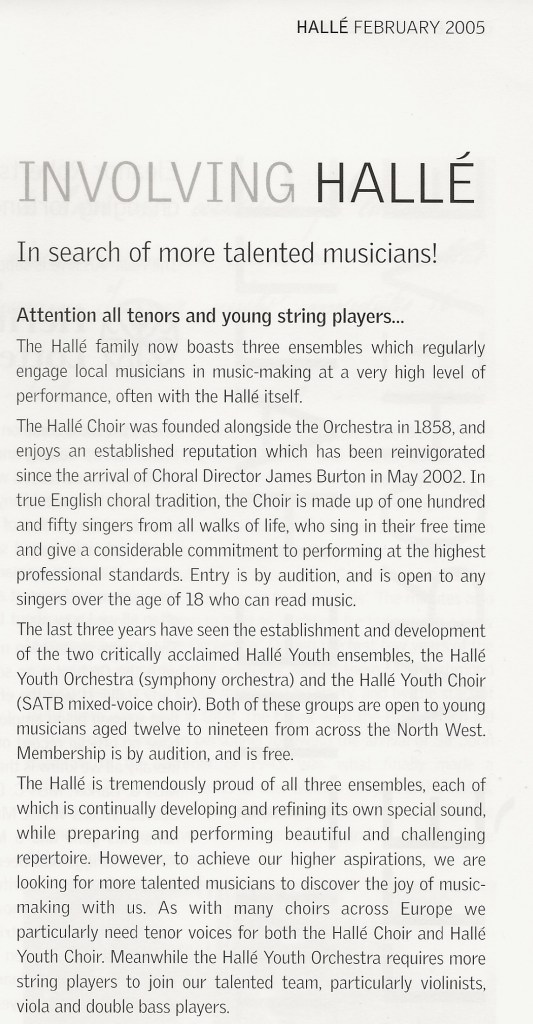
The February 2005 issue of Hallé saw an advertisement for tenors for the Hallé Youth Choir and also for strings for the Hallé Youth Orchestra (with a side order for tenors for the Hallé Choir!). The Youth Orchestra was another innovation started by Mark Elder, providing opportunities for young instrumentalists in the North West to play to the highest standard possible, trained by the Hallé’s Assistant Conductor, yet another post initiated by Elder to provide a training ground for young conductors, most of whom have gone on to achieve great success. For example, the first Assistant Conductor was Edward Gardner who went on to the emulate Elder by taking control at English National Opera and who now directs both the London Philharmonic and Bergen Philharmonic orchestras.
Mark Elder has also over the years maintained a relationship with the conducting courses at the Royal Northern College of Music run by Mark Heron and Clark Rundell, and over the years many graduates of these courses have found conducting opportunities within the Hallé choral family.
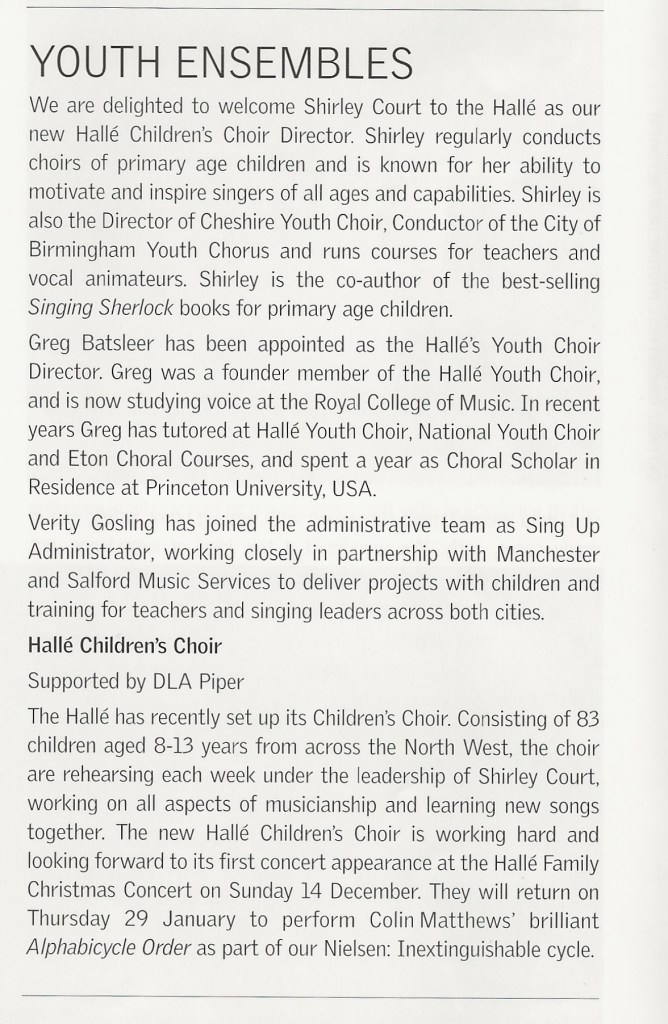
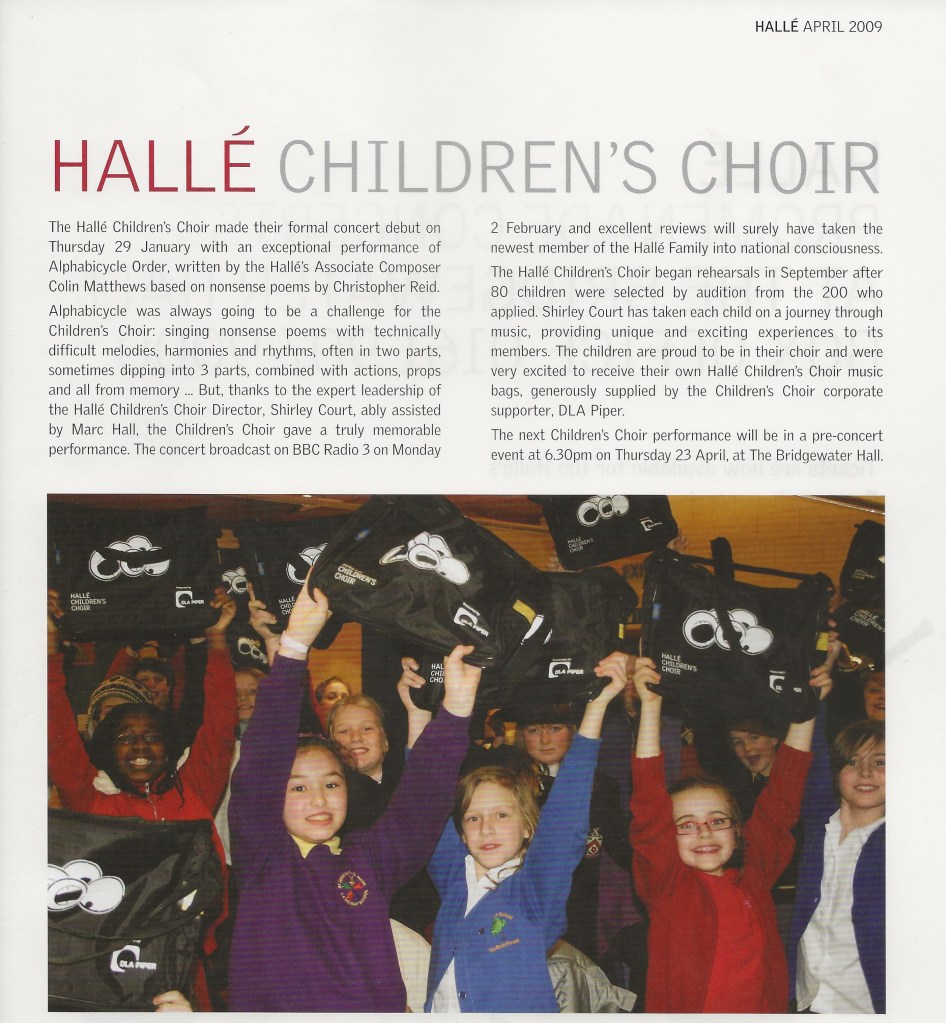
2008 saw the foundation of the Hallé Children’s Choir with as its first, and thus far only, director the redoubtable Shirley Court, and this was celebrated in the February 2008 issue of Hallé. The choir was set up for children between the ages of 8 and 13 and it immediately became a permanent fixture in the Hallé’s annual Christmas carol concerts alongside the Hallé Choir and the Hallé Youth Choir.
As with the Youth Choir they were soon considered more than capable of appearing in the big prestige concerts alongside their more senior colleagues. For example 2010 saw them singing the children’s choir part in Mahler’s epic 8th Symphony, conducted by Mark Elder as part of that year’s Mahler festival, and they have also appeared alongside the senior choir in works such as Britten’s Spring Symphony and Orff’s Carmina Burana, and will play a vital role in the upcoming performances of MacMillan’s Timotheus, Bacchus and Cecilia. One of their earliest performances, of Colin Matthews Alphabicycle Order was broadcast on Radio 3 and later released on CD on the Hallé’s own label, as was celebrated in April 2009 in the pages of Hallé.
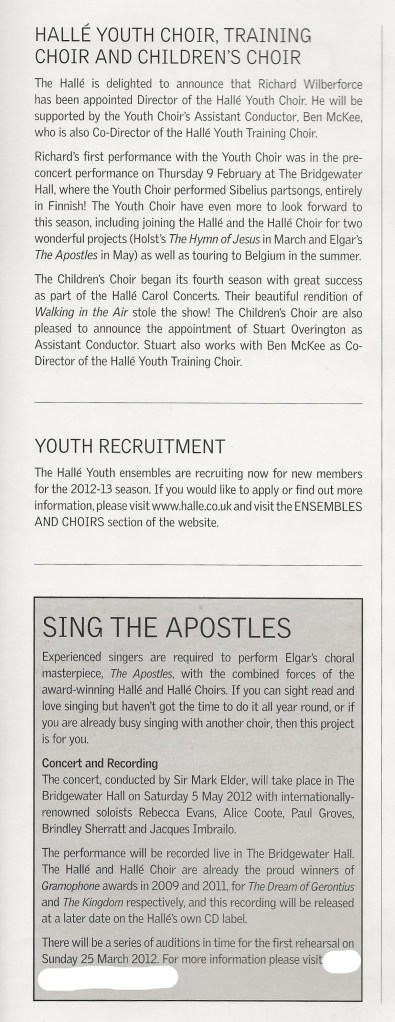
Mark Elder’s choral vision for Manchester was not yet complete as further pieces were added to the jigsaw over the next few years. Two call outs in the March 2012 issue of Hallé highlighted two further initiatives, firstly to recruit singers for the Hallé Youth Training Choir, designed to bridge the gap between the Children’s Choir and the Youth Choir, particular in the area of sight-reading. The second call out was for so-called ‘associate’ singers for the Hallé Choir performance of The Apostles later that year. The associates scheme had been running for a while by this time, and was designed to allow accomplished singers who were unable to commit to singing whole seasons with the Hallé Choir to bolster the choir for one or two designated concerts each season.
2013 saw the establishment of the Hallé Workplace Choirs scheme, whereby Hallé choral trainers went out to firms and institutions in Manchester and throughout the North West and trained choirs of work colleagues for a choir competition held each year in the newly opened Hallé St Peter’s building in Ancoats. This proved to be a huge success and the choir recently had a red letter day when the first singer trained through the scheme was admitted into the main Hallé Choir.
The opening of Hallé St Peter’s also saw an opportunity for the Hallé to set up the Hallé Ancoats Community Choir, a non-auditioned choir of local residents who gather together each week to sing for fun, but to a standard that allows them to perform at the highest level. For example, they were one of the choirs that contributed to the performance of Emily Howards Peterloo piece The Anvil which was subsequently released on CD.
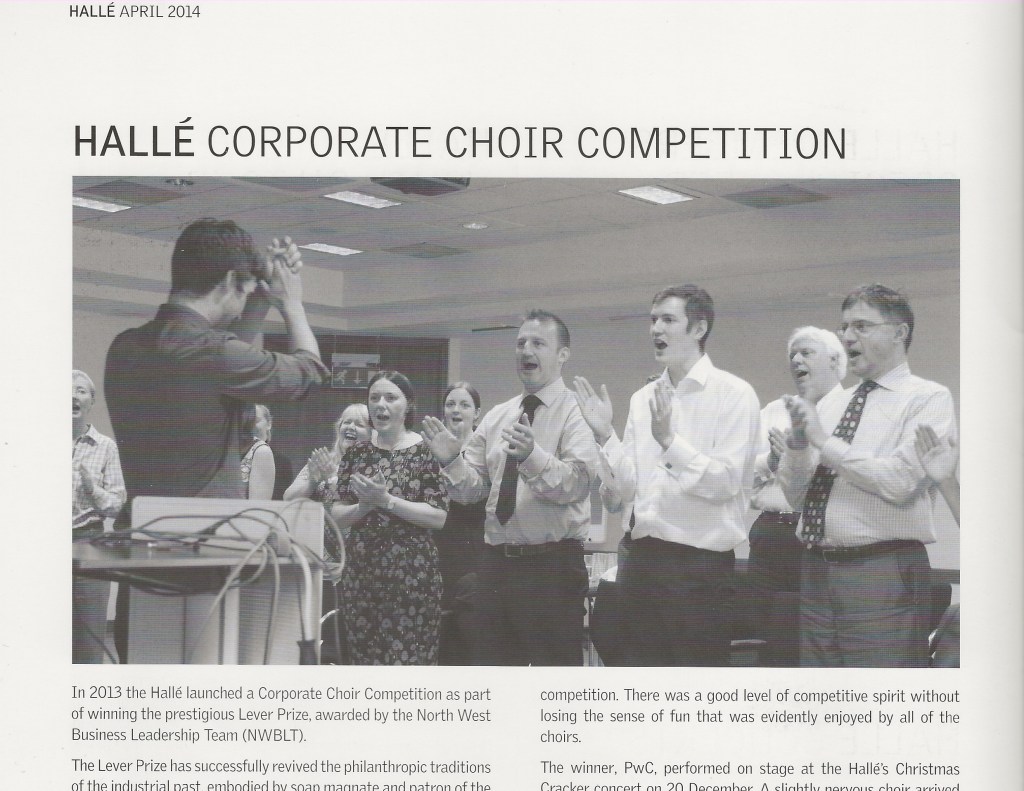
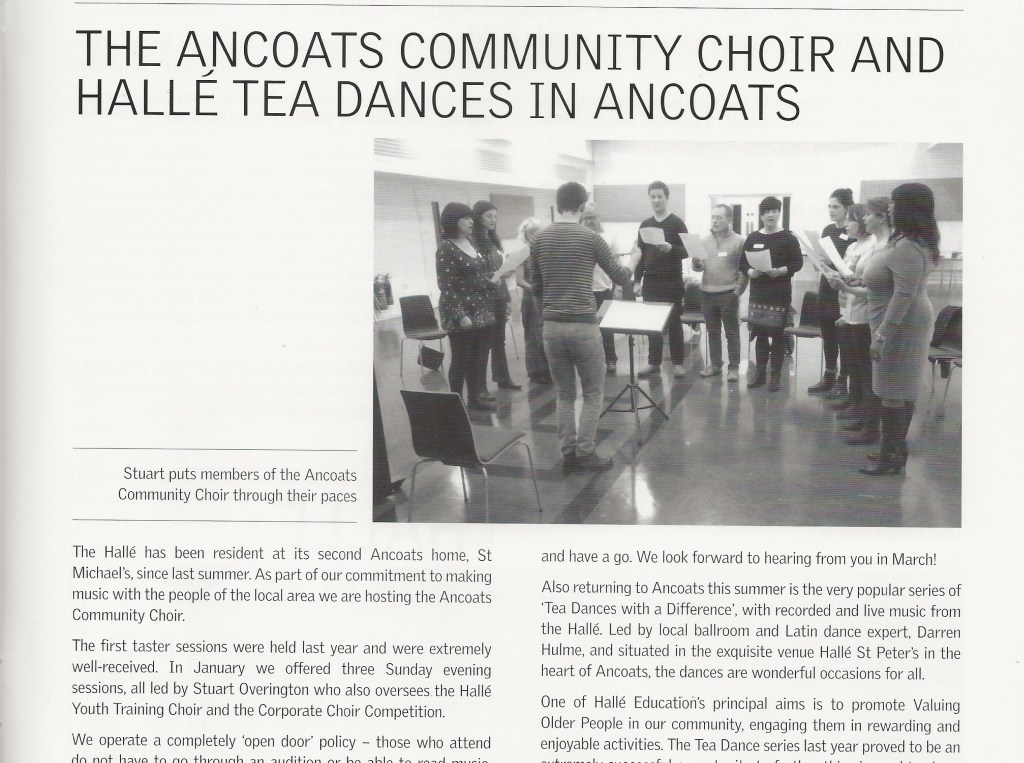
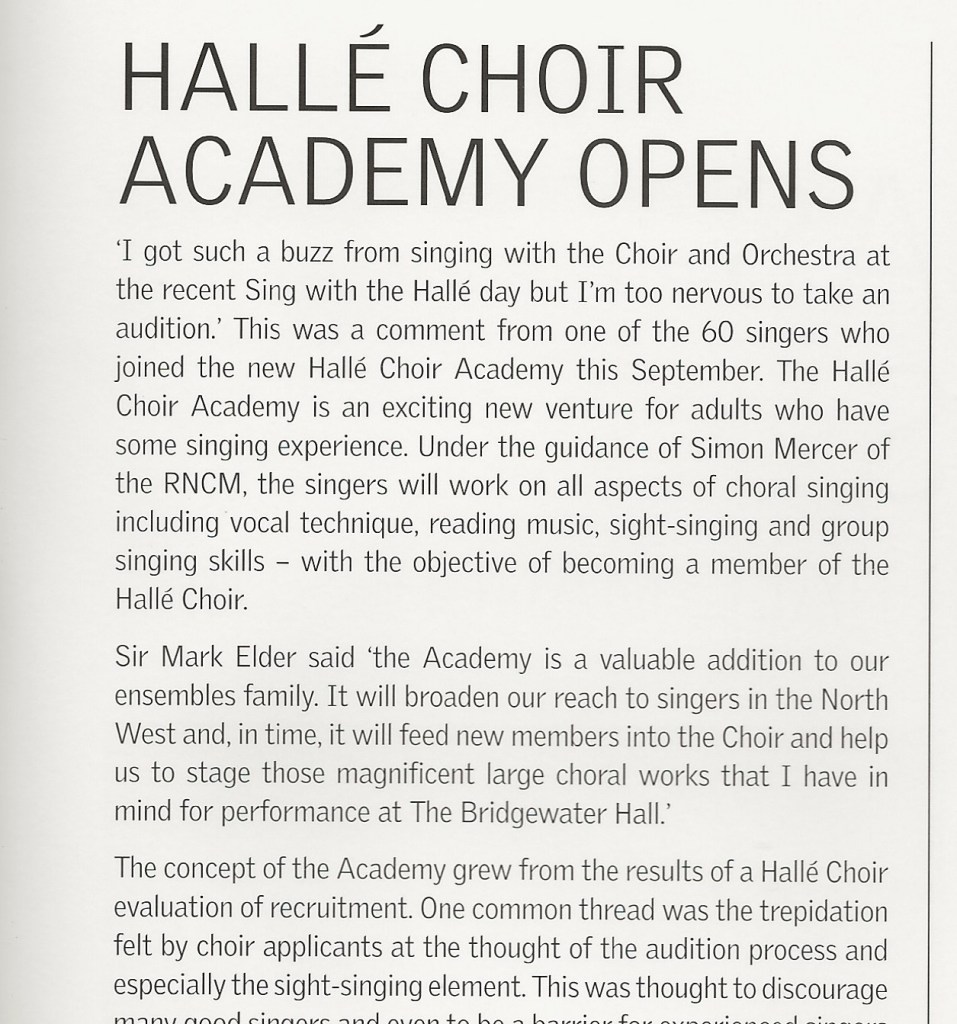
The community choir was formed in early 2014 and later that year saw the foundation of the Hallé Choral Academy. This was designed to fulfil a similar role to the Hallé Youth Training Choir, taking good singers who felt themselves lacking in vocal technique and sight-reading skills and training them up to a standard where there was a potential for them to be auditioned for the main Hallé Choir. The Academy was announced in the November 2014 issue of Hallé, with an encouraging endorsement from Mark Elder, and again it has borne fruit, with many singers over the last 10 years making the step up from the Academy to the main choir.
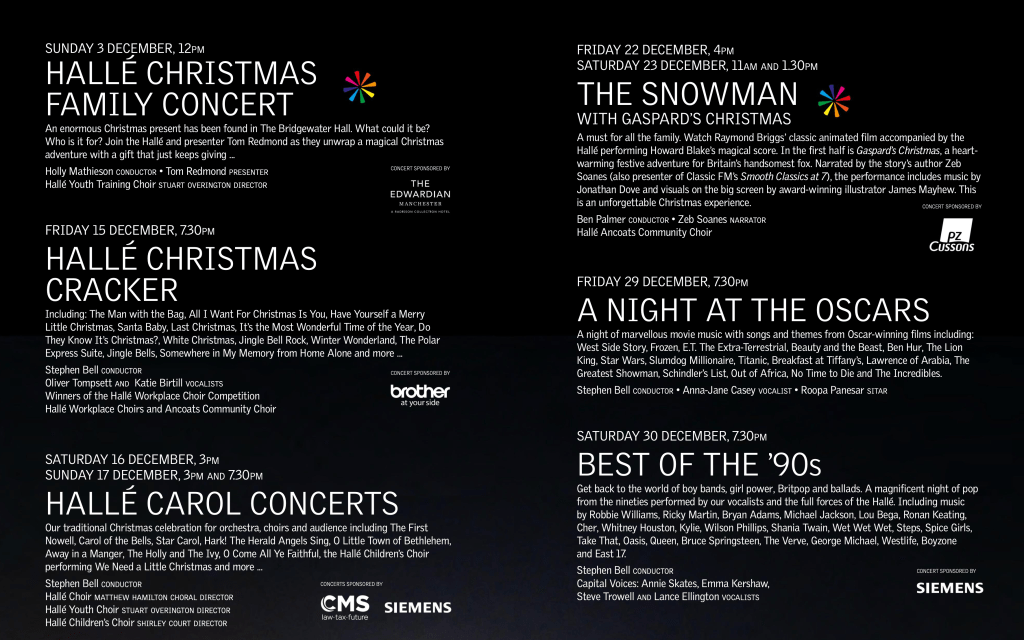
When Sir Mark Elder began his time as Chief Conductor and Music Director of the Hallé in 2000 there was just one choir within the Hallé family, the Hallé Choir itself which had been standing alone since its foundation back in 1858. By the time he leaves in August of this year there will be six choirs operating directly under the Hallé banner plus the numerous choirs that compete in the Workplace Choirs Competition. The success of this astounding expansion is evidenced by the Christmas concert pages from the Hallé’s 2023/24 season brochure shown below. You can see that at various times during the pre-Christmas period the Hallé Choir, Hallé Youth Choir, Hallé Youth Training Choir, Hallé Children’s Choir, Ancoats Community Choir and the winners of the Workplace Choir competition all got the opportunity to appear in concert in the Bridgewater Hall with the Hallé Orchestra. The only choir to miss out were the Choral Academy and their turn will come with the annual Sing With The Hallé day in June 2024, in which they will play a vital part.
For all that Sir Mark Elder has created an orchestra able to compete with the best in the world, perhaps his biggest legacy will be this remarkable variety of choirs that now sing under the Hallé banner, spreading the joy of singing across Manchester and beyond. I will finish by expanding the quote from Tom Service’s BBC Music Magazine interview with Sir Mark that I gave early on in this blog:
Elder speaks as proudly about the ‘pyramid of choirs’ that are a part of the Hallé as any of the big performance projects from Wagner to Elgar over the last 24 years. ‘We founded the children’s choir, as well as the community choir at Ancoats where’s no audition and anyone can take part. And then there’s the main choir. My very first concert with the Hallé was Belshazzar’s Feast in the early 1980s, so the choir has always been very central to me.’
From Tom Service, ‘The BBC Music Magazine Interview – Mark Elder‘, BBC Music, May 2024
The good work that Jamie Burton started with the Hallé Choir has continued and been built on by Fanny Cooke, Madeleine Venner, Matthew Hamilton and the many others working with the other Hallé choirs. The signs are good that under Mark Elder’s successor as Principal Conductor, Kahchun Wong, the choirs will go from strength to strength.
Appendix – Facts and Figures
Complete List of Concerts
Here is a complete list of Hallé Choir concerts conducted by Sir Mark Elder, and the works performed. Note that this, and all the other lists, includes what at the time of writing were the three upcoming performances of James MacMillan’s new work.
| Date | Composer | Work | Section | Venue |
| 29/08/1981 | Walton | Belshazzar’s Feast | Free Trade Hall | |
| 06/02/1986 | Janáček | Glagolitic Mass | Free Trade Hall | |
| 26/09/1991 | Mahler | Symphony No. 3 | Free Trade Hall | |
| 12/06/1999 | Beethoven | Symphony No. 9 ‘Choral’ | Oldham | |
| 06/01/2000 | Tippett | The Mask of Time | Bridgewater Hall | |
| 28/10/2000 | Holst | The Planets | Bridgewater Hall | |
| 25/01/2001 | Verdi | Aida | Act 2 | Bridgewater Hall |
| 24/03/2001 | Various | Opera Gala | Bridgewater Hall | |
| 03/05/2001 | Elgar | The Dream of Gerontius | Bridgewater Hall | |
| 22/07/2001 | Verdi | Aida | Act 2 | Royal Albert Hall |
| 23/09/2001 | Various | “Rainbow” Preview Concert | Bridgewater Hall | |
| 29/09/2001 | Verdi | Requiem | Sheffield City Hall | |
| 06/10/2001 | Verdi | Requiem | Bridgewater Hall | |
| 11/11/2001 | Britten | War Requiem | Bridgewater Hall | |
| 17/11/2001 | Britten | War Requiem | Leeds Town Hall | |
| 07/03/2002 | Prokofiev | Cantata for the 20th Anniversay of the October Revolution | Bridgewater Hall | |
| 04/04/2002 | Elgar | The Spirit of England | Bridgewater Hall | |
| 06/04/2002 | Elgar | The Spirit of England | Sheffield City Hall | |
| 16/05/2002 | Wagner | Tristan and Isolde | Act 1 | Bridgewater Hall |
| 18/05/2002 | Wagner | Tristan and Isolde | Act 1 | Bridgewater Hall |
| 26/06/2002 | Elgar | The Dream of Gerontius | St Paul’s Cathedral, London | |
| 29/09/2002 | Various | Preview Concert | Bridgewater Hall | |
| 02/10/2002 | Holst | The Planets | Bridgewater Hall | |
| Walton | Belshazzar’s Feast | |||
| 05/10/2002 | Holst | The Planets | Royal Concert Hall, Nottingham | |
| Walton | Belshazzar’s Feast | |||
| 10/10/2002 | Walton | Henry V – A Shakespeare Scenario | Bridgewater Hall | |
| 19/10/2002 | Walton | Henry V – A Shakespeare Scenario | Leeds Town Hall | |
| 26/10/2002 | Holst | The Planets | Sheffield City Hall | |
| Walton | Belshazzar’s Feast | |||
| 29/10/2002 | Walton | Henry V – A Shakespeare Scenario | Newcastle City Hall | |
| 03/11/2002 | Haydn | The Creation | Bridgewater Hall | |
| 08/11/2002 | Walton | Henry V – A Shakespeare Scenario | Sheffield City Hall | |
| 09/11/2002 | Walton | Henry V – A Shakespeare Scenario | Warwick Arts Centre | |
| 08/05/2003 | Verdi | Falstaff | Bridgewater Hall | |
| 10/05/2002 | Verdi | Falstaff | Bridgewater Hall | |
| 19/10/2003 | Brahms | Ein Deutsches Requiem | Bridgewater Hall | |
| 08/04/2004 | Bach | St John Passion | Bridgewater Hall | |
| 09/05/2004 | Janáček | Glagolitic Mass | Bridgewater Hall | |
| 12/06/2004 | Various | Opera Excerpts | Bridgewater Hall | |
| 02/10/2004 | Verdi | Stabat Mater | Bridgewater Hall | |
| Verdi | Te Deum | |||
| 08/10/2004 | Verdi | Stabat Mater | Royal Concert Hall, Nottingham | |
| Verdi | Te Deum | |||
| 27/01/2005 | Brahms | Ein Deutsches Requiem | 4th Movement | Bridgewater Hall |
| 26/02/2005 | Tippett | Midsummer Marriage: Ritual Dances | Bridgewater Hall | |
| 17/03/2005 | Elgar | The Music Makers | Bridgewater Hall | |
| 22/03/2005 | Elgar | The Music Makers | Bridgewater Hall | |
| 14/04/2005 | Mascagni | Cavalleria Rusticana | Bridgewater Hall | |
| 26/05/2005 | Wagner | Tannhäuser | Act 1 | Bridgewater Hall |
| 09/07/2005 | Various | Opera Excerpts | Bridgewater Hall | |
| 22/07/2005 | Elgar | The Dream of Gerontius | Bridgewater Hall | |
| 24/07/2005 | Elgar | The Dream of Gerontius | Royal Albert Hall | |
| 06/11/2005 | Elgar | As Torrents in Summer | Bridgewater Hall | |
| Ireland | The Hills | |||
| 12/11/2005 | Rachmaninov | The Bells | Bridgewater Hall | |
| 02/02/2006 | Shostakovich | Symphony No. 2 ‘To October’ | Bridgewater Hall | |
| 09/02/2006 | Shostakovich | Symphony No. 3 ‘The First of May’ | Bridgewater Hall | |
| 18/05/2006 | Mahler | Symphony No. 3 | Bridgewater Hall | |
| 14/10/2006 | Kodály | Psalmus Hungaricus | Bridgewater Hall | |
| Beethoven | Symphony No. 9 ‘Choral’ | |||
| 11/02/2007 | Mozart | Mass in C Minor ‘The Great’ | Bridgewater Hall | |
| 06/05/2007 | Poulenc | Gloria | Bridgewater Hall | |
| 03/07/2007 | Elgar | The Kingdom | Bridgewater Hall | |
| 10/11/2007 | Sibelius | The Origin of Fire | Bridgewater Hall | |
| 11/11/2007 | Sibelius | O Maa Maa | Bridgewater Hall | |
| 29/11/2007 | Verdi | Requiem | St Paul’s Cathedral, London | |
| 01/12/2007 | Verdi | Requiem | Bridgewater Hall | |
| 30/01/2008 | Vaughan Williams | Toward the Unknown Reqion | Bridgewater Hall | |
| 20/03/2008 | Bach | St Matthew Passion | Bridgewater Hall | |
| 01/05/2008 | Harty | The Mystic Trumpeter | Bridgewater Hall | |
| 17/07/2008 | Elgar | The Dream of Gerontius | Bridgewater Hall | |
| 09/10/2008 | Mahler | Symphony No. 2 ‘Resurrection’ | Bridgewater Hall | |
| 01/12/2008 | Fauré | Requiem | Bridgewater Hall | |
| 26/03/2009 | Holst | The Planets | Bridgewater Hall | |
| 04/04/2009 | Holst | The Planets | Leeds Town Hall | |
| 05/04/2009 | Mendelssohn | Symphony No. 2 ‘Lobgesang’ | Bridgewater Hall | |
| 10/05/2009 | Wagner | Götterdämmerung | Acts 2 and 3 | Bridgewater Hall |
| 28/05/2009 | Mendelssohn | Symphony No. 2 ‘Lobgesang’ | Palau de La Música, Valencia | |
| 30/07/2009 | Mendelssohn | Symphony No. 2 ‘Lobgesang’ | Royal Albert Hall | |
| 17/10/2009 | Elgar | The Kingdom | Bridgewater Hall | |
| 02/05/2010 | Mahler | Symphony No. 8 | Bridgewater Hall | |
| 09/10/2010 | Parry | Blest Pair of Sirens (Sing with the Hallé day) | Bridgewater Hall | |
| 17/03/2011 | Delius | Sea Drift | Bridgewater Hall | |
| 14/05/2011 | Britten | Spring Symphony | Bridgewater Hall | |
| 05/11/2011 | Adams | Harmonium | Bridgewater Hall | |
| 15/03/2012 | Holst | The Hymn of Jesus | Bridgewater Hall | |
| 05/05/2012 | Elgar | The Apostles | Bridgewater Hall | |
| 10/08/2012 | Elgar | The Apostles | Royal Albert Hall | |
| 27/09/2012 | Holst | The Planets | Bridgewater Hall | |
| 10/11/2012 | Stravinsky | Symphony of Psalms | Bridgewater Hall | |
| 10/02/2013 | Wagner | Die Meistersinger von Nürnberg | Act 3 | Bridgewater Hall |
| 24/03/2013 | Berlioz | The Trojans | Royal Hunt and Storm | Bridgewater Hall |
| Weber | Der Freischütz | Huntsmen’s Chorus | Bridgewater Hall | |
| 24/11/2013 | Verdi | Simon Boccanegra | Act 1 | Bridgewater Hall |
| Verdi | Otello | Act 3 | ||
| 29/03/2014 | Vaughan Williams | A Sea Symphony | Bridgewater Hall | |
| 22/05/2014 | Brahms | Nänie | Bridgewater Hall | |
| 09/10/2014 | Ravel | Daphnis et Chloé | Complete ballet | Bridgewater Hall |
| 06/11/2014 | Elgar | The Spirit of England | Bridgewater Hall | |
| 19/02/2015 | Haydn | Mass in D Minor ‘Nelson’ | Bridgewater Hall | |
| 06/06/2015 | Beethoven | Missa Solemnis | Bridgewater Hall | |
| 30/07/2015 | Vaughan Williams | Sancta Civitas | Royal Albert Hall | |
| 03/10/2015 | Verdi | Requiem | Bridgewater Hall | |
| 27/02/2016 | Delius | A Song of the High Hills | Bridgewater Hall | |
| Rachmaninov | Three Russian Songs | |||
| 21/05/2016 | Dvořák | Saint Ludmila | Bridgewater Hall | |
| 06/10/2016 | Beethoven | Symphony No. 9 ‘Choral’ | Bridgewater Hall | |
| 12/03/2017 | Elgar | The Dream of Gerontius | Bridgewater Hall | |
| 04/06/2017 | Schoenberg | Gurrelieder | Bridgewater Hall | |
| 29/08/2017 | Berlioz | La Damnation de Faust | Usher Hall, Edinburgh | |
| 04/11/2017 | Elgar | The Dream of Gerontius | York Minster | |
| 16/11/2017 | Verdi | Four Sacred Pieces | Bridgewater Hall | |
| 15/03/2018 | Mendelssohn | Psalm 114 | Bridgewater Hall | |
| 26/08/2018 | Debussy | La Damoiselle Elué | Royal Albert Hall | |
| 10/02/2019 | Berlioz | La Damnation de Faust | Bridgewater Hall | |
| 17/04/2019 | Wagner | Parsifal | Act 3 | York Minster |
| 24/11/2019 | Bach | Mass in B Minor | Bridgewater Hall | |
| 30/01/2020 | Beethoven | Christus am Ölberge (Christ on the Mount of Olives) | Finale | Bridgewater Hall |
| Beethoven | Symphony No. 9 ‘Choral’ | |||
| 02/02/2020 | Beethoven | Symphony No. 9 ‘Choral’ | The Barbican, London | |
| 23/02/2020 | Beethoven | Symphony No. 9 ‘Choral’ | Sage Gateshead | |
| 27/02/2020 | Beethoven | Fidelio | Act 2 | Bridgewater Hall |
| 29/02/2020 | Beethoven | Symphony No. 9 ‘Choral’ | Royal Concert Hall, Nottingham | |
| 09/10/2021 | Stravinsky | Symphony of Psalms | Bridgewater Hall | |
| 23/01/2022 | Mahler | Symphony No. 3 | Bridgewater Hall | |
| 20/04/2022 | Vaughan Williams | A Sea Symphony | Bridgewater Hall | |
| 27/10/2022 | Verdi | Requiem | Bridgewater Hall | |
| 29/10/2022 | Verdi | Requiem | York Minster | |
| 04/06/2023 | Elgar | The Dream of Gerontius | Bridgewater Hall | |
| 10/06/2023 | Elgar | The Apostles | Bridgewater Hall | |
| 11/06/2023 | Elgar | The Kingdom | Bridgewater Hall | |
| 26/07/2023 | Rachmaninov | The Bells | Royal Albert Hall | |
| 05/10/2023 | Ravel | Daphnis et Chloé | Complete ballet | Bridgewater Hall |
| 23/11/2023 | Rossini | Stabat Mater | Bridgewater Hall | |
| 31/05/2024 | MacMillan | Timotheus, Bacchus and Cecilia | Bridgewater Hall | |
| 01/06/2024 | MacMillan | Timotheus, Bacchus and Cecilia | Bridgewater Hall | |
| 21/07/2024 | MacMillan | Timotheus, Bacchus and Cecilia | Royal Albert Hall |
Most Performed Works
A list of those works that have been performed three times or more by the Hallé Choir with Sir Mark Elder. Note that the high position of the Walton Henry V piece is down simply to it being performed five times as part of one project:
| Composer | Work | Number of Performances |
| Elgar | The Dream of Gerontius | 8 |
| Beethoven | Symphony No. 9 ‘Choral’ | 7 |
| Holst | The Planets | 7 |
| Verdi | Requiem | 7 |
| Walton | Henry V – A Shakespeare Scenario | 5 |
| Walton | Belshazzar’s Feast | 4 |
| Elgar | The Apostles | 3 |
| Elgar | The Kingdom | 3 |
| Elgar | The Spirit of England | 3 |
| MacMillan | Timotheus, Bacchus and Cecilia | 3 |
| Mahler | Symphony No. 3 | 3 |
| Mendelssohn | Symphony No. 2 ‘Lobgesang’ | 3 |
Most Performances of a Composer’s Works
A list showing the number of performances of works by the Hallé Choir under Sir Mark Elder for each composer. It is surely no surprise which composer comes top of the list, nor which comes second! Note that this excludes opera galas and other ‘miscellany’ concerts where a complete list of works performed was not available:
| Composer | Number of Performances of Works |
| Elgar | 20 |
| Verdi | 18 |
| Beethoven | 10 |
| Walton | 9 |
| Holst | 8 |
| Wagner | 6 |
| Mahler | 5 |
| Mendelssohn | 4 |
| Vaughan Williams | 4 |
| Bach | 3 |
| Berlioz | 3 |
| Brahms | 3 |
| Britten | 3 |
| MacMillan | 3 |
| Rachmaninov | 3 |
| Delius | 2 |
| Haydn | 2 |
| Janáček | 2 |
| Ravel | 2 |
| Shostakovich | 2 |
| Sibelius | 2 |
| Stravinsky | 2 |
| Tippett | 2 |
| Adams | 1 |
| Debussy | 1 |
| Dvořák | 1 |
| Fauré | 1 |
| Harty | 1 |
| Ireland | 1 |
| Kodály | 1 |
| Mascagni | 1 |
| Mozart | 1 |
| Parry | 1 |
| Poulenc | 1 |
| Prokofiev | 1 |
| Rossini | 1 |
| Schoenberg | 1 |
| Weber | 1 |
Most Performances in Concert Halls
| Venue | Number of Concerts |
| Bridgewater Hall | 95 |
| Royal Albert Hall | 8 |
| Sheffield City Hall | 4 |
| Free Trade Hall | 3 |
| Leeds Town Hall | 3 |
| Royal Concert Hall, Nottingham | 3 |
| York Minster | 3 |
| St Paul’s Cathedral, London | 2 |
| Newcastle City Hall | 1 |
| Oldham | 1 |
| Palau de La Música, Valencia | 1 |
| Sage Gateshead | 1 |
| The Barbican, London | 1 |
| Usher Hall, Edinburgh | 1 |
| Warwick Arts Centre | 1 |
References
Hallé – magazine for music lovers / Hallmark / Hallé News / Hallé courtesy of the Hallé Archive
Concert reviews and adverts from the Guardian Archive courtesy of Manchester Libraries
Hallé Season 2023/24 brochure
David Allen, ‘A Critic’s First Orchestra Defines Britain’s Musical Soul’, New York Times, June 15th, 2018
Laura Barnett, ‘Mark Elder, conductor – portrait of the artist’, The Guardian, October 1st, 2013
Mark Elder, ‘The Music of War‘, The Guardian, October 5th 2001
Fiachra Gibbons, ‘Miracle man to stir Hallé giant‘, The Guardian, June 7th, 1999
Rachel Pugh, ‘Hero of the Hallé?‘, Manchester Evening News, June 8th, 1999
Tom Service, ‘The BBC Music Magazine Interview – Mark Elder‘, BBC Music, May 2024

 Home
Home 
Leave a reply to Make A Joyful Noise – The Hallé Choir on TV – The Hallé Choir History Blog Cancel reply