Introduction
In the first part of this blog I described how the broadcast of live classical music became an important element of the newly-formed British Broadcasting Company in the early 1920s, and how the Hallé Concerts Society effectively lobbied the BBC for a chance to appear on the new medium, resulting eventually in the Hallé Choir’s first broadcast performance on February 5th, 1925.
Within this second part I don’t intend to write a chronological history of the choir’s relationship with the BBC. Given that, at time of writing, I have managed to locate 159 separate radio performance given by the choir over the years, such a history would be inordinately long and somewhat dull. Instead, I will attempt to pick up some interesting elements of the choir’s relationship with radio, beginning with the sheer variety of places on the radio dial in which the choir has appeared. It will be more of a miscellany than a history.
Station to Station
In the first part of this blog I described briefly how the system of broadcasting evolved from the network of 3-digit local stations that included the national 5XX transmitter in Daventry, via a distinction in the 1930s between ‘National’ programming via the Daventry transmitter and ‘Regional’ programming via the local transmitters to, during the Second World War and its aftermath, a set of stations defined by their purpose – the Home Service, the Light Programme, and the Third Programme. In 1967 this changed further into the system of numbered BBC stations that formed the basis with some later additions of the BBC we know today – Radio 1 for contemporary pop, Radio 2 for classic pop and light music, Radio 3 for classical music and jazz, and Radio 4 for news and general speech broadcasting.
As the BBC evolved so did the means of transmission. VHF (Very High Frequency) transmissions began in 1955 enabling a big improvement in the quality of broadcast sound, which improved further with the first test transmissions in stereo in 1962. By the 1970s all classical music broadcasts would be in stereo with individual sections of the orchestra and choir and the soloists having their own microphones to enable the sound be balanced correctly. Further improvements came with the advent of DAB (Digital Audio Broadcasting) enabling a clear digital signal to be transmitted, and today one is just as likely to listen to the radio digitally via mobile phone or smart speaker as through a conventional radio.
The table below shows the number of times the Hallé Choir has appeared on specific stations since its first radio appearance in 1925. As I said in the previous blog, these numbers reflect all of the broadcasts I have been able to uncover from the Radio Times and general BBC archives, and may not necessarily reflect the totality of the choir’s broadcast output. For example, the complete archive of programmes on the BBC World Service is not yet available, so I’ve not been able to ascertain if the choir has made any appearances there. However, what is clear whatever the numbers are is the sheer variety of stations the choir has appeared on.
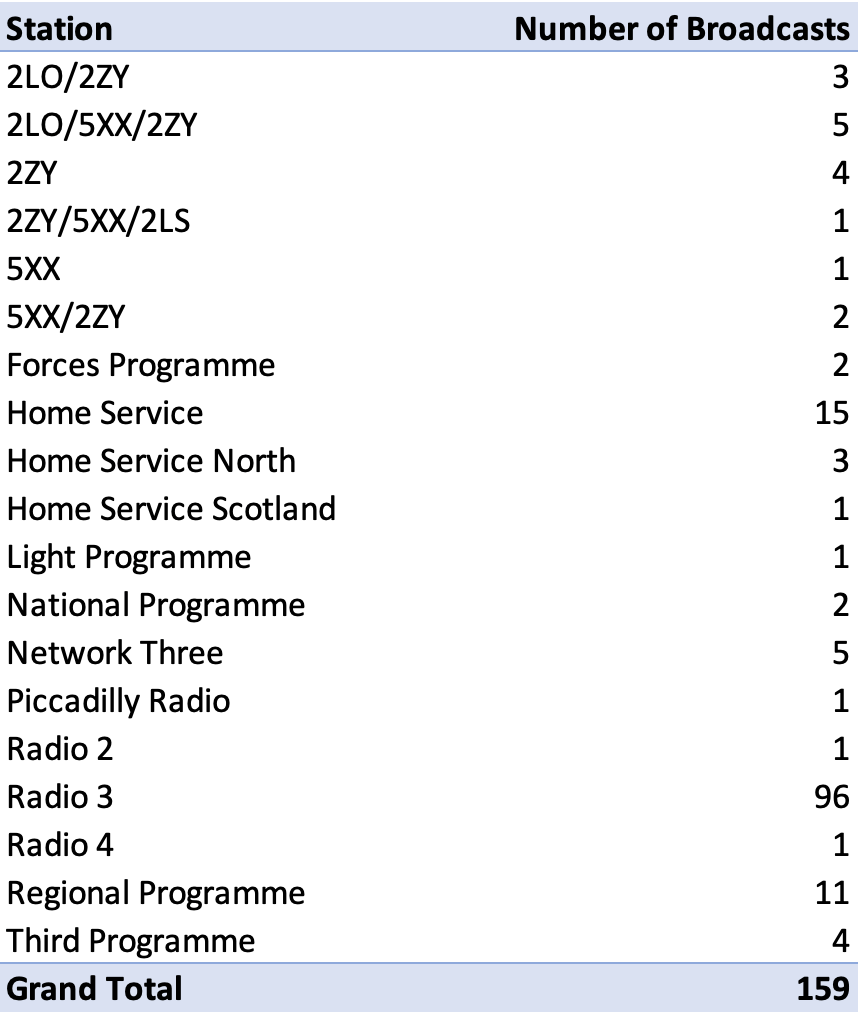
Given the choir’s status as an ensemble almost exclusively performing classical music, it’s not surprising that the vast majority of the choir’s performances have been on stations devoted to that form of music, namely Radio 3, its predecessor the Third Programme, and the Third Programme’s auxiliary station Network Three. Indeed the last time the choir performed on any station other than Radio 3 was in 1991, a programme of festive music from BBC Manchester’s Studio 7 featuring the Leyland DAF band that was broadcast on Radio 2. However, prior to this the choir appeared on practically every national domestic station available up to the reorganisation in 1967 other than Radio 1.
Up to the Second World War the choir appeared on a mixture of regional and national stations. You can see from the table above that the early performances on the 3-digit stations were on a hotch-potch of different combinations of stations, three on both the London (2LO) and Manchester (2ZY) stations, five on these two stations plus the high-power Daventry station (5XX), four just on the Manchester station and so on. This pattern continued after the 3-digit station naming system was dropped. The table shows just two appearances on the ‘National’ Programme, namely two concerts of music by Bach, one in 1936 and one in early 1939, and eleven on the ‘Regional’ Programme. However, just because a concert was on the Regional Programme didn’t mean it was only broadcast in the North. The same programme could be broadcast in a number of regions. For example, on the evening of February 18th 1932, while the National Programme from Daventry was broadcasting ‘Songs From The Shows’ with the BBC Theatre Orchestra, Midland Regional was broadcasting a concert by the City of Birmingham Orchestra, and both the London and North Regional stations were broadcasting the Hallé Choir singing Frederick Delius’ Mass of Life live from the Free Trade Hall conducted by Sir Hamilton Harty. Confusingly, all of the other Regional stations were at this time broadcasting the National Daventry programming, whilst the National programming itself also had a London variation!
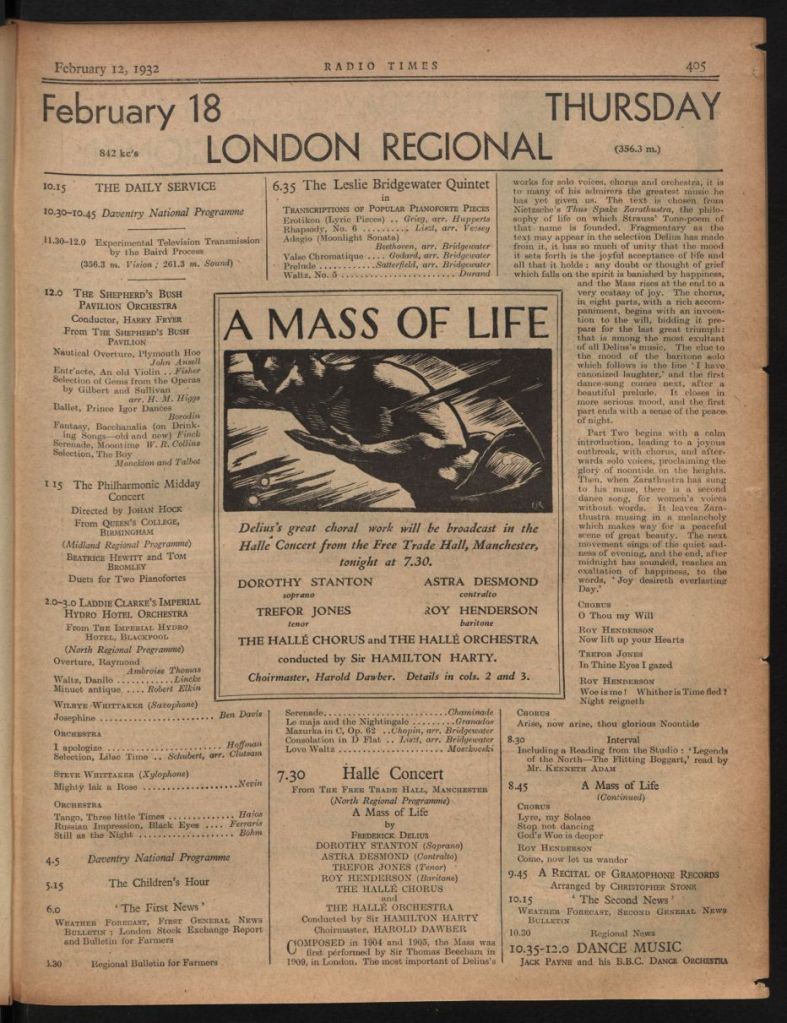
At around this time the choir were regularly broadcasting the music of Delius, encouraged by two Delius devotees, Hamilton Harty and Thomas Beecham. The previous year a performance of Appalachia conducted by Harty had been broadcast, and performances of Songs of Sunset and Sea Drift conducted by Beecham would follow in 1934 and 1938 respectively. As for Mass of Life, this was actually the first Hallé performance of the work, though given Neville Cardus in his review for the Manchester Guardian wrote of the ‘disappointing audience’ one hopes more people tuned in on the radio than attended in person! Despite the poor turnout, however, Cardus was impressed with both the performance and the choir: ‘The orchestra and chorus were certainly the best that, in my experience, have presented this masterpiece. Mr. Dawber [Harold Dawber, the choral director] deserves high praise for a careful preparation of his singers…’.

Following the formation of the Home Service and the Third Programme, one might have expected the choir to appear most often on the latter. However the distinction between the two stations was much less pronounced than the difference between Radios 3 and 4 today. Classical concerts were just as likely to appear on the Home Service as the Third Programme, and vice versa for speech and drama. Therefore you will see that the choir made frequent appearances on the Home Service and its regional variants, more indeed than the combined total of appearances on the Third Programme and Network Three.
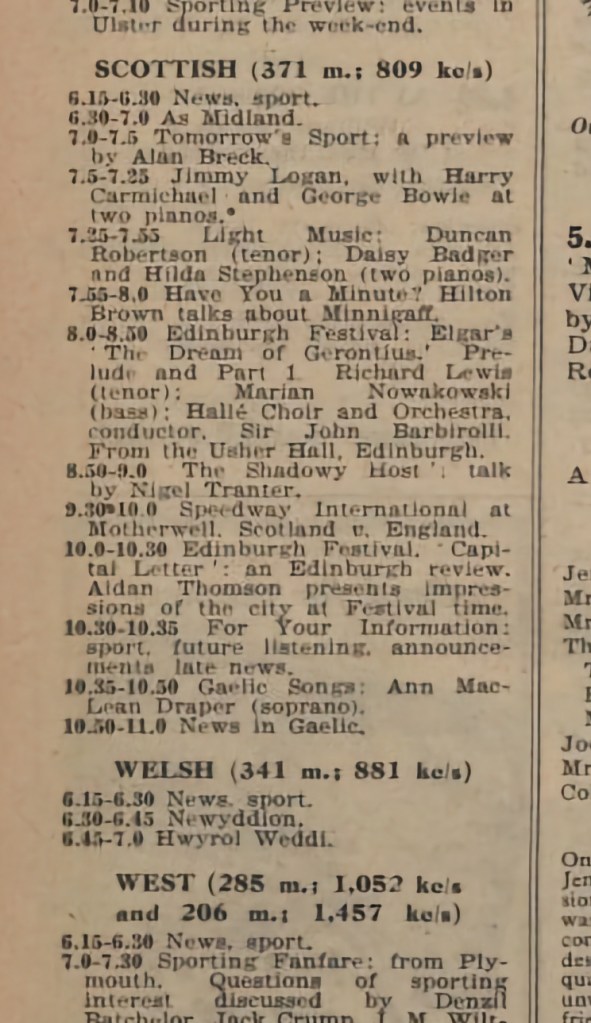
There is one Home Service appearance I would like to draw your attention to, that on Home Service Scotland on September 5th, 1952. In a previous blog I mentioned Kathleen Ferrier singing Land of Hope and Glory with the choir on the occasion of the re-opening of the Free Trade Hall in December 1951. In the following year’s Edinburgh Festival, just over a year before her tragic early death, Ferrier sang with the choir again in a performance of Elgar’s Dream of Gerontius, conducted by John Barbirolli. Whilst the Home Service nationally was broadcasting that night’s Promenade Concert, Home Service Scotland broadcast the Hallé’s Gerontius performance from Edinburgh. However, in their wisdom they only broadcast Part 1 of the oratorio, in which of course Ferrier as the Angel would not have appeared. Tragically therefore, the listening public were denied an opportunity to hear Ferrier sing with the choir with which she had appeared many times and with which she would have had a great affinity as a daughter of Lancashire. The brief performance of the previous year remained her only broadcast appearance with the choir. In his obituary for Ferrier the following year, Neville Cardus expressed beautifully what the Scottish radio audience would have missed that evening: ‘The mingling of an impersonal grandeur with a great tenderness free of sentiment made Kathleen Ferrier’s interpretation of the Angel one of the most moving experiences, musical and spiritual, of a lifetime.’
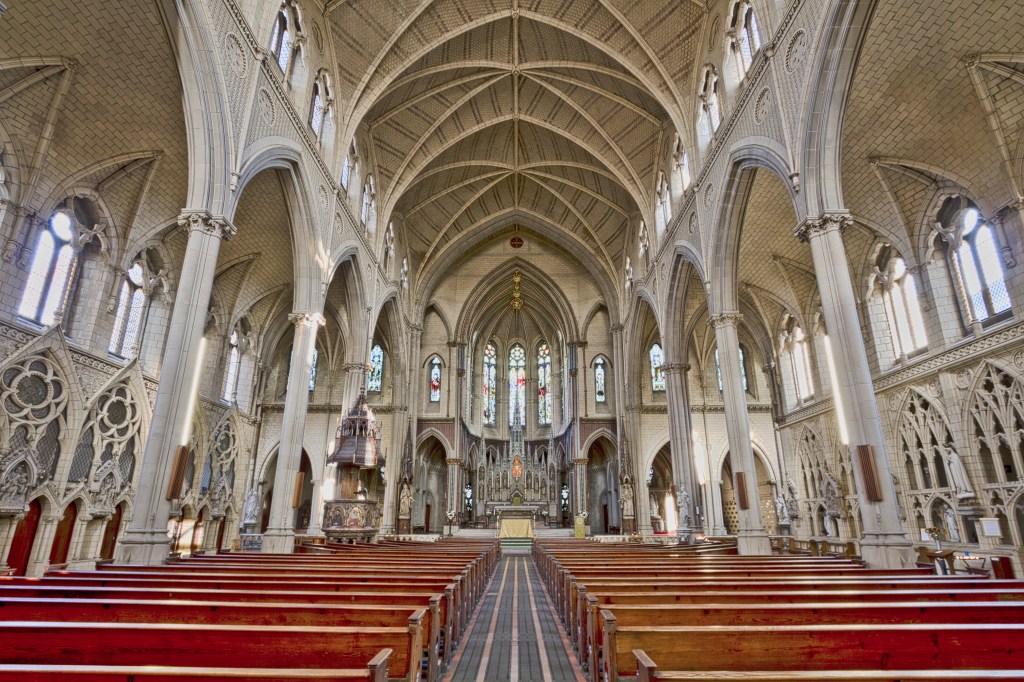
I will conclude this section with a couple more of choir’s radio appearances, their only appearances (as far as I can find) on Manchester’s local commercial radio station, Piccadilly Radio, and the BBC’s old popular music station, the Light Programme. Piccadilly Radio began broadcasting in 1974 as part of the government’s plan to encourage local radio, both non-commercial via the BBC and commercial via independent operators such as Piccadilly. Given that it has now evolved through many iterations to become the local outlet for Greatest Hits Radio, it is perhaps surprising that on Easter Sunday, April 22nd 1984, they broadcast a performance by the Hallé Choir of Handel’s Messiah in the glorious surrounding of the Church of the Holy Name in Oxford Road. Conducted by Maurice Handford, it has proved to be the only time the choir have broadcast alongside the Manchester Camerata. Sadly, apart from the names of the soloists, that is the only information I have been able to ascertain about either the concert or the broadcast. If any reader has any memories of either or further appearances on Piccadilly Radio, I would love to hear from you!


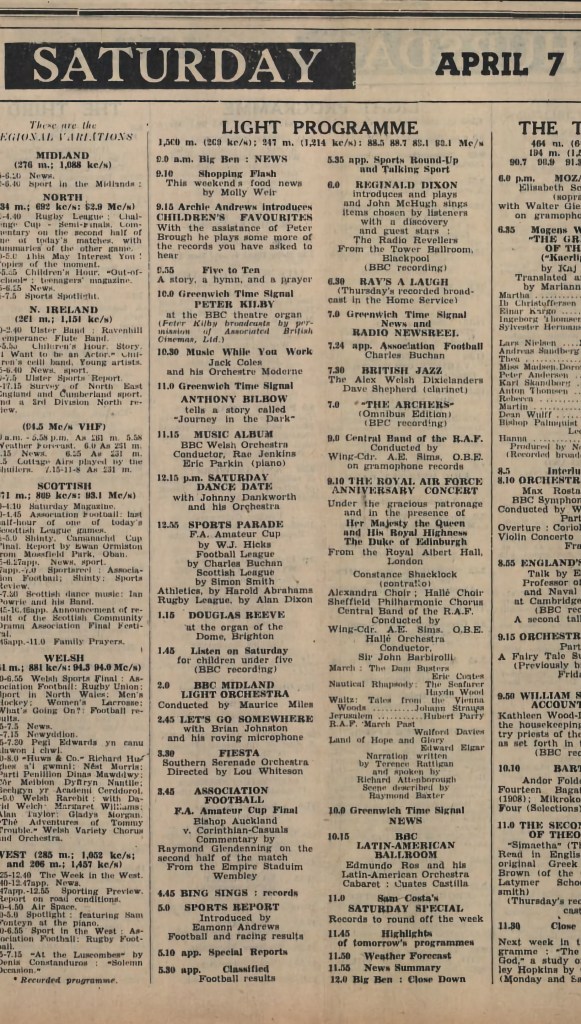
The choir’s only appearance on the Light Programme must have been by its very nature a memorable night. On April 7th 1956 they appeared at the Royal Albert Hall in front of Queen Elizabeth and the Duke of Edinburgh in the annual concert to mark the anniversary of the Royal Air Force. The choir were accompanied by the Hallé Orchestra and Central Band of the RAF, conducted by John Barbirolli, and joined by Sheffield Philharmonic Chorus and London’s Alexandra Choir. It must have been quite an affair: the narration for the concert was written by playwright and RAF veteran Terrence Rattigan and read on the night by the actor Richard Attenborough, who had also served in the RAF during the Second World War. A third RAF veteran, the broadcaster Raymond Baxter, described the concert for the radio audience. They only heard the second half of the concert and therefore sadly missed the choir’s performance of Dedication by the Sheffield Philharmonic’s Chorus’ director Herman Lindars, which Lindars himself conducted. They did however hear the choir sing Jerusalem, Land of Hope of Glory, and what must have been the most exciting, an arrangement for orchestra, band and chorus of Eric Coates’ glorious Dam Busters March!
Strike Up The Band
If we look now at the different ensembles the Hallé Choir have sung with in their radio appearances, as would be expected the vast majority of appearances have been with the Hallé Orchestra itself, as can be seen from the table below.
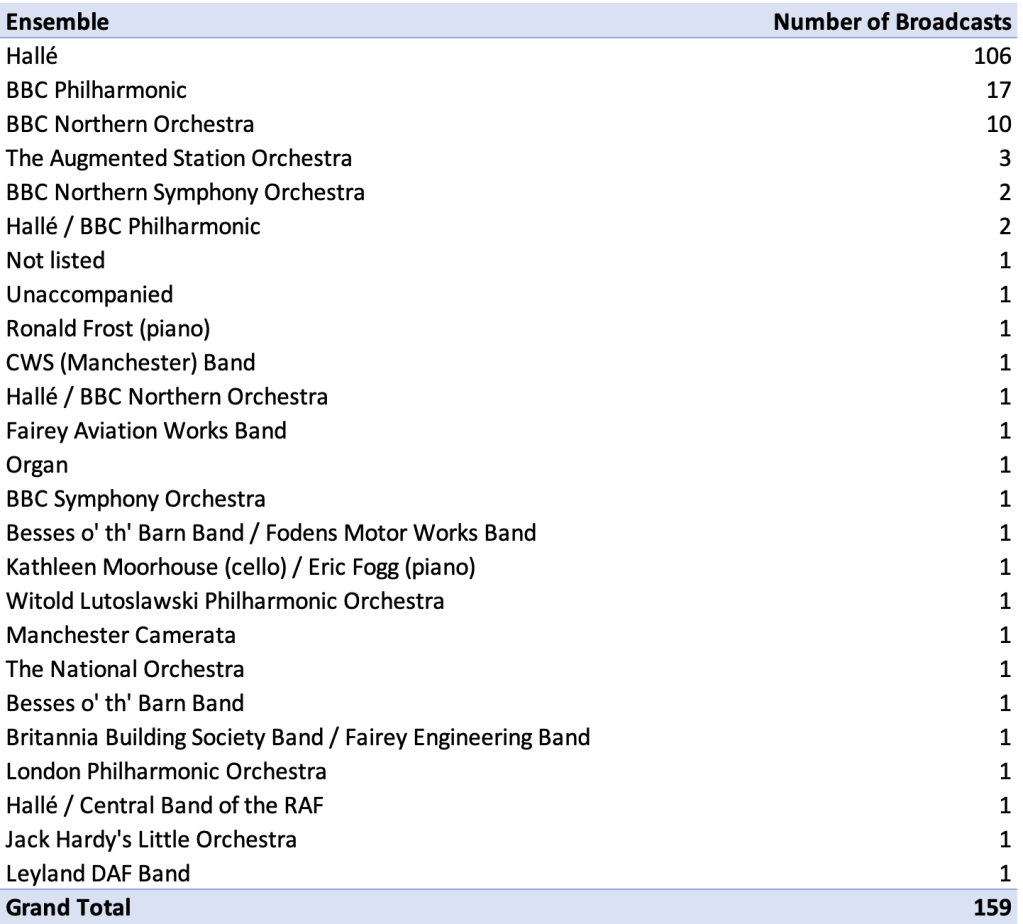
However, the Manchester area is home to two symphony orchestras, and over the years the choir has built up a strong relationship with the BBC Philharmonic in its various incarnations. The nature of performance with a BBC orchestra is that virtually every performance is either broadcast live or recorded for future performance. Therefore if we add together the broadcast totals for the BBC Philharmonic, BBC Northern Orchestra, BBC Northern Symphony Orchestra and The Augmented Station Orchestra, the choir have appeared on the radio with northern BBC orchestras 32 times, nearly a third of the number of times they have appeared with the Hallé. There is also the memorable occasion in 1981 when the choir joined the BBC Symphony Orchestra for the Last Night of the Proms, an event described in detail in my blog about the Hallé Choir and the Proms.
In addition, on three occasions the nature of the work being performed has resulted in the Hallé and the BBC Philharmonic or its equivalent combining to form a super-orchestra (dubbed in most recent times the Hallémonic!). There have been two recent instances, a 2010 performance of Gustav Mahler’s 8th Symphony (‘Symphony of a Thousand’) in which the Hallé Choir were also joined by the members of the City of Birmingham Symphony Chorus, and a 2017 performance of Arnold Schoenberg’s monumental Gurrelieder, where the choir were joined by the tenors and basses of Edinburgh Festival Chorus and the London Philharmonic Choir. Both of these performances were conducted by Sir Mark Elder, but there had been been a previous Gurrelieder collaboration in 1966 when the Hallé combined with the BBC Northern Orchestra, as it then was, to perform the work under the baton of the Scottish conductor George Hurst, who was at the time the BBC orchestra’s chief conductor.
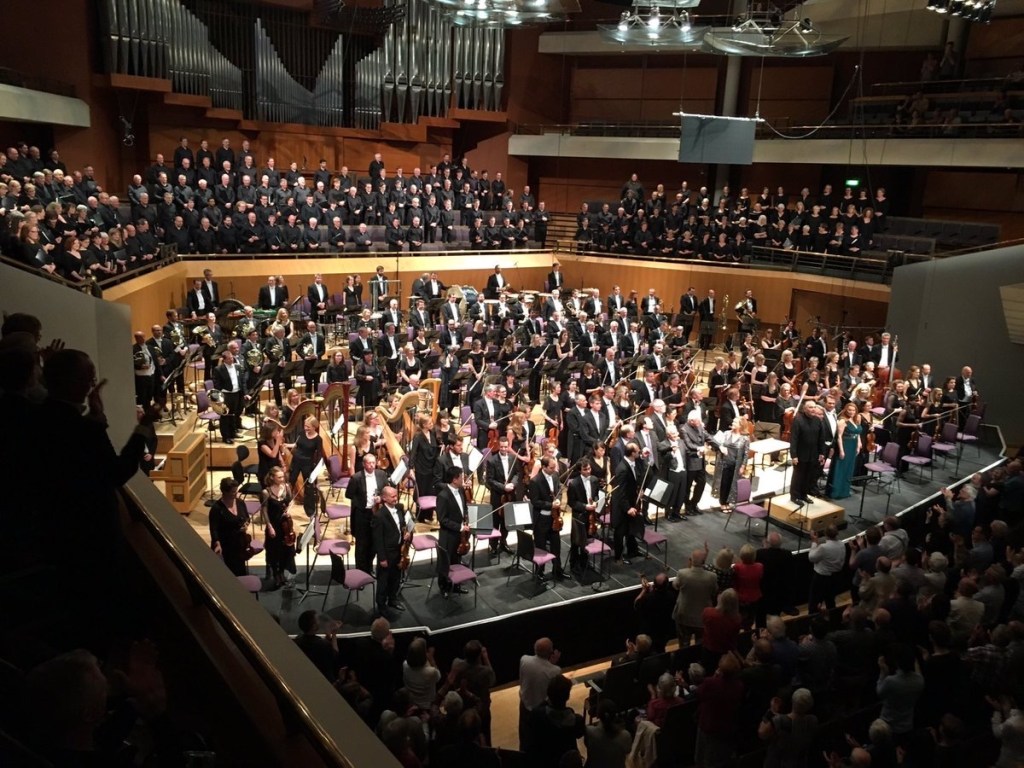
You can see from the photograph above the sheer immensity of forces that were deployed for the 2017 performance of Gurrelieder. You may also notice a few gaps in the massed ranks of tenors and basses in the choir seats. As I wrote above the choir were joined by tenors and basses of the London Philharmonic Choir who came up to Manchester on the train from Euston. The concert on the night started at 6pm and the last train back to Euston left Manchester Piccadilly approximately 30 minutes after the scheduled end of the concert, so as soon as the applause started at the end of the concert they immediately scurried out to be sure of not missing the train. In 2024 one of course imagines the train would have been cancelled!
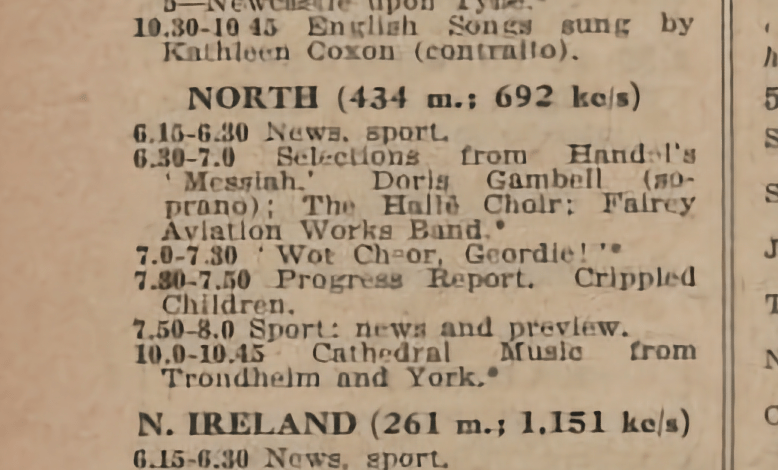
One very Northern thing jumps out from this list, namely the many broadcasts that the choir did between 1952 and 1991 with brass bands. I have already mentioned the 1991 Christmas broadcast with the Leyland DAF band (sadly the last brass band collaboration up to this point in time), but before that there were five broadcasts with various combinations of the Fairey, CWS, Besses o’ th’ Barn, Fodens and Britannia Building Society bands. I would like to focus on two pairs of concerts, firstly the two broadcasts the choir made where brass bands accompanied the choir in selections from the Messiah. The first, with the Fairey Aviation Works Band and soprano Doris Gambell, was in December 1957. Note the asterisk against the Radio Times listing above. This meant that the programme was recorded. As I said in Part 1 of this blog, early radio broadcasts by the choir were very much live, into the ether, listen and they’re gone performances, but through the 20s, 30s and 40s the BBC experimented with different ways of recording programmes for later playback, such as wax discs, steel tape and directly cut gramophone records. By the late 40s and early 50s the preferred medium was magnetic tape, initially via German Magnetophone tape machines acquired at the end of the war and later via home-produced EMI versions of the same type of machine. This particular programme would likely have been recorded on one or other of those, presumably at the BBC Manchester studios in Piccadilly Gardens. Later developments allowed for portable recording of live concerts, first on tape or cassette, then on various forms of digital recording, the method used today.
The second brass band Messiah broadcast was seven years later in December 1960, when the choir were accompanied by the Besses o’ th’ Barn Band from Whitefield with Stanford Robinson conducting. Robinson holds a crucial position in the development of choral singing within the BBC, having founded both the Wireless Chorus, which became the BBC Singers, and the BBC National Chorus, who became the BBC Symphony Chorus, and as a long-term BBC employee he was also active in the promotion of broadcasts of opera and light music. This particular programme was only 25 minutes long, consisting just choruses from Messiah, but the choir were involved in three further broadcasts with Robinson, two programmes earlier in 1960 featuring Ralph Vaughan Williams’ rarely heard but beautiful Benedicite (the first being a programme showing the choir in rehearsal for the second) and a further programme in 1965 described as ‘Nobilmente – A portrait in words and music of Edward Elgar’ in which the choir were accompanied by the BBC Northern Orchestra.
The second pair of brass band broadcasts involved two performances of Gilbert Vinter’s ‘cantata for bass, chorus, brass and percussion’ The Trumpets, the first in 1979 conducted by Maurice Handford with the combined Besses o’ th’ Barn and Fodens Motor Works bands and the second in 1990 with frequent choir collaborator Owain Arwel Hughes and the combined Britannia Building Society and Fairey Engineering bands. A former bassoonist with the London Philharmonic Orchestra under Thomas Beecham, like Robinson he had an important in the development of music within the BBC having been appointed as the first principal conductor of the BBC Concert Orchestra in 1952. In 1960 he turned his hand to composing music for brass bands and proved particularly adept at it, composing many pieces that remain important parts of the brass band repertoire to this day.
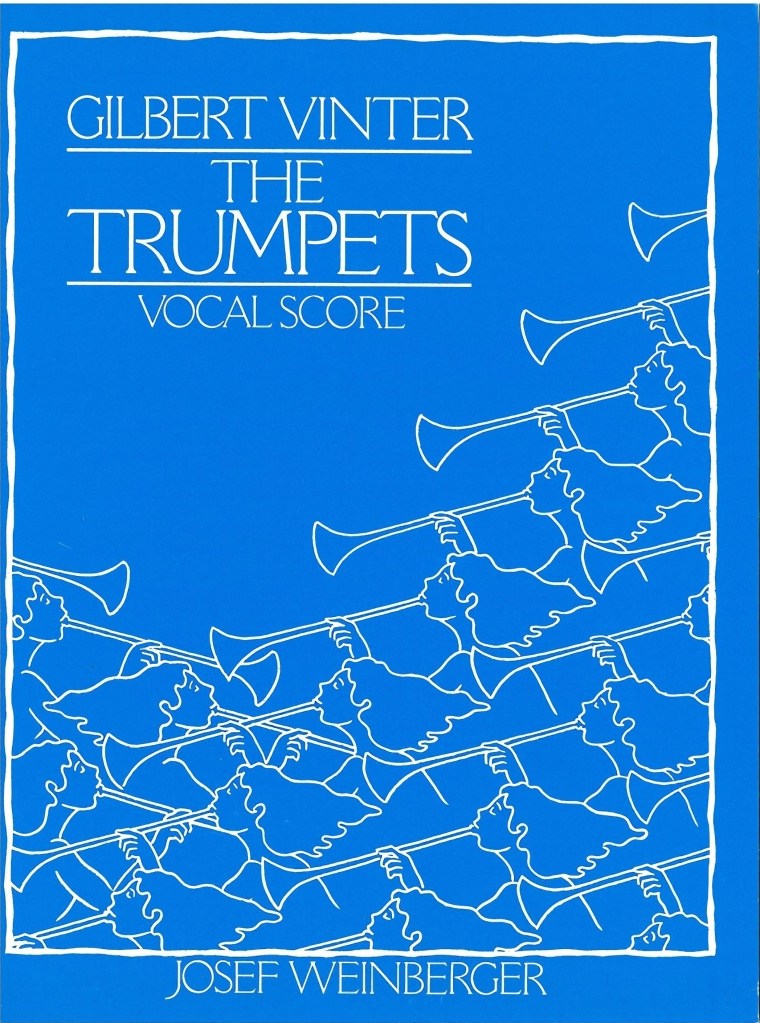
Sadly, with his early death in 1969 at the age of 60 his composing career lasted a mere nine years, but amongst the most substantial works he left behind was The Trumpets, a setting for brass band, chorus and baritone soloist of words from the Old Testament and the Book of Revelation that stylistically and thematically is occasionally reminiscent of Vaughan Williams’ Sancta Civitas. It was premiered at the Royal Festival Hall in 1965 with Owen Brannigan as the soloist and attracted many performances over the following years, including a Dutch performance from 1980 with Peter Pears dropping down a notch to deliver the solo that is available on YouTube. The performance that Radio 3 broadcast in October 1979 was a recording taken from a concert in June of that year in the Free Trade Hall commemorating the 10th anniversary of Vinter’s death. This performance is also available on YouTube and I have attached the link below. Be warned that the sound quality is extremely variable with some of the quieter passages sounding as they have been mixed by the BBC Radiophonic Workshop! However, there is enough in the recording, especially in the louder passages which come through strongly, to suggest that the piece is well worth revisiting.
Finally in this section I would like to give one small mention of an unusual entry in the ensembles list, namely the Witold Lutoslawski Philharmonic Orchestra. This a record of a visit a number of members of the choir made to Poland to support the Witold Lutoslawski Philharmonic Chorus and the Polish Radio Chorus in a rare Polish performance of Elgar’s Dream of Gerontius under conductor Jacek Kaspszyk that attracted a fine trio of soloists, Jonathan Lemalu, Jane Irwin and as Gerontius the then very young tenor Allan Clayton, who reprised the role with the choir and the LPO many years later in the 2022 BBC Proms. The Polish Radio recording finally saw the light of day in the Radio 3 Afternoon Concert slot in January 2010.
Hit Parade
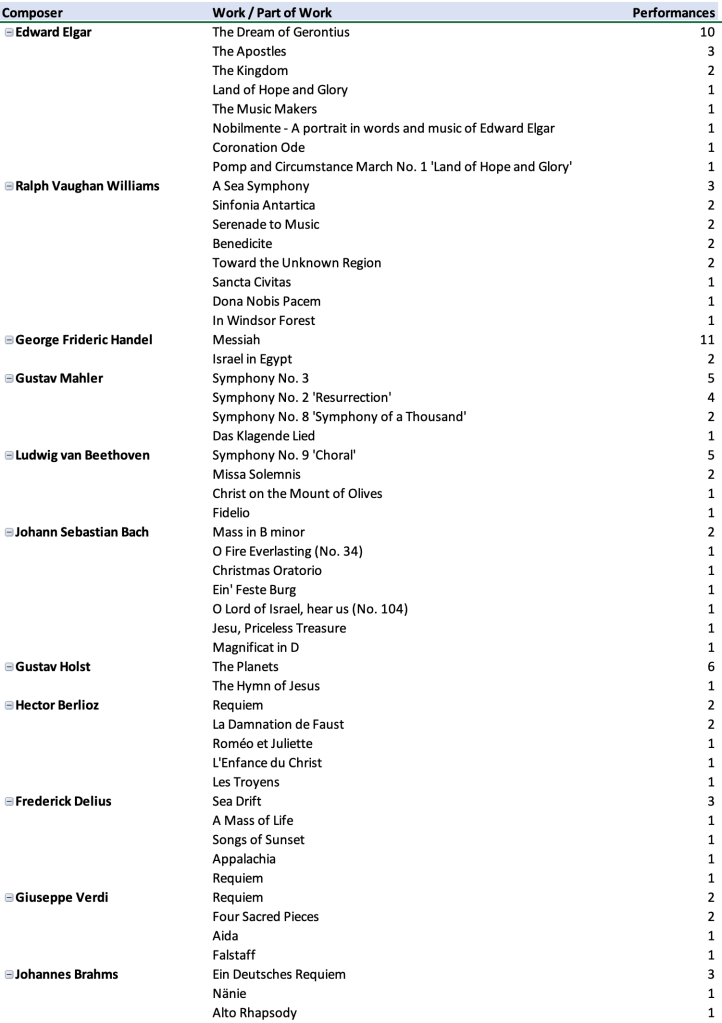
No round up of the Hallé Choir’s radio history would be complete without considering which composers and works have featured most strongly over the years in the choir’s broadcasts. The table above shows the composers that have had five or more performances of their works (or parts of their works) broadcast on the radio by the choir since 1925.
Perhaps unsurprisingly the top two positions are taken by Edward Elgar and Ralph Vaughan Williams, reflecting the tradition of performance of English choral music that has existed within the Hallé since the days of its founder but has been strengthened over the years by the likes of Hans Richter with his links to Elgar, Hamilton Harty, John Barbirolli and most recently and perhaps most importantly, Mark Elder. In just the first four years of broadcasting on the BBC, the choir performed Gerontius (1925), The Apostles (1926), The Kingdom (1928) and The Music Makers (1929), and performances have continued regularly through years with Gerontius, if one includes the Polish Radio recording, being broadcast 10 times.
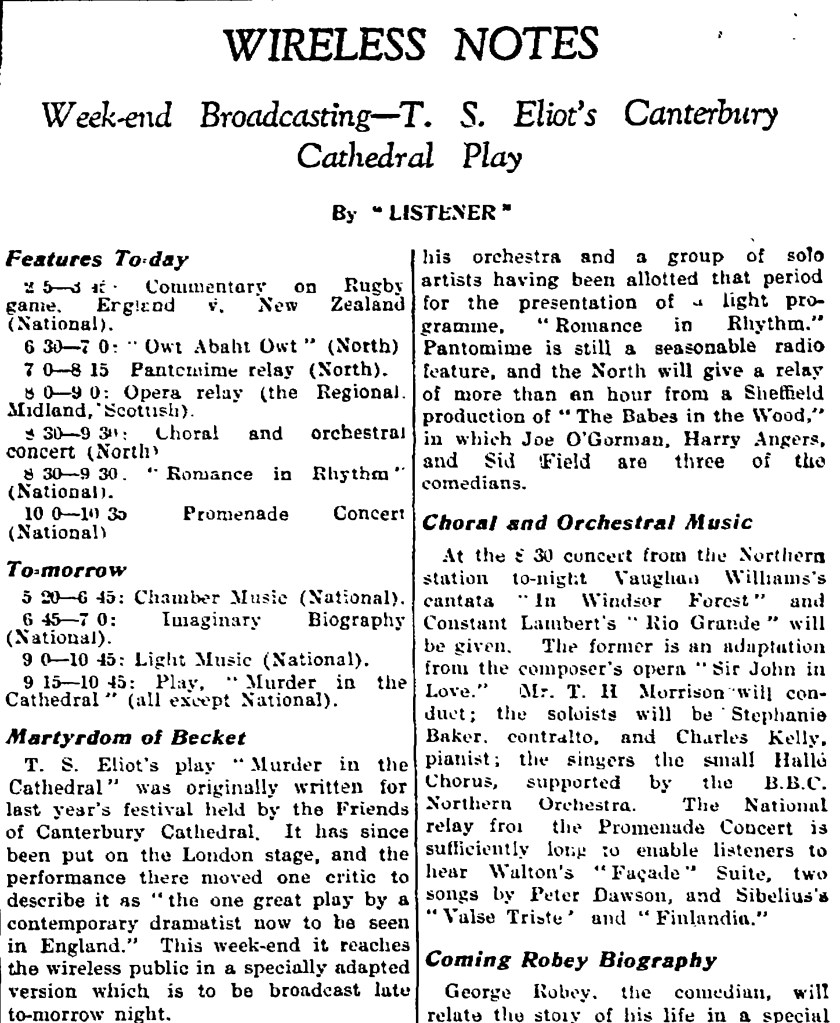
Vaughan Williams has also featured regularly over the years, with all of his major choral works being broadcast at least once, including the rare performance of Sancta Civitas that the choir gave at the BBC Proms in 2015. The first Vaughan Williams broadcast the choir gave was, however, even rarer than Sancta Civitas. It was the broadcast on January 4th, 1936 of his cantata for chorus and orchestra In Windsor Forest, adapted from material within his almost equally rare opera Sir John in Love, itself based on John Falstaff’s not-so-amorous adventures in Shakespeare’s Merry Wives of Windsor. This was the choir’s first broadcast with the BBC Northern Orchestra under their conductor T.H. Morrison and also included a performance of Constant Lambert’s Rio Grande that the choir had premiered a few years before. As it was a studio broadcast the Radio Times listing noted that the performance would be by ‘The Small Hallé Chorus’ – presumably the full choir would not have been able to fit into the BBC studio! I particularly like this broadcast for the notice about the broadcast in that morning’s Manchester Guardian and how it reminds listeners that if they switch over to the National station at the end of the concert they can catch the end of the Winter Promenade concert there.
Other notable English composers are present within the list, though Gustav Holst is represented almost exclusively by broadcasts of The Planets, with the only exception being the 2012 broadcast of The Hymn of Jesus that was later released on CD. Likewise that famous son of Oldham, William Walton, is represented solely by his dramatic oratorio Belshazzar’s Feast, reflective of the fact that at times during the 1970s and 1980s it seemed to be performed by the Hallé every other season. Noticeably it hasn’t been performed by the choir in any context, broadcast or otherwise, since 1990. Frederick Delius is represented by a wider spread of works, largely due to the championing of his works by Hamilton Harty and especially Thomas Beecham, but sadly there have only been two broadcasts of his works by the choir since 1941, one of his Requiem with Martyn Brabbins and the BBC Philharmonic in 1994 and one of Sea Drift with Mark Elder and the Hallé in 2011 that eventually ended up on the same CD as Hymn of Jesus.
Gustav Mahler’s music is also strongly represented in the list, though the fact that the choir’s first broadcast performance of a Mahler work was not until 1959 illustrates how the fascination with Mahler’s music is a relatively recent thing. The broadcasts are dominated by the big three choral symphonies, numbers 2, 3 and 8, but there is also room for the broadcast of Mahler’s early Das Klagende Lied, that formed the basis, with some manipulation, of the CD release that I talked about in an earlier blog.
Handel’s Messiah wins the prize for the work most often broadcast, though often only short sections were broadcast and there have been relatively few performances of the complete work. It is noticeable that the choir haven’t performed the work on the BBC since 1964, an indication that the present-day BBC is more interested in broadcasting historically informed performances of Messiah than the traditional performances in which the choir used to specialise. I imagine it is only a matter of time before Gerontius overtakes Messiah to claim the top spot! What is noticeable also is that the only other Handel oratorio to have been broadcast is Israel in Egypt – even though under Charles Hallé the choir would perform many of the other oratorios, and perform them often, in the 20th century and beyond the oratorios other than Messiah and to an extent Israel in Egypt have tended become the domain of specialist ensembles. Again, Bach was performed often by the choir on the radio up until the beginning of World War Two, but since 1939 there has been one solitary broadcast, a thrilling performance of the Magnificat in D with Ryan Wigglesworth in April 2016.
Finally there are strong showing for three composers that have been part of the bedrock of the choir since the days of Charles Hallé, with seven performances of Berlioz (with one to come shortly at the time of writing as the tenors and basses join with the CBSO in April 2024 to perform La Damnation de Faust), five performances of Brahms including three of Ein Deutsches Requiem, and six of Verdi including two of his Requiem.
Rarities and Omissions
If those were the most frequent composers and works that have featured in the Hallé Choir’s radio broadcasts, what of those that are less familiar, and what of those that appear under-represented? Below I have listed where a composer is represented by just one performance of one work.
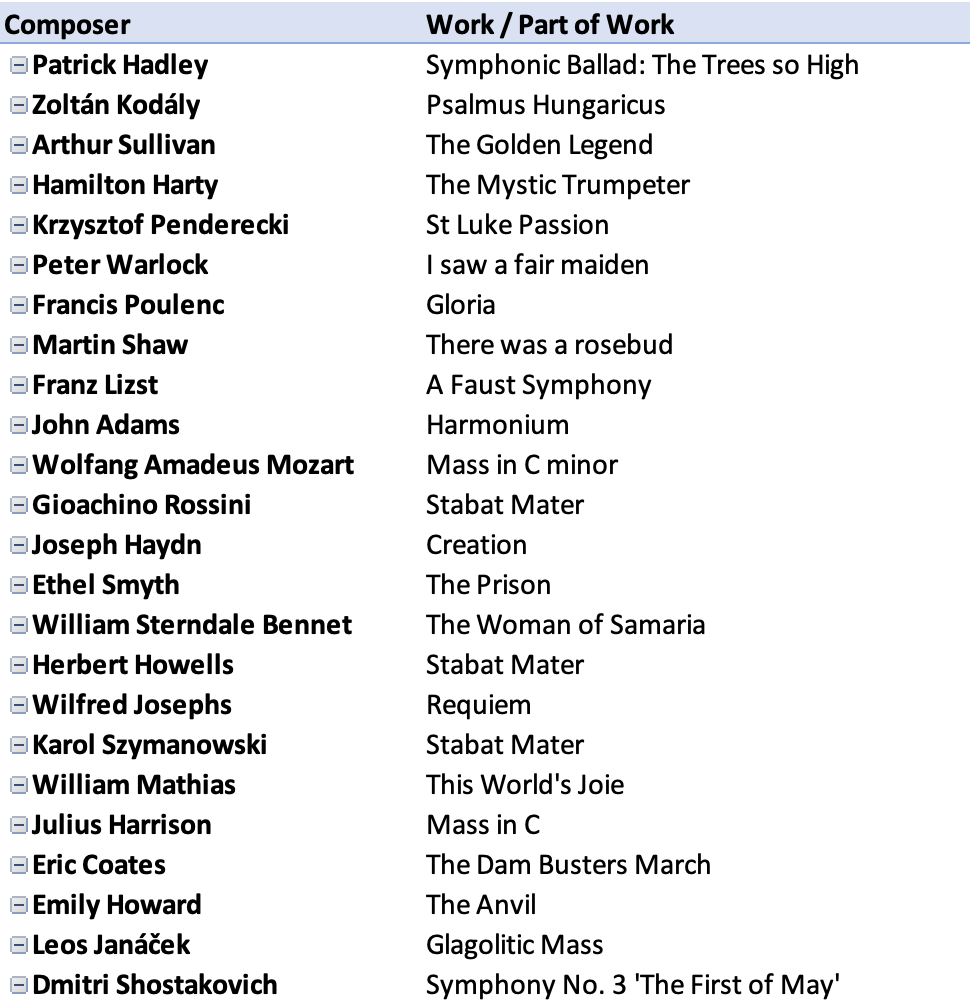
What leap out immediately are two names on the list, Mozart and Haydn. It seems surprising that these two great composers are represented by just two performances, and in the case of Mozart, not even by a performance of his most familiar choral work, the Requiem. It maybe becomes less surprising when you realise that nowadays the choir perform works by Mozart and Haydn relatively infrequently. Haydn’s Creation was performed 32 times by the choir up until the start of the First World War, but since then it has averaged a complete performance only about once every 20 years, and performances of his other choral works are rare. Mozart’s Requiem has in fact been performed less frequently over the years than Creation, and again, performances of his other choral works are rare. Opportunities for the BBC to broadcast these works have therefore been very limited.
Also within this list are composers and works that though well known might reasonably be expected to only represented once, such as John Adams, Francis Poulenc, Leos Janáček and Dmitri Shostakovich (though the choir is scheduled to perform his 3rd Symphony again later in the 2023/24 season with the BBC Philharmonic, thus guaranteeing a radio broadcast and a move up the table!). Finally within this list there are broadcasts of works that are genuine rarities. Of these some maybe deserve to be rarities, but others are more intriguing, making one wish that traces still existed of those broadcasts. Of particular notice are the many British choral works in the list that now languish in obscurity but which in their time were very much worth of note, such as William Sterndale Bennett’s The Woman of Samaria and Arthur Sullivans’ The Golden Legend, sections of both of which were broadcast in 1928, Herbert Howells Stabat Mater, broadcast with Edward Downes and the BBC Philharmonic in 1987, and Hamilton Harty’s Whitman setting The Mystic Trumpeter, broadcast with Mark Elder and the Hallé in 2008.
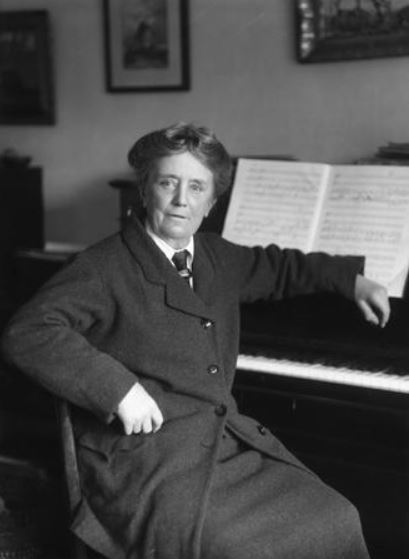
The composer from this list that I want to concentrate on here is the formidable Dame Ethel Smyth, renowned in her own time not just as a composer but also as a feminist and suffragette (indeed she wrote the suffragette anthem March of the Women). After her death in 1944 she quickly drifted into obscurity, but in recent years her star has risen, helped significantly last year by Leah Broad’s excellent Quartet, a biography of four 20th century female British composers (Smyth, Rebecca Clarke, Dorothy Howell and Doreen Carwithen). Throughout her life Smyth had multiple affairs and infatuations with both men and, more usually, women. Her most long lasting male friendship was with the writer Henry Brewster, known affectionately to her as ‘H.B.’.

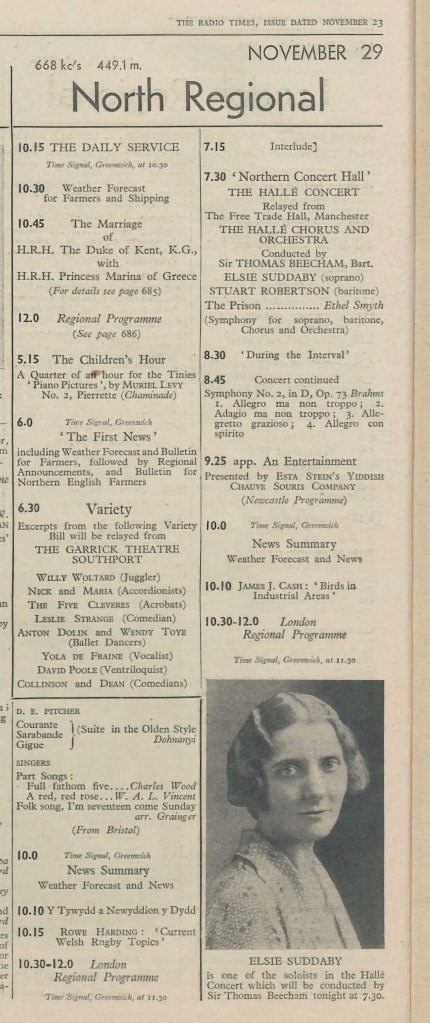
Around 1929, Smyth was in her 70s and many years had passed since her greatest popular success, the opera The Wreckers. Brewster had died 20 years previously. She was finding writing difficult but felt that now was the time, as Broad writes, ‘with twenty years’ distance… to piece together her eulogy [to Brewster], a final farewell.’ She assembled a text from Brewster’s book The Prison, wherein a prisoner ‘realises he is dying, and communes with his soul in an attempt to make sense of his existence.’ Despite her increasing frailty, and encouraged by Virginia Woolf, she completed the hour long piece for orchestra, soloists and choir that she named The Prison. As Broad describes it, the work ‘wasn’t just a good opus, it was an extraordinary one’. However, the premiere in 1931, conducted by Adrian Boult at the Queen’s Hall London, was not a success. Broad quotes two reviewers, one who wrote that it ‘had little evidence of real musical talent’ and one who joked that ‘Ethel Smyth and Henry Brewster have made brave attempts at mediocrity’. However, Thomas Beecham was very much one of Smyth’s champions, and it was presumably under his auspices that The Prison received its Manchester premiere in November 1934 with the Hallé Orchestra and chorus, two excellent soloists in Elsie Suddaby and Stuart Robertson, and Beecham himself conducting. The concert was broadcast on the BBC’s Regional North network, preceded by a ‘variety bill’ from the Garrick Theatre in Southport, and followed by ‘an entertainment’ by Esta Stein’s Yiddish Chauve Souris Company! As well as an advertisement for the concert itself, on the morning of the concert the Manchester Guardian also printed a reminder for radio listener of the upcoming transmission, describing The Prison as one of ‘two major works’ alongside Brahms Second Symphony.
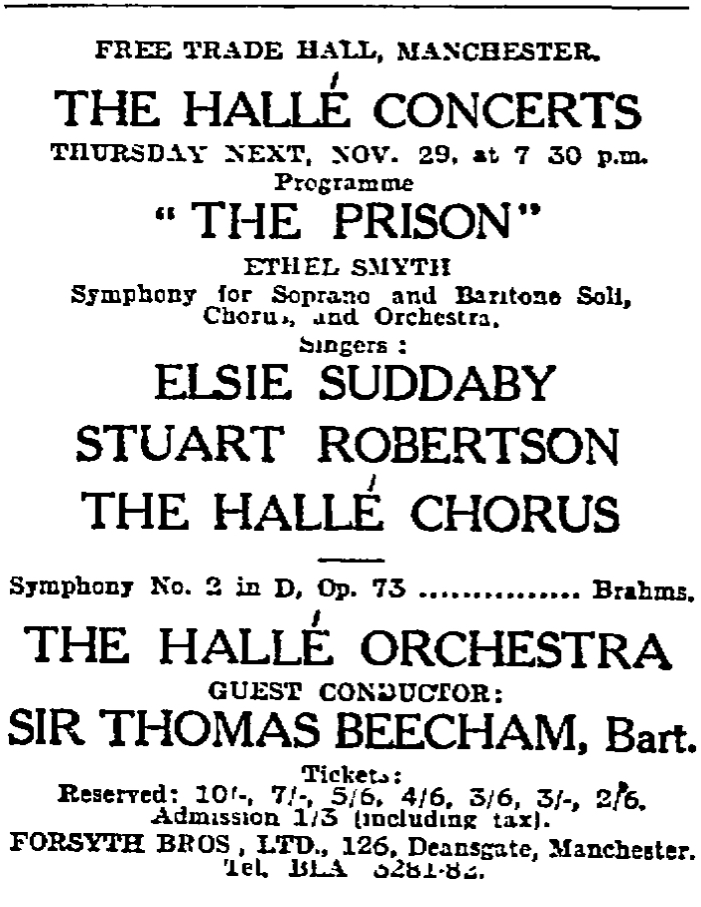
If Smyth intended The Prison to be a eulogy for Henry Brewster, Granville Hill’s review of the concert in the Guardian began very much as a eulogy for the elderly Smyth herself:
The applause last night in the Free Trade Hall… was a tribute to Dame Ethel Smyth in her capacity of musician and composer; but it was, we believe, something more than that. During her long life as a musical artist and as a hard worker in her special craft Dame Ethel has yet found time to enter into the general intellectual life of her day with such gusto and understanding as to wipe out the reproach that the musician’s vocation must of necessity be a narrowing one… It is thus easy to see her and to write of her as a genius and a great Englishwoman.
from Granville Hill’s Hallé review in the Manchester Guardian, November 30th 1934
On the work itself, Hill was less positive. Whilst admiring the fact that ‘there is no reliance on fashionable modalism or other pseudo-archaic harmonic systems’ (a dig at the likes of Vaughan Williams?) and the work’s lack of sentimentality he writes ‘and yet, all is not well. We feel that the music ought to light up more frequently, to take on a greater warmth and fullness’. Whilst the choral singing ‘often gave us such splendours and such evidence of insight and aptness of approach in subtle movements of the work’ Hill regretted the fact that there obviously hadn’t been a combined rehearsal with orchestra before the concert, a situation that would be unthinkable today.
The Leader of the Band
And so to the men (and they have all been men) who have conducted the choir’s radio broadcasts through the years. The table below lists all of these conductors and the number of broadcasts they have appeared in.
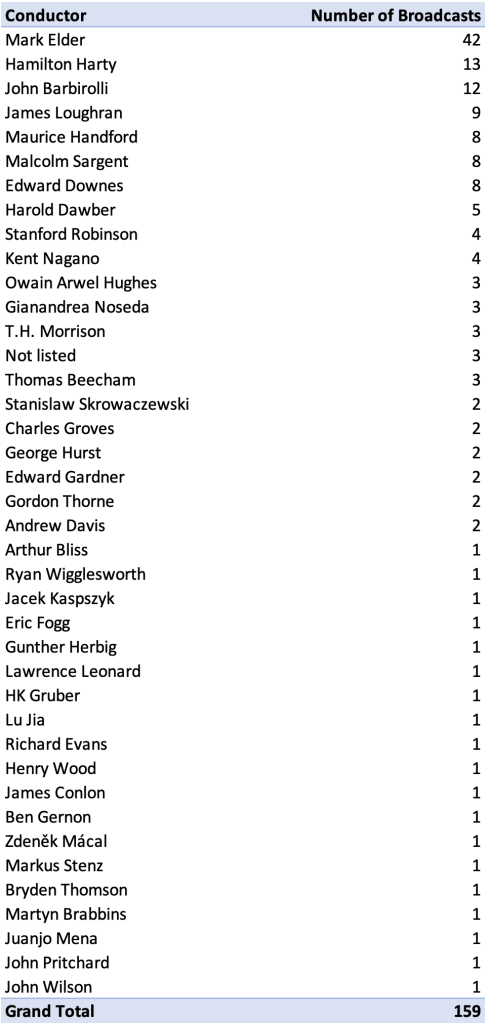
One dominant figure immediately stands out, namely Mark Elder. The number of times he has appeared on the radio with the choir, which is the same as the next four conductors on the list combined, is testament to two things. Firstly, there is the regard with which he is obviously held within the BBC. As long ago as 1987, when he was the music director of English National Opera and a mere conducting stripling at 40 years of age, he was considered by the BBC worthy enough to lead the Last Night of the Proms. Over the years he has appeared as a talking head many times on BBC Radio and TV programmes, including helming a TV series on the history of the symphony and the short-lived celebrity conducting competition, Maestro. Secondly, it is testament to the emphasis he has given since the day he arrived in Manchester to promoting and widening the choral element of the Hallé Concerts Society. Under his auspices we have seen the foundation of the Hallé Youth Choir, the Hallé Children’s Choir and the Ancoats Community Choir, all of whom appeared at least once in BBC radio broadcasts. The choirs have been at the forefront of Elder’s vision for the Hallé, with the result that choral concerts have been high up in the queue when the BBC have been picking concerts from each Hallé season to broadcast. When one adds the number of times Elder has appeared with the choir in broadcasts to the number of times other conductors have appeared with the choir on the radio during his tenure, one arrives at a total of 59. More than a third of choir radio broadcasts have therefore happened during the 24 years since Elder took the helm, a remarkable statistic.
It is also remarkable when compared to the other long lasting conductor of the radio era, John Barbirolli. In his 27 years with the orchestra, he only conducted the orchestra 12 times on the radio, and during his tenure the choir only appeared 21 times in total. Barbirolli is indeed beaten to second place in the table by Hamilton Harty, who made 13 broadcasts with the choir between 1925 and 1933, indicative of how quickly he took to the new broadcast medium with both orchestra and choir, as he had took to recording the orchestra with the Columbia label. Similarly with both Stanislaw Skrowaczewski and Kent Nagano, one is struck by how rarely they too appeared on the radio with the choir, with Nagano making four appearances and Skrowaczewski only two. There is a sense within any choir of whether the person standing in front of them is or is not a good choral conductor. Speaking to those in the choir who remember these two conductors there is definitely a feeling from them that conducting the choir was not their main priority, and that is obviously reflected in the works chosen for broadcast. With Mark Elder, the choir definitely has been a priority.
As with the previous section, however, I would like to conclude with a rarity. Of those conductors in the above list who have appeared only once, the most prestigious is probably Sir Henry Wood, the man who founded the Queen’s Hall Promenade Concerts in 1895 and throughout his conducting life was both a champion of new music and of providing affordable performances of classical music to the masses. Today his bust stands proudly in front of the organ console for every performance in what are now known as the BBC Proms.
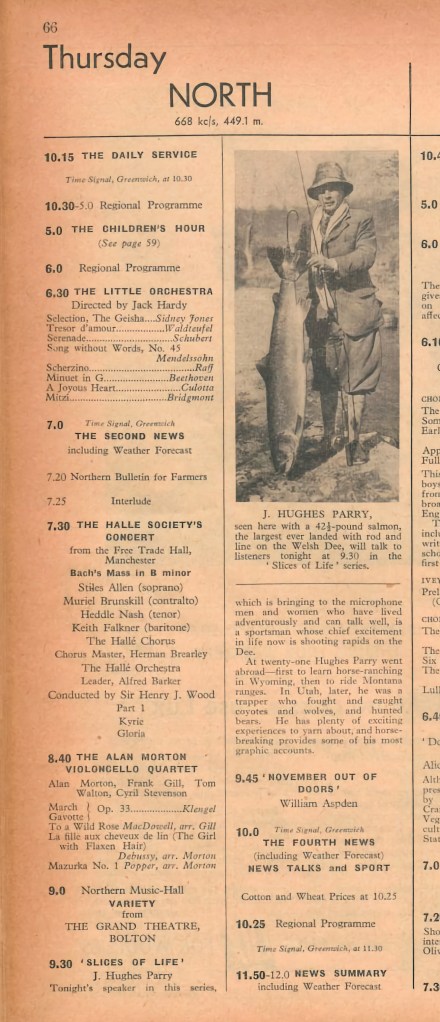
He conducted many performances by the Hallé over the years up to his death in 1944, five of which involved the choir, performances of Verdi’s Requiem, Vaughan Williams’ A Sea Symphony, Brahms’ Schicksalslied, Handel’s Coronation Anthem The King Shall Rejoice, and in November 1938 Bach’s choral masterpiece, the Mass in B minor. It was this last concert that was chosen by the BBC for broadcast on the Regional North station. Sadly only Part 1 of the work was actually broadcast, consisting of the Kyrie and the Gloria, though the monumental nature of the work (and I would guess somewhat relaxed tempi by modern standards) meant that the broadcast lasted over an hour. As a side note, see the listing in the Radio Times extract below for 6.30pm. Jack Hardy’s Little Orchestra were a small ensemble based in the Manchester area who appeared countless times on the BBC, specialising in light orchestral music that appealed especially to Old Time Sequence Dancing afficianados. They actually appeared with the Hallé Choir on the radio a couple of times during the Second World War, both times accompanying the choir in ‘Songs of Ellan Vannin’, in other words songs originating from the Isle of Man – an interesting curiosity in the broadcast history of the choir.
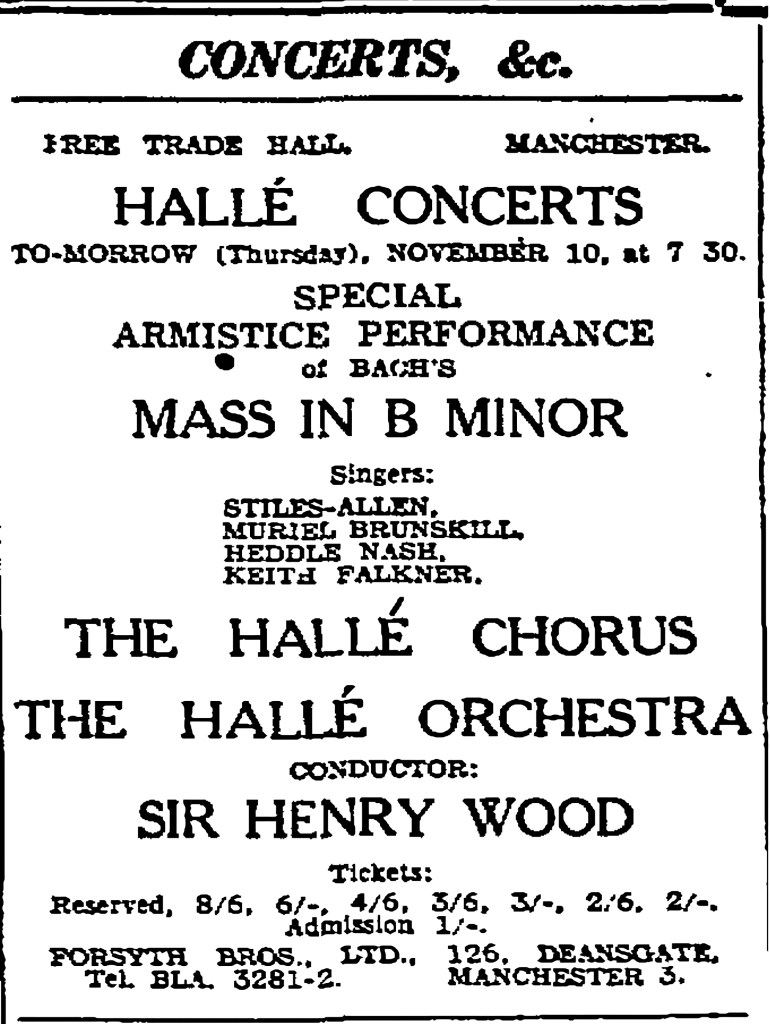
To return to Bach and Henry Wood, you can see from the advertisement in the Guardian that this was a special performance to commemorate the 20th anniversary of the Armistice, though there is no mention of this fact in the Radio Times. Neville Cardus reviewed the concert for the Guardian, perhaps echoing the thoughts of many listeners to the piece over the years (though I have to say not myself!) by writing that: ‘The B minor Mass of Bach is masterpiece beyond mortal question, but also it is for some of a musical duty which must occasionally be done, and I, for one, am relieved when it is over.’ However, according to Cardus it appears that Wood spent a great deal of time with the choir in the weeks leading up to the concert, giving them two thousand markings for their vocal scores, so the preparation must have been meticulous, and it showed. As Cardus wrote:
For several weeks he had prepared the Hallé Chorus, made them work hard and love their labours. They rewarded him by some admirable singing on this occasion – after much preliminary raggedness it was as good as any choral singing the city has heard recently… There was much to praise in the Hallé singers’ tone, endurance, balance, and energy of attack.. the performance in fact improved in security and eloquence as the evening lengthened.
from Neville Cardus’ Hallé review in the Manchester Guardian, November 11th 1938
Not forgetting…
The final section of this blog briefly remembers the individuals without whom none of these broadcasts would have been possible, namely the various choral directors that over the years have cajoled the Hallé Choir into giving of their best over the air. It also serves as a taster for a future blog in which I will trace the choral director lineage from the time of Charles Hallé to that of Mark Elder.
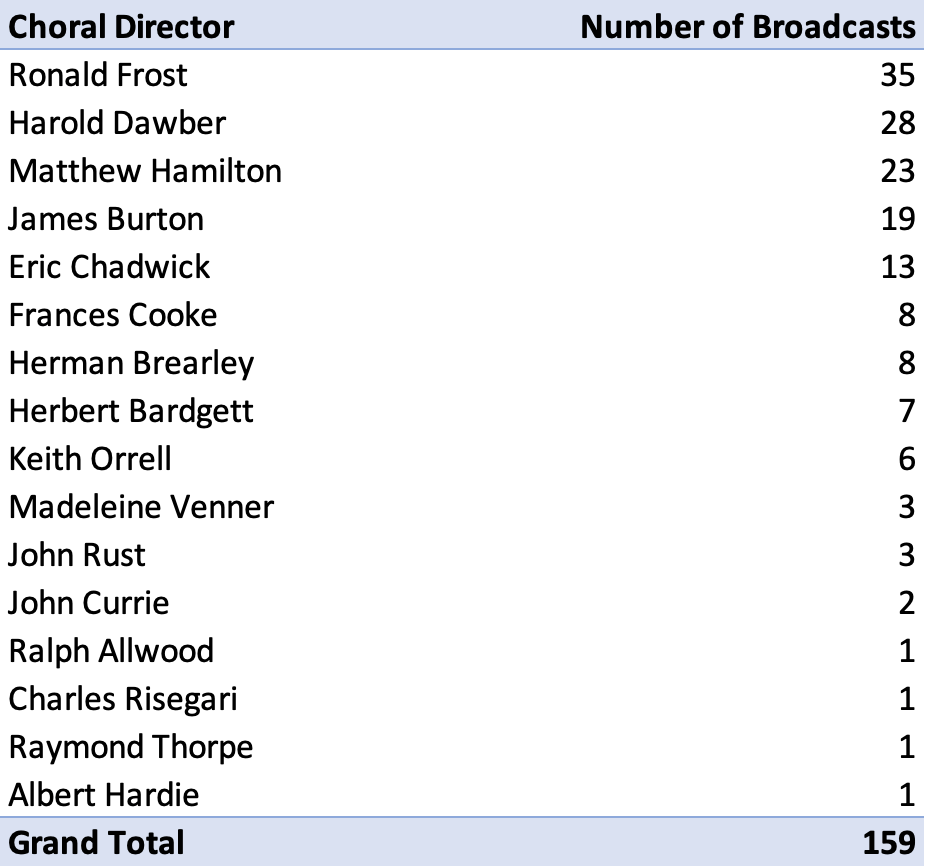
The list above shows the numbers of radio performances the choir’s choral directors have been responsible for since 1925. Most of the names I have obtained from printed sources, either the Radio Times, concert advertisements or concert programmes, but where the name was not directly available I have assumed the choral director in overall charge at the time was responsible for that specific concert. That may result in one or two errors, as indeed it did in the case of the Ethel Smyth concert. I had assumed Harold Dawber trained the choir for that concert, but reading the review of the concert it transpired that in fact Dawber had been ill, and Charles Risegari had taken over his responsibilities for that concert.
Putting aside the potential for error, what is clear is that Ronald Frost has by far the most broadcasts under his belt. Indeed, as I will show in a future blog, he was prominent in a number of TV appearances made during the 1970s and 1980s, even appearing in person conducting the choir. The high positions of both Matthew Hamilton and James Burton, plus a strong showing for Fanny Cooke, emphasise the rise in radio appearances during Mark Elder’s time at the Hallé. As the current incumbent, and with more radio appearances in the schedule for the remainder of the 2023/24 season, Matt Hamilton will soon be pushing for second place, and may indeed, depending on how the schedules look under the new chief conductor-designate Kahchun Wong when he takes charge at the beginning of next season, he may soon be challenging Ronnie Frost for the top spot! Whatever happens, it is clear that the Hallé Choir’s radio journey is not finished yet.
Appendix: List of Hallé Choir radio appearances
References
Leah Broad, Quartet: How Four Women Changed The Musical World (London: Faber & Faber, 2023)
Michael Kennedy, The Hallé Tradition – A Century of Music, (Manchester: Manchester University Press, 1960)
BBC Genome Project https://genome.ch.bbc.co.uk
BBC Radio 3 Listings https://www.bbc.co.uk/schedules
Roger Wilmut, Fragments of an Informal History of Broadcasting: Recording at the BBC https://rfwilmut.net/broadcast/recording2.html
Manchester Evening News Archives, provided by British Newspaper Archive https://www.britishnewspaperarchive.co.uk
Guardian Archives, provided by Manchester Library and Information Services
Royal Albert Hall Archives https://catalogue.royalalberthall.com


Leave a comment