Introduction
Following the first UK performance of The Damnation of Faust in 1880 the Hallé Orchestra continued to champion new music. 1905 saw the first performance of Sibelius’ Second Symphony, the first performance of any Sibelius symphony in Britain. Three years later saw the world premiere of Elgar’s First Symphony, conducted by Hans Richter. However, whilst the Hallé Choir continued to add previously unsung works to its repertoire – the first decade of the 20th century saw first Manchester performances of the big three Elgar oratorios and 1925 their first performance of Berlioz’ Grande Messe des Morts – there was an absence of anything completely new.
The Rio Grande (1929)
That changed in 1929 with the first concert performance of Constant Lambert’s jazz-inspired work for chorus, orchestra and solo piano The Rio Grande, though there is a provis to that statement, as we shall see, in that two studio performances of the work had already been broadcast on the still relatively new-fangled BBC. That first performance, and subsequent performances in London, proved to be huge successes, though sadly not necessarily for the choir.

The Vic-Wells Ballet is of course the precursor to the present-day Royal Ballet, and Lambert was associated with it through its first two decades. Not long after conducting her in a ballet version of Rio Grande in 1937 he began a long tempestuous affair with the young Margot Fonteyn, made scandalous by the fact that he was married at the time. Some credit him with imbuing Fonteyn with the musicality that later made her such a great dancer.
Lambert had his own personal demons, however, and eventually years of dissolute living and hard drinking resulted in his early death at the age of only 46 in 1951. His role in the birth of British ballet is commemorated to this day by his being listed in every programme printed by the Royal Ballet and Birmingham Royal Ballet as the ‘Founder Music Director’ alongside de Valois as Founder, Frederick Ashton as Founder Choreographer, and Fonteyn as Prima Ballerina Assoluta.

Sir Hamilton Harty, the then musical director of the Hallé Orchestra, was obviously listening, scheduling Rio Grande for what the Hallé Concerts Society called the ‘first time in performance’ in a concert at the Free Trade Hall on December 12th, 1929. The concert also included selections from Berlioz and Brahms along with a performance of the Beethoven Violin Concerto the virtuoso Hungarian violinist Jelly d’Arányi, who as can be seen from the concert advertisement was very much the headlining act! She also played some solo violin pieces, accompanied by the Hallé Choir’s choral director, Harold Dawber

The main conductor for the concert was Harty, but for Rio Grande he handed the baton to Lambert and moved over to play the complex piano part. Lambert was still only 24 years old. The concert was a great success, with Neville Cardus, writing in the Guardian, particularly effusive:
“On the strength of one performance only, we take the risk of calling it a work of genius. Mr. Lambert transfigures jazz into poetry; more wonderful still, he transfigures Mr. Sitwell into poetry. The verses have a skilful pattern sort of rhythm, but their exoticism is cold, objective. The music gives colour, where the text gives a mannered line, and while it paints the changing scene it also steeps everything into emotion subjectively felt. Beauty is the result – swift changeful beauty, now graphic, now romantic. And yet it is all done by jazz.”
Neville Cardus writing in the Manchester Guardian, December 13th 1929
Note that Cardus doesn’t mention the choir at all in his review. It’s very much worth noting that Rio Grande as originally written is a work for a chamber choir rather than a full symphony chorus, so it was a selection of the choir that followed in the footsteps of Charles Hallé going down to London nearly 50 years earlier to reprise Damnation of Faust to perform Rio Grande with the same forces the very next day at the Queen’s Hall, London. There was much critical praise for this performance as well. The Times called it ‘the first completely successful example of a composer so absorbing the spirit, the rhythm and the instrumentation of jazz as to be able to use it naturally and in good faith to express ideas of his own which suit the medium.’
The critic for the Musical Times was equally praising, but offered a caveat – ‘Constant Lambert’s Rio Grande was brilliantly successful, despite the inadequacy of the choral portion, sung by a small contingent of the Hallé chorus.’ He thought it ‘the hit of the season’ but further damned the choir with faint praise when expressing his wish for another performance – ‘This work should be heard again soon, and with a larger and better chorus.’ And indeed when Lambert, Harty and the orchestra gathered again in London in January 1930 for a further concert performance and a recording session with Columbia, the Hallé Choir had sadly been replaced by Harold Darke’s St Michael Singers. The resulting recording can be heard on Spotify and will give you a reasonable idea as to what the early performances sounded like. For something slightly more polished, an excellent recording by the André Previn and the LSO, with Cristina Ortiz as the piano soloist, is also available on Spotify. It’s a fanciful idea, but it would be nice to think that the Hallé Choir could remedy perceived past inadequacies with a performance to mark the work’s centenary in a few years time!
So, as I described in the first part of this blog, through the first 100 years or so of its existence, premieres and first UK performances of major choral works largely passed the Hallé Choir, remaining the domain mostly of music festivals and special occasions. Thus Damnation of Faust and Rio Grande became the exceptions that proved the rule. However, the last 30 years have seen many more opportunities for the choir to sing works for the first time, and I will conclude this blog by briefly running through a few of these.
Battle of the Atlantic Suite (1993)
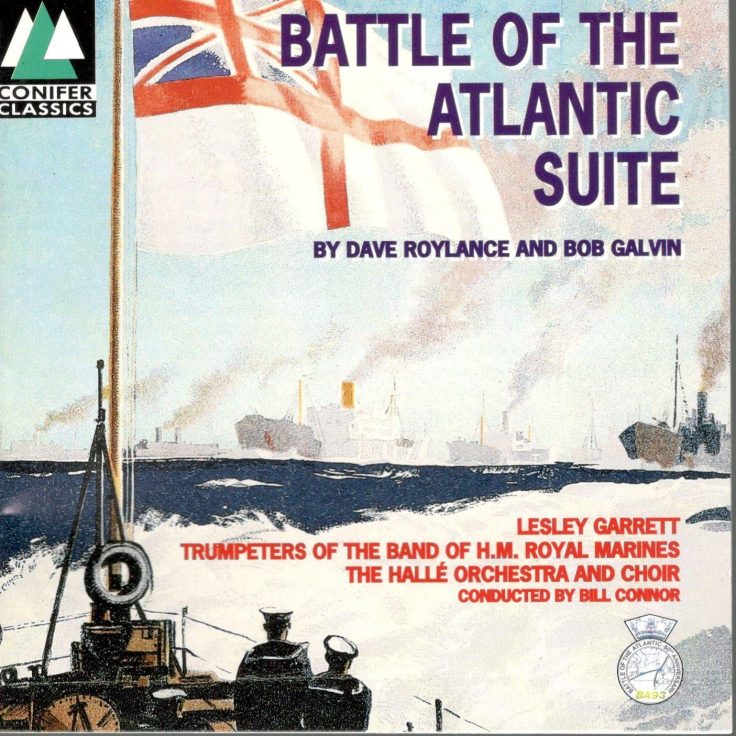
In 1992 the composer/orchestrator partnership of Dave Roylance and Bob Galvin (from the literature it’s not entirely clear who did which) were commissioned to write the Tall Ships Suite to commemorate the organised visit to Liverpool in that year of a fleet of Tall Ships, the large ocean-going vessels from the age of sail. The piece was recorded using the Royal Liverpool Philharmonic Orchestra with Bill Connor conducting, and released on CD that year. It was a big commercial success, largely one assumes because of the film and television background of the composers, its cinematic wash of sound proving popular with the public. Dave Roylance’s background was particularly interesting – apparently not only did he write the theme music for the popular Channel 4 soap opera Brookside, but also created the music for the legendary Shake N’Vac advert that those of you of a certain vintage will remember with a mix of nostalgia and affection!
Following its success, they went on the next year to create another piece that commemorated a maritime event, this time the 50th anniversary of the general ending of hostilities in the Battle of the Atlantic during World War 2. The mix was much as before, though this time the premiere recording was made with the Hallé Orchestra, again conducted by Bill Connor. Also, added to the mix in what they called the Battle of the Atlantic Suite was a wordless chorus that burst into full-blown song in the final section of the suite accompanying the soprano Leslie Garrett, at the time probably the classical singer with the biggest name recognition in the country.
I was unable to find any contemporary reviews of the CD release, but an indication of how far it’s fame spread is that I found a record in the 2000s of a section of the suite forming part of the musical soundtrack that was used to entertain the queue (or should that be line!) for the ‘Soarin’ Over California’ ride at Disney’s California Adventure theme park, alongside music by John Williams, James Horner, Alan Silvestri and other cinematically inclined composers. Sadly the section they used was not one that featured the choir – the idea of a choir member queueing for the ride and suddenly hearing themselves over the loudspeakers would have been quite surreal!
Crossing the Alps / Aftertones (2010/2014)

The Battle of the Atlantic Suite is interesting from the choir’s perspective in that in happened during the brief reign of John Alldis as the choir’s director, a temporary appointment as the Hallé Concerts Society attempted to find a replacement for the much-loved former director Ronald Frost. A similar situation happened in 2010, when the Hallé and the BBC Philharmonic decided to commemorate the 100th anniversary of the birth of Gustav Mahler by commissioning contemporary composers to write works that would be performed alongside each of Mahler’s symphonies. The work chosen to sit alongside Mahler’s Symphony No. 2 (“Resurrection“) was a setting by Colin Matthews of words by William Wordsworth that he entitled Crossing the Alps, a work that the choir premiered in late January 2010, and later reprised in Nottingham with Markus Stenz conducting.
The previous summer James Burton had departed as the choir’s director and with a permanent replacement still not forthcoming, the job to prepare both the Matthews piece and the choir’s contribution to the conclusion of the Mahler symphony wasgiven to the renowned choral director Ralph Allwood. Unfortunately that December and January saw extremely cold weather and heavy snow that resulted in the cancellation of a number of rehearsals. As a result, preparation for what was a significantly difficult new piece was more limited than Allwood would have liked, especially given that the piece was written to be performed unaccompanied. In the end, to keep the choir on track, they were accompanied by a pedal note on the organ, a device that was repeated when four years later the work was recorded by the Hallé Youth Choir with Richard Wilberforce conducting. The recording was made for a CD that also included Aftertones, Colin Matthews’ setting of some of Edmund Blunden’s First World War poems which the main Hallé Choir recorded with Nicholas Collon conducting and Roderick Williams as the baritone soloist.
The work had originally been written for Huddersfield Choral Society but this was to be its world premiere recording. The recording was notable in two respects. Firstly, the choir had not performed the work live in front of an audience, the usual precursor to a recording – indeed for a lot of works a live performance often formed the basis of what was eventually recorded. At the time of writing the choir have still not performed the work through from beginning to end without a halt, other than a rough run through before recording started in earnest. Secondly, this was one of the first recording sessions in the Hallé’s new rehearsal and recording venue Hallé St Peter’s, housed in a redundant church in the Ancoats area of Manchester, which the orchestra and choir had moved into that year.
Christ’s Nativity (2014)

Hallé St Peter’s was the venue for the next premiere performance I would like to discuss. John McCabe was a prolific composer whose works ranged from large scale symphonies to song cycles to chamber works to ballet music. He had had a long association with the region, having been born in Liverpool and having studied at Manchester University and at what is now the Royal Northern College of Music. Sadly, in 2012 he was diagnosed with a brain tumour and over the next couple of years he continued to compose whilst undergoing courses of treatment. By the middle of 2014 it was becoming obvious that his condition was terminal, but thankfully he lived long enough to hear one of the last commissions he received, which came directly from the Hallé Choir.
This was Christ’s Nativity, a setting of words by Henry Vaughan whose poetry resonated particularly with McCabe. He described the work as follows:
“One of the features of poetry of his period is the use of dialogues, e.g. between Heaven and Hell, or between two characters. This is reflected in the music by the occasional use of pairs of melodic lines. In the decades before writing this setting, I spent a lot of time listening to much early English church music (notably Byrd, Tallis, Tye and Whyte) and this may well have influenced some of the layout of the music, notably the contrapuntal aspects.”
John McCabe writing about Christ’s Nativity – from the Wise Music Classical website
The work arrived in time for a world premiere performance in December 2014 in Hallé St Peter’s with the choir’s then choral director Madeleine Venner conducting and Jonathan Scott providing organ accompaniment. By this time McCabe was too ill to travel to hear the performance, but the choir were able to make a recording of the concert which was sent to the composer who responded with a heartfelt message of gratitude to the choir. He lost his battle with cancer two months later, in February 2015.
The Anvil (2019)
The final two premiere performances bookended the pandemic that shut much of the musical world down in 2020 and 2021. Both were premieres that the choir were invited to participate by bodies other than the Hallé Choral Society, in the first instance the Manchester International Festival and in the second the City of Birmingham Symphony Orchestra, and both were written by composers who were uncompromising in their demands on the choir. In other words – they were hard!
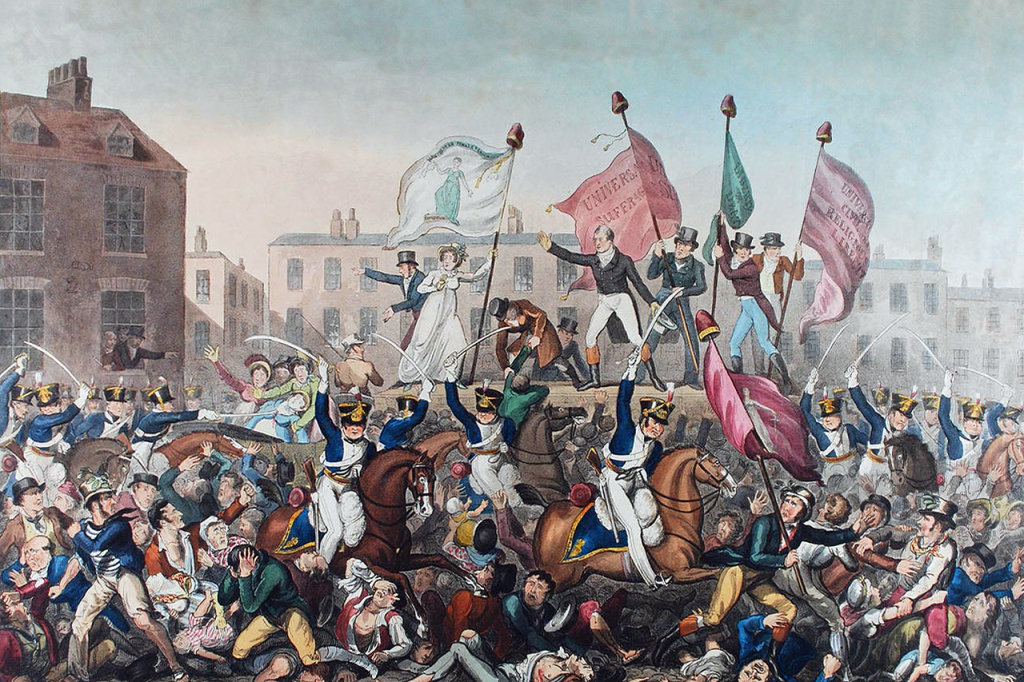
The Anvil was commissioned by the Manchester International Festival from the composer Emily Howard to commemorate the 200th anniversary in 2019 of the Peterloo Massacre, the fateful day when mounted yeomanry stormed a peaceful demonstration in St Peter’s Fields (a site on which was later built the Free Trade Hall) causing the death of many of many of the demonstrators. It was an event that was a catalyst for the founding of the Chartists and the wider Labour movement who agitated both for a safe and humane working environment and a living wage for working people, and for the right for working people to vote.
Critical response was positive. The Times gave it four stars, praising the ‘bone-shaking force of Emily Howard’s climactic music commission’. Robert Beale, writing on the ArtsDesk website was more ambivalent, admiring the work but with reservations but wondering whether it would travel well. He did however praise Ben Gernon’s ‘sure hand on the tiller’ and thought the confident singing of the vocal forces deserved credit.
In This Brief Moment (2022)
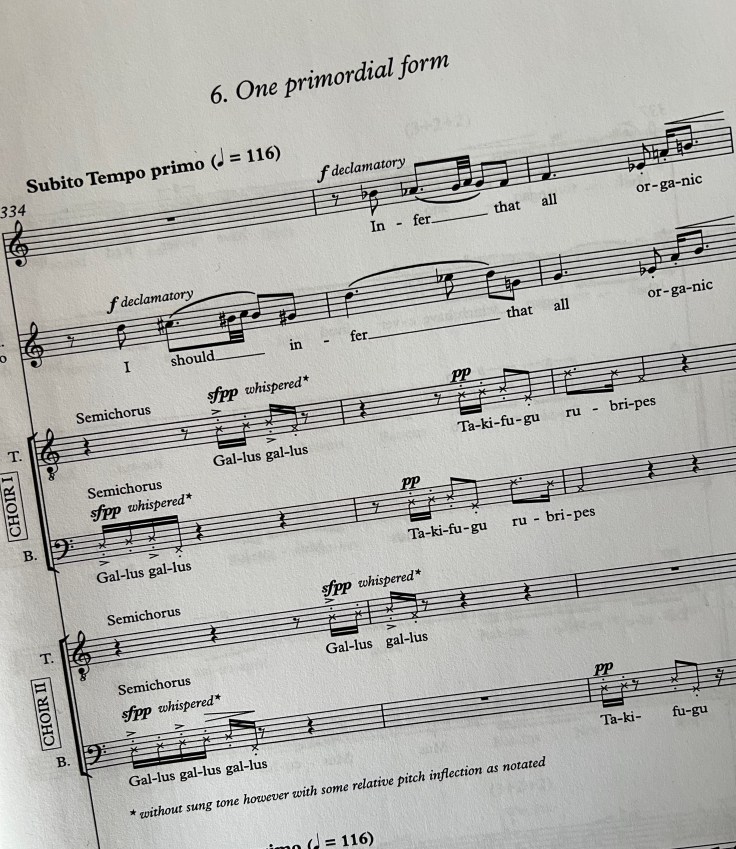
The final premiere I want to talk about is one that at the time of writing is fresh in the mind of all who sang it, not just because of the extreme demands it made on the choir but also because of the extraordinary scope of the work. The work was In this Brief Moment, by the Australian composer Brett Dean, written to mark the 100th anniversary of the founding of the City of Birmingham Symphony Orchestra. Dean described it as an ‘Evolution Cantata’, and it covered the entire history of the planet from the creation of the first oceans and landmasses, through the gradual emergence of progressively more complex life, to the current supremacy of human kind and the existential threat it poses to the world as it has evolved. Written for a large orchestra, double choir (one choir being the CBSO Chorus and the other the Hallé Choir), and soprano and counter-tenor soloists (Jennifer France and Patrick Terry), the work also included parts for music-boxes and for whirlygigs made from recycled plastic, prose passages spoken on tape by Sir John Tomlinson, a section where the counter-tenor soloist channelled his inner rockstar hugging a microphone, and a final section where all the choir donned black masks to sing the final pages – presumably a comment on recent events. The choral passages were especially difficult both rhythmically and in terms of tonality, with at one moment the choir intoning the names of all the geological periods, at another naming the first inverterbrates, and at another praising today’s vast living tapestry in a riotous fugal passage where the two choirs jostle and compete with each other.
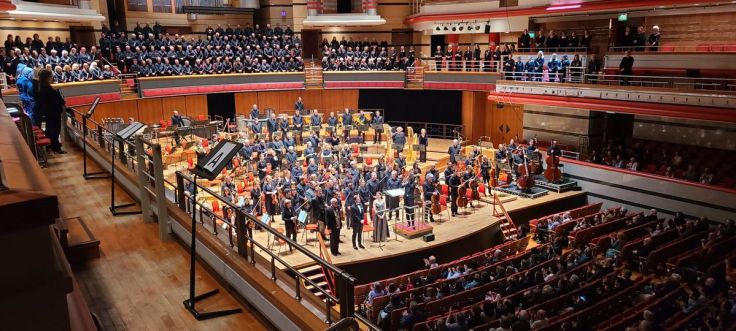
Even after an unusually large number of rehearsals there was anxiety, in both choirs, but gently cajoled by the respective choral directors, Matthew Hamilton and Simon Halsey, and the conductor Nicholas Collon, and with the composer himself looking on encouragingly for the last few rehearsals, the premiere performance on September 24th, 2022 was something of a triumph. Yes, the work ended up being loved by many in the choir and hated by many others, but the press reviews indicated that the event had left a deep impression. Rian Evans in the Guardian called the work a ‘mind-blowing affair’ in which ‘the CBSO Chorus and Hallé Choir brilliantly combined.’ Of the final twirling of the whirlygigs by selected choristers he wrote that their sound ‘evoked nothing so much as birdsong in the tallest branches of forest man is destroying’, probably the first critique ever in the choir history’s of their whirlygig prowess. The Times called it ‘exhilarating’ with a particularly telling opening remark: ‘Nothing can prepare you for hearing 200 singers pelting the phrase “Let the strongest live and the weakest die” at you at full volume. It is chillling and thrilling, like watching a tooth-and-claw David Attenborough documentary.’
And onward: Magnificat (2023)
I hope this blog has given you an idea of how the pace of premieres and first performances has accelerated in recent years. For some of these pieces the Hallé Choir may have given the first and only performance, but others have stood the test of time and continue to be performed regularly. Even a work seemingly as obscure now as Lambert’s Rio Grande has seen recent performances in the North West at Ellesmere Port and Buxton.
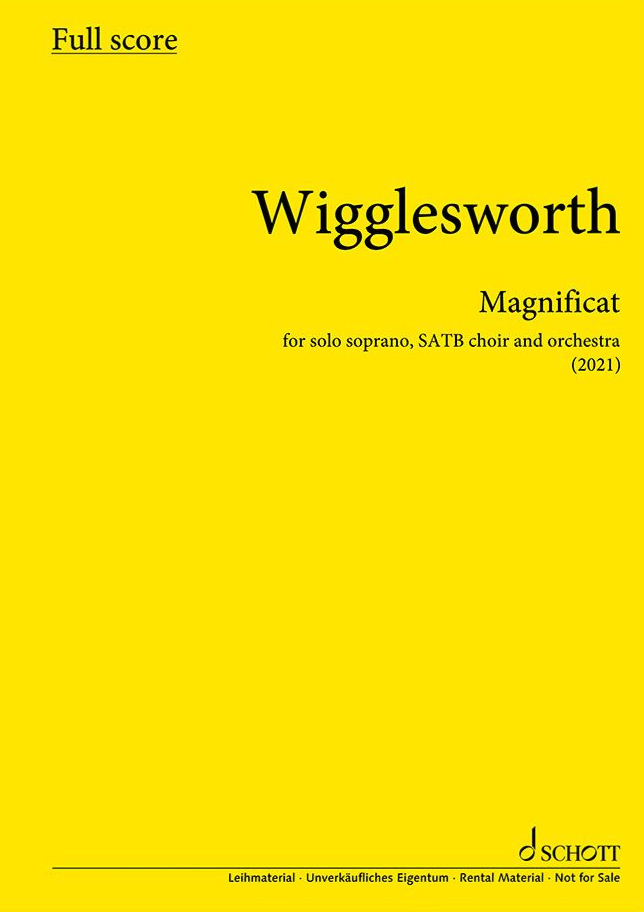
And the pace of new work is not showing any signs of diminishing. 2023 will see the Hallé Choir perform in the UK premiere of Ryan Wigglesworth’s new setting of the Magnificat, which Wigglesworth himself will conduct and in which the choir will be joined by Wigglesworth’s partner Sophie Bevan as the soprano soloist, and further new work is in the pipeline for 2024. The Magnificat is a joint commission between the Hallé and the Bergen Philharmonic Orchestra who gave the world premiere of the work, conducted by Edward Gardner, in April 2022. A video of the performance is available on Vimeo and judging by that it should be another challenging but rewarding experience for the choir, which is probably just as it should be with new works.
References:
Michael Kennedy, The Hallé Tradition: A Century of Music (Manchester: Manchester University Press, 1960)
Andrew Motion, The Lamberts (London: Faber & Faber, 2018)
Stephen Lloyd, Constant Lambert: Beyond the Rio Grande (London: Boydell Press, 2014)
The Guardian newspaper archive
The Times newspaper archive
artsdesk.com
wisemusicclassical.com
rncm.ac.uk
schott-music.com
bergenphilive.no

 Home
Home 
Leave a reply to On Record – Part 1: Hamilton Harty and John Barbirolli – The Hallé Choir History Blog Cancel reply