Introduction
February 6th, 1858 was a significant date in the history of choral music in the North West of England, and in Manchester in particular. That day saw the second of Charles Hallé’s ‘Grand Orchestral Concerts’, and the final item in the first half of the concert was a performance of Beethoven’s Choral Fantasia, in which Hallé himself on the piano and and an ‘orchestra of sixty performers’ was joined in its dramatic finale by what the programme described as a ‘full chorus’. This therefore marked the first occasion in which a group players which in time became known as the Hallé Orchestra were joined by a group of singers which in time became known as the Hallé Choir.
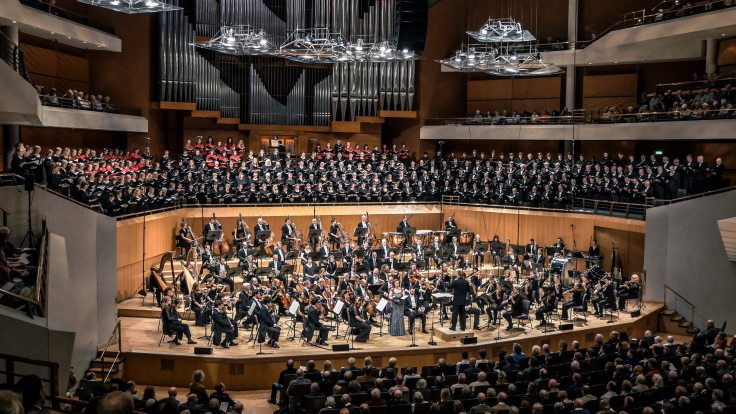
Within this blog I am planning to offer a number of perspectives on the Hallé Choir, a choir I am proud to have been a member of for the last twelve years. I’m not going to write a formal linear history of the choir, but will rather look at different aspects of the choir over the years, its relationships with particular composers and works, with its conductors and choirmasters, and with significant external events such as the two great world wars of the 20th century. Though it will flit backwards and forwards through time there was only one place to start, and that was at the beginning. Within this first of two posts chronicling the genesis of the choir, I will look at how the choir became the almost inevitable product of several centuries of choral development in Europe and Britain, and how an ambitious German immigrant harnessed the spirit of the age to create not one but two great Manchester institutions, the Hallé Orchestra and the Hallé Choir. The second post will chronicle the early years of the institutions, the development of the choral repertoire, and the conflict between an amateur and a professional ethos that marked the early years of the choir.
From private to public – the expansion of the chorus
What becomes obvious when studying the history of western music is that the emergence of a choir such as the Hallé Choir in the 19th century was part of a natural progression, of an opening out of the choral idea in terms of the number of singers, the type of singers, the accompaniment given to said singers, and the breadth and depth of the musical ideas they were performing.
Andrew Parrott provides us with an evolutionary timeline in his fascinating run-through the development of choral music between the 15th and late 18th century in the Cambridge Companion to Choral Music. For much of that period, as he states it, choral music was very much the private domain of the Church, such that a choir could be described as “an organized body of singers performing or leading in the musical parts of a church service”. In the 15th century such choirs would be made up of small numbers of adult male clerical singers such as those depicted in Jacob Van Eyck’s famous Ghent Altarpiece.
The primary means of expression at this time would have been solo or unison chant but over time choirs began improvising polyphonic ideas over the chant, often in intricate counterpoint. These polyphonic ideas began to be formalised in the music of composers such as Dufay in the second half of the 15th century, who started composing polyphony and incorporating boy singers alongside the men. Parrott describes how in his will Dufay asked that a chant hymn be sung by eight men of Cambrai Cathedral, but that it be followed by his composition Ave Regina Coelorum, sung by “altar boys, together with their master and two companions.”
Instruments began to be incorporated into the choral sound, beginning in the 1400s with the church organ. Slowly but surely other instruments began to be used. Parrott quotes a report of a mass being sung in 1500 “with the help of the organ, three trombones and a cornett, [and] likewise four crumhorns with the positif,” and by the end of the 16th century there is evidence that Masses were being sung in Rome accompanied by instruments such as cornetts, trombones, violins and lutes. This was around the time that Giovanni Gabrieli was writing increasingly complex double-choir settings for St. Mark’s in Venice with specific instrumental requirements and specific instructions as to how the choirs and instruments should be placed to create the maximum choral effect. On the other side of post-Reformation religious divide Lutheran composers were also expanding ideas of instrumental accompaniment, such that eventually instruments might outnumber voices by a considerable margin.
Choirs at this time were still largely all male, a mixture of men and boys, but through the 17th century dissatisfaction was frequently expressed with boy singers both in terms of the quality of their voices and the fact that their vocal instrument was so short-lived. The fact that many all-female convents, like the Ospedale della Pietà in Venice for which Vivaldi wrote so extensively, maintained high standards of polyphonic music that led many, such as a visitor to Venice in 1649 to wish “that the sound of such music might spread to the electoral court chapel in Dresden.”
Questions began to be asked as to whether female singers could be used in a church context, and particularly in the German states, and changes began to be made. By 1717 a ten-person church ensemble in Württemberg was reported as including four soprano voices, and female singers were also documented in the first half of the 18th century in Würzburg, Stuttgart and Cologne.
Choral music at this time was still largely the domain of the Church, however. If we now turn our attention specifically to Britain, the innovative ideas of one particular composer, George Friedrich Handel, helped to take choral music out of the church and into the concert hall. Handel had settled in London in 1712 and began a career combining the writing of music for the Hanoverian court with satisfying the appetite of the London theatre audience for Italian operas. After writing his last opera in 1737 he changed direction completely and began writing a series of sacred oratorios designed to be performed not in church but in the concert hall, essentially as sacred dramas. The most famous of these was, of course, Messiah, first performed in Dublin in 1742. This achieved instant fame and has been an integral part of British choral life (and of the life of the Hallé Choir) ever since.
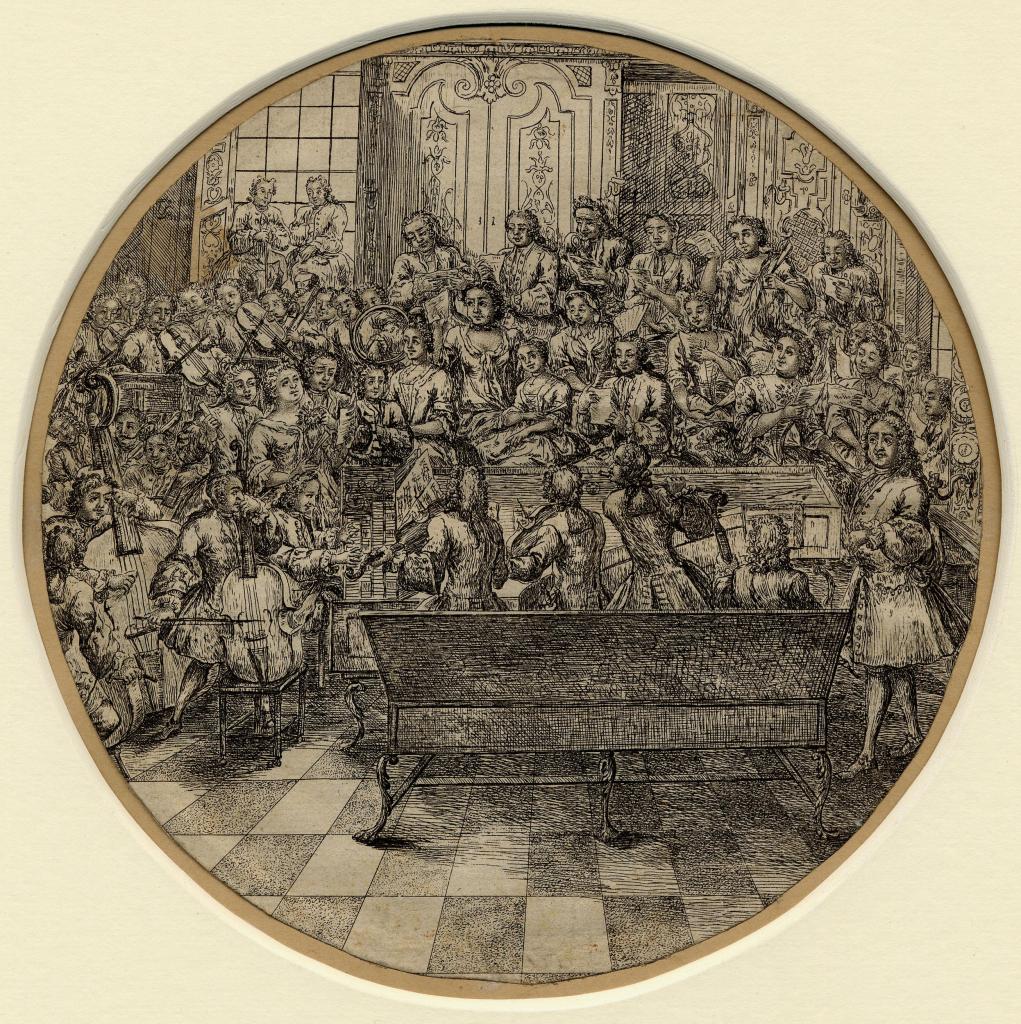
Whilst the choir itself remained largely male, Handel employed female singers experienced in his Italian operas to sing the solo parts, most notably in the first performance of Messiah, Susanna Cibber, an experienced stage actress and singer whose presence singing sacred texts caused unease with many (though having heard her sing a Dublin clergyman was heard to shout “Woman, for this be all thy sins forgiven thee”). Importantly, these oratorio performances were also commercial exercises performed to a paying audience – the first performance of Messiah, set up as a charity performance, made £400 for its designated charities.
In Handel’s lifetime, performances of his oratorios still used relatively limited resources, hence the fashion within present-day period instrument groups for pared-down performances of these works. Handel set up a series of charity performances of Messiah in aid of the Foundling Hospital in the 1750s and records of these performances show generally 5 or 6 soloists, 4 to 6 boys and 11 to 13 adult male singers, along with an orchestra combining 33 to 38 instruments, plus continuo. However, after his death in 1759, whilst the size of the orchestra remained much the same, from 1770 onwards the numbers of singers began to rise, with the number of boys rising to 12 and the size of the rest of the chorus increasing to 26 or more. As important as this development was the status of the chorus. Up until this period choral singers had largely either been clerics, or in later times professionally engaged – the concept of an amateur chorus did not exist. However, there is evidence that the chorus in these charity performances of Messiah was increasingly largely unpaid. This distinction between professional and amateur was to have great significance in the early years of the Hallé Choir.
This growth in the size of choirs is evidenced by the ‘Commemoration of Handel’ that was put on in Westminster Abbey in 1784, for which a choir of 250 was engaged. Though only 6 of these singers were female, the idea of the large secular mixed-voice chorus (albeit one largely singing sacred texts) was beginning to emerge.
Beethoven and beyond – the symphonic chorus
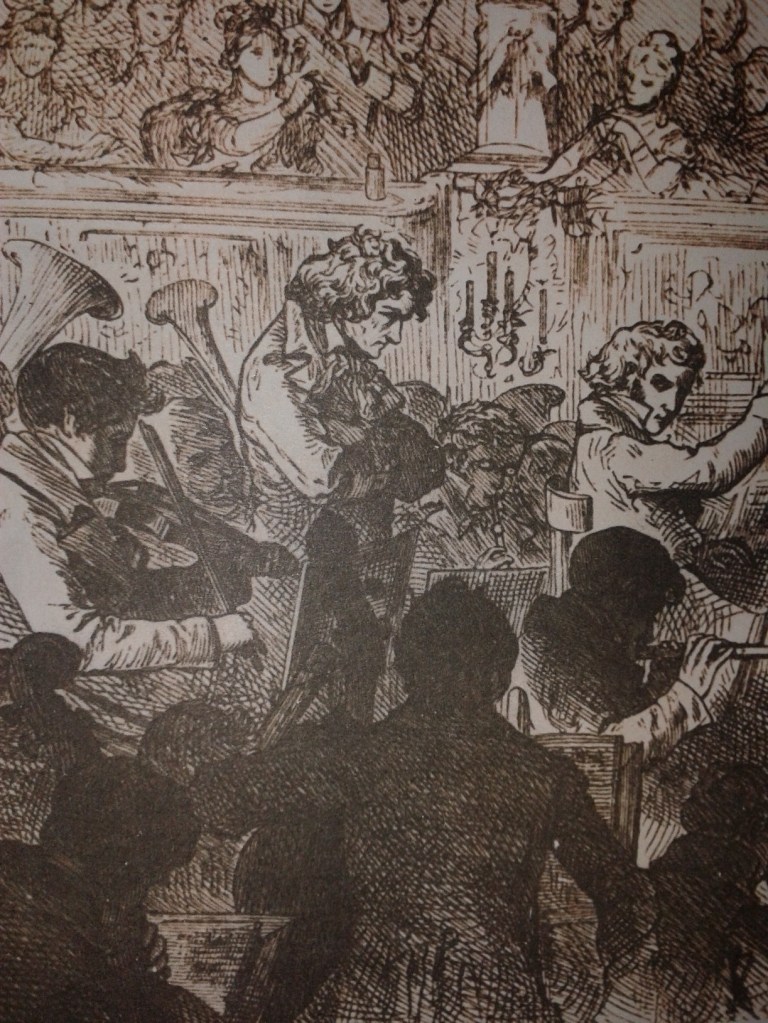
Entering the 19th century, ever closer to 1858, the idea of the chorus exploded in two ways. I will talk later about the growth in the actual numbers of choirs and the democratisation of their membership, but firstly I will discuss the way in which the choral repertoire grew in ways that brought us close what we consider as standard choral fare today. Composers such as Handel had brought the choir out of the church and into the concert hall, even if the repertoire still consisted of a sacred mix of Masses, Passions and Oratorios.
However, as classical composers such as Mozart and Haydn developed the still relatively new idea of the orchestral ‘symphony’, and as this symphonic concept was developed in radically new ways by Beethoven it was maybe inevitable that the idea of incorporating voices would emerge. It blazed into life in 1824 with Beethoven’s monumental 9th Symphony, the ‘Choral’. Here was chorus as drama, as spectacle, completely divorced from the ecclesiastical setting out of which it had grown. D. Kern Holoman describes the dramatic effect of this new idea of the symphonic chorus very effectively: “…the spectacle of a sea of singers rising architecturally and symbolically over the seated players, and the anticipation of what they might have to say, stirred the souls of many a concert-goer in the Age of Industry.”
The Ninth Symphony found an immediate place in the repertoire of the symphony orchestras of the new Romantic era, with, for example, a performance by the London Philharmonic Society following within the year. Over time, other composers added their contributions to the ‘symphony-with-chorus’ repertoire, many only tangentially connected with the sacred ideas that had driven choral music through the centuries. Berlioz was particularly active in this arena with his Roméo et Juliette of 1839, ostensibly a symphony, but a work that also, as Berlioz himself noted, “falls into the domain of opera or oratorio” He followed this in 1846 with more of the same with La Damnation de Faust, full-blown Romantic music requiring a big orchestra and a big symphonic chorus, as did Mendelssohn’s 2nd (choral) symphony Lobgesang in 1840.
The sacred oratorio did not go away, however, and Mendelssohn was instrumental in adding to the repertoire, first with his St Paul of 1836 and later with Elijah in 1846, a work still firmly in the present-day choral repertoire and one which crucially was commissioned in England by the Birmingham Festival, crucially because if fed an appetite for oratorio that was specifically British. Handel had remained pre-eminent in Britain in terms of oratorio, in particular with regard to Messiah, which was instrumental both in feeding the growth in choral activity in Britain in the late 18th and early 19th centuries, and also played a part, as Fiona Palmer says, in “shaping a sense of national belonging and identity.” She quotes Charles Dibdin observing when touring the north of England in 1788 that “children lisp ‘For unto us a child is born’ and cloth makers, as they swear under their loads in the cloth-hall, roar out ‘For his yoke is easy and his burden is light’.”
Let the people sing – Choral Festivals and Choral Societies
This brings me to the second explosion, the exponential growth in the sheer number of choirs that occurred in Britain in the first half of the 19th century, as building on the performance of Handel’s Messiah in 1784, the appetite grew, in Palmer’s words, “for momentous performances of oratorio with highly-populated choruses.”
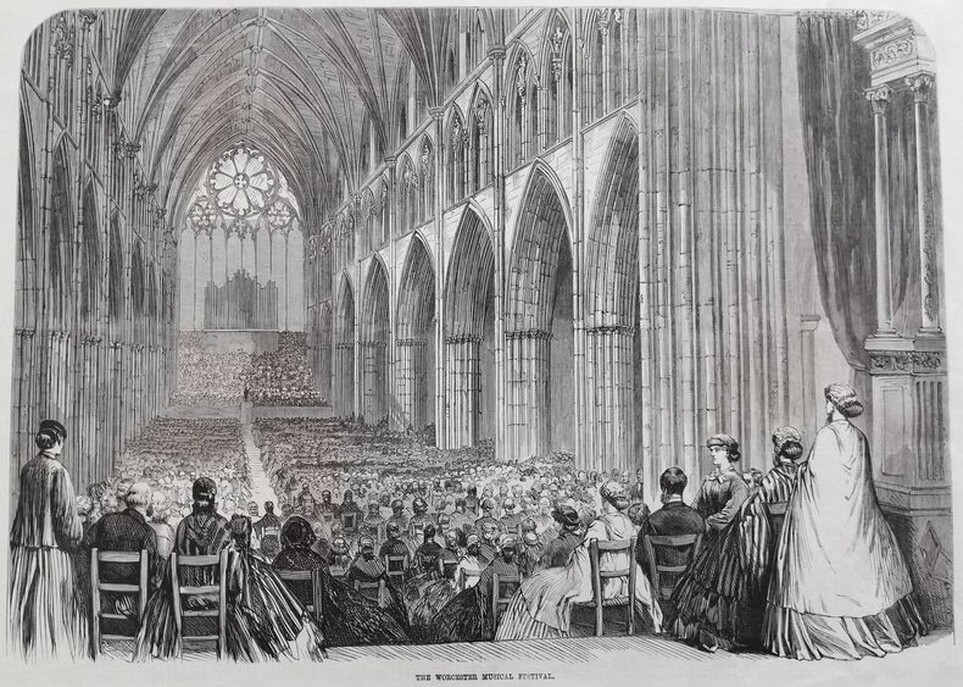
Partly this expressed itself in the growth of festivals. The earliest of these was the Three Choirs Festival, established in 1754 to showcase the singing both of the cathedral choirs of Gloucester, Hereford and Worcester, and of members of amateur music clubs in those towns.
Many more such festivals appeared in the early 19th century, From the 1820s onwards, there were festivals in Birmingham, Derby, Hull, Manchester, Norwich, and York, and Messiah was a staple of these festivals. Liverpool had music festivals from the 1790s to the 1830s, culminating in the first English performance of Mendelssohn’s St Paul in 1836. A festival in 1834 in Westminster Abbey included 644 performers, drawn from cathedral and other choirs across the country.
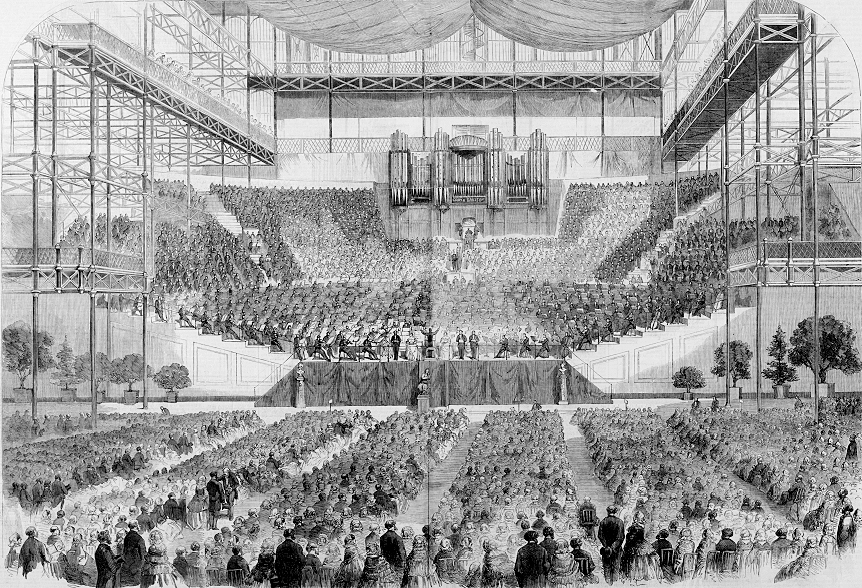
Such festivals grew ever more spectacular. A three-day festival in London in 1857, incorporating performances of Handel’s Messiah, Judas Maccabeus and Israel in Egypt, drew an audience of 48,474.
Howard Smither makes the point that such performances helped democratise choral music, changing it from the domain of a social and musical élite to an activity that could be enjoyed by all, from the highest to the lowest, a process that was accelerated by improvements in education and working conditions during the early Victorian era. To this Palmer adds the impact of increased free time and better wage packets, and Judith Blezzard, writing about the growth in choral singing in the West Riding, adds improved transport, allowing easier access to rehearsals, and availability of cheap printed music. She also cites the rise of Nonconformism and of the Sunday School and Temperance movements, all of which actively encouraged women to sing in choirs.
What was also important in fostering the growth in choirs was what Smither calls a “mania” for sight-singing that developed after 1841, in which year Joseph Mainzer and John Hullah first gave sight-singing classes in London, and John Curwen started developed the ‘Tonic Sol-fa’ method. Through the influence of these teachers singing classes began to be established all over Britain, aimed specifically at the middle and lower classes.
Ultimately, the singers who had found a fruitful outlet in the great singing festivals wanted something week on week. Sometimes the festival choruses established themselves on a more permanent basis, as happened in Birmingham and Bradford, but more often brand-new choral societies began to emerge providing opportunities to all to indulge their passion for choral singing all year round. The growth was so fast that Dave Russell has shown that by the middle of the 19th century, there was a choral society in all English towns with a population of 20,000 or more. The honour of being the first such choral society falls to the Halifax Choral Society, founded by William Priestley in 1817, which held its first concert in 1818, a performance of Haydn’s oratorio Creation, along with Messiah and Elijah a staple work to this day.
New halls were built in Northern cities that as well expressing their new-found Victorian civic pride, provided venues in which these new choirs could perform. In Bradford, the opening of St George’s Hall in 1853 was celebrated with a choral festival during which works by Mendelssohn (Credo and St Paul), Handel (Messiah and Israel in Egypt), Haydn (Creation) and Beethoven (The Mount of Olives) were performed. Five years later Leeds Town Hall was opened with a performance of a newly commissioned choral cantata by William Sterndale Bennett, The May Queen.
Manchester sings
Manchester had its own grand civic gesture with a musical connection, with the 1856 opening of Manchester’s Free Trade Hall. It was, as we shall see, to play a very important role in the story of the Hallé Choir, but how did Manchester get to this point in its musical and choral development?
Manchester was growing at an exponential rate in the first half of the 19th century, its population growing from 76,000 to over 315,000 between 1801 and 1851. As it discovered and developed its civic identity during this time, its cultural needs were not forgotten. The Manchester Literary and Philosophical Society had been founded back in 1781, and its members during this time included Samuel Greg, the founder of Quarry Bank Mill and William Gaskell, Unitarian minister and husband of the novelist Elizabeth Gaskell who chronicled the life of industrial Manchester in her novels Mary Barton and North and South. Many of its members were also members of the Portico Library, founded at the beginning of the 19th century to foster an interest in the literature of the age. Manchester Art Gallery opened in 1823 and soon gathered an impressive collection of Victorian art, particularly that of the Pre-Raphaelites.
Music was not forgotten, and especially not choral music. There is evidence of organised musical activity in Manchester going back into the 18th century, particularly the establishment in 1770 of the ‘Gentlemen’s Concerts’, according to Michael Kennedy by “25 amateur flautists in a large room in a Market Street tavern.” The orchestra that grew out of this was a mixture of amateur and professional musicians which in course of time gave 12 public subscription concerts a year, attracting by 1844 a subscription list of 600 individuals (with a waiting list of four years!). Operating from a concert hall in Peter Street their repertoire covered music of the previous century – Haydn, Mozart, Beethoven and Handel – and as time passed the proportion of professional musicians in the orchestra increased.
As the Gentlemen’s Concerts developed, a choir was often engaged to offer up choral items. Early on a concert in 1798 included excerpts from Handel’s Saul, Samson, Deborah, Judas Maccabeus and Joseph, and a concert in 1803 included parts of Haydn’s then almost new Creation.
Whilst the growth of amateur choral societies continued apace in Manchester as elsewhere in the North, this idea of a professional orchestra and chorus getting together to perform pointed directly to the future development of the Hallé Choir, as did the formation in 1841, following a bequest from deceased tax inspector Hamer Hargreaves, of the Hargreaves Choral Society. Hargreaves’ will asked for the establishment of a choral society in Manchester, “for the purpose of Practicing Sacred Music with an Instrumental Band, having one leader and one conductor, professionally engaged”, though the minute books of the society show that the members of the orchestra and the chorus were in fact all paid. The orchestra was drawn from, amongst others, the Gentlemen’s Concerts, and the chorus from the variety of choirs, madrigal societies and glee clubs that had sprung up throughout Manchester.
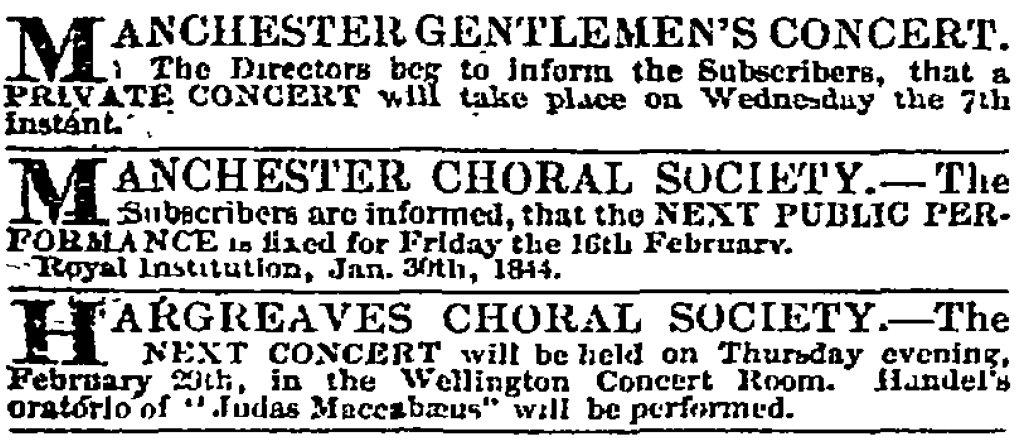
Their concerts were well received and well attended. The Manchester Guardian praised a performance of Judas Maccabeus in 1844 as a performance “in a style of completeness and with a degree of excellence worthy of the society, and hitherto unapproached, we fancy, in any provincial town, except (very rarely) at the festivals.” In 1847 the choir was sufficiently well-established to invite Mendelssohn to conduct it in Elijah, a work he had premiered in Birmingham only the year before.
The repertoire of the Hargreaves choir included all the major oratorios by Handel, Haydn and Mendelssohn, along with mass settings by the likes of Haydn, Mozart and Beethoven, and other sacred works such as Handel’s Dettingen Te Deum, and Rossini’s Stabat Mater. Also featured in their miscellaneous sacred concerts were less well-known pieces by composers such as Romberg, Palestrina, Spohr and Cherubini, and in their secular concerts they covered selections from operas by the likes of Rossini, Handel, Mozart and Beethoven, along with glees, madrigals and English operas from composers like Michael Balfe. Interestingly, in an indication of how the makeup of choruses was still evolving from the all-male choirs of previous centuries, whilst the Sopranos in a choir such as the Hargreaves were all female, the Altos were all male.
A drop in income in the late 1840s due to reduced subscriptions and dissatisfaction with the repertoire meant that the Hargreaves Choral Society was short-lived, and by the end of the decade the choir had folded, though not without leaving a legacy that could be built on by future entrepreneurs. This is where we must bring Charles Hallé into the story
Enter Charles Hallé
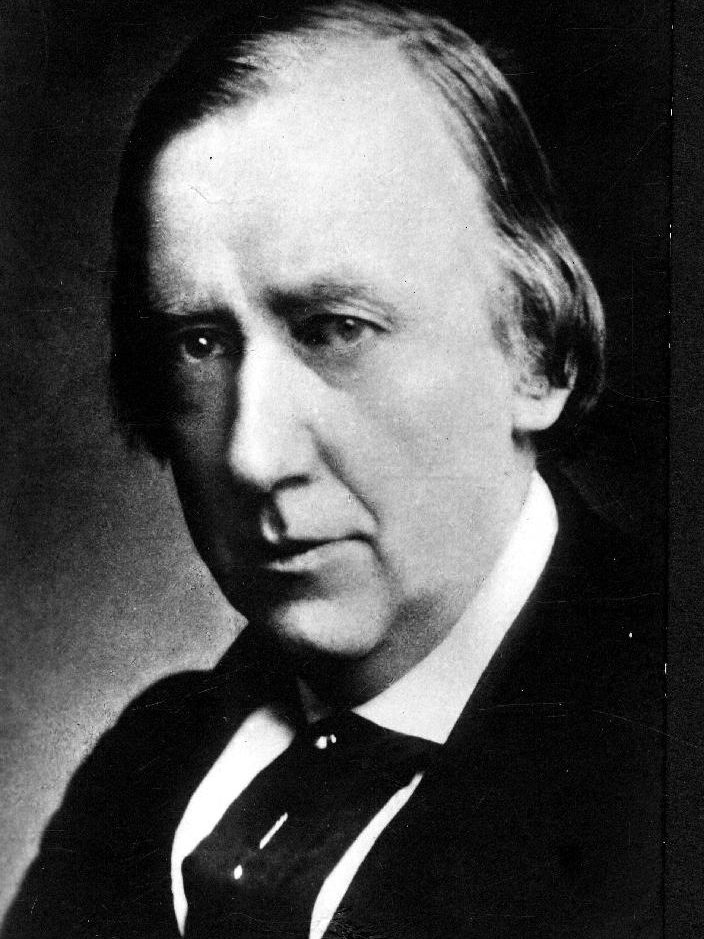
Karl Halle was born in Westphalia in 1819, and from childhood gained fame as a virtuoso pianist (his first public performance was at the age of 4!). At the age of 17 he moved to Paris where he collaborated with composers such as Cherubini, Chopin and Liszt. His talent for the promotion of music-making that brought him so much fame later in life was first evidenced here as he started a series of chamber concerts. However, the revolutionary events of 1848 led him to seek pastures new and he moved with his family across the English Channel to London, where he soon changed his name to Charles Hallé, the acute accent being added ostensibly to ensure the correct pronunciation of his surname.
He had visited England on many occasions before and achieved a degree of fame, helped no doubt by his playing in front of Queen Victoria and Prince Albert when they visited France in 1843, and he was soon receiving invitations to play in prestigious concert halls. He played Beethoven’s 5th Piano Concerto at Covent Garden, and soon after began playing for the Musical Union, a prestigious chamber music concert series. In his autobiography he also describes meetings at literary salons with the likes of Browning, Thackeray, Dickens, Leighton, Watts and Wilkie Collins.
However, as the 1848 London musical season ended, and with money a problem for this forced emigré, he took the advice of the brother of one of his Parisian friends, a Mr Leo, to set his sights further north, to Manchester. In Hallé’s words, Leo proposed “that I should take up my residence in Manchester”, assuring him “on behalf of many devoted lovers of music, that Manchester was quite ripe to be taken in hand, and that they thought me the fittest man to stir the dormant taste for the art.” He decided to “give it a trial.”
He was well received in Manchester, as he had been in London, especially amongst the German community who were an important element of Manchester life at the time (for example, Friedrich Engels spent some of the 1840s working at his family’s mill in Salford, and his observations of Manchester life at the time informed his book The Condition of the Working Class in England, first published in 1845).
Hallé took a number of pupils to help make ends meet and came into contact with the Gentlemen’s Concerts, soon being engaged to play the same Beethoven concerto he had performed in London. His passion for musical promotion soon manifested itself, and over the winter of 1848/49 he organised a series of six subscription chamber concerts. Subscribers were slow in coming forward. He sold only three single tickets for the first concert, but by the end of the series that number had risen for 67. He was not downhearted and displayed the resilience that stood him in good stead a decade later.
And indeed, at the end of 1849 he was offered the conductorship of the Gentlemen’s Concerts, and accepted on condition that “the band should be dismissed and its reorganisation left entirely in my hands,” and soon set to finding the best musicians in the area and persuading “first-rate instrumentalists” to come up from London. The following year, having “come across so many amateurs with fair voices and an ear for music”, he founded the St. Cecilia Society, which consisted of “ladies and gentlemen of the best society, a first about fifty in number.” These would be the singers that would bolster his Gentlemen’s Concerts band when choral forces were required. At first he directed the choir, but as the decade progressed and his commitments increased he engaged his friend, the young Bavarian Edward Hecht, to be his chorus-master, a role he continued to fulfil for Hallé as his chorus developed, until his death in 1887.
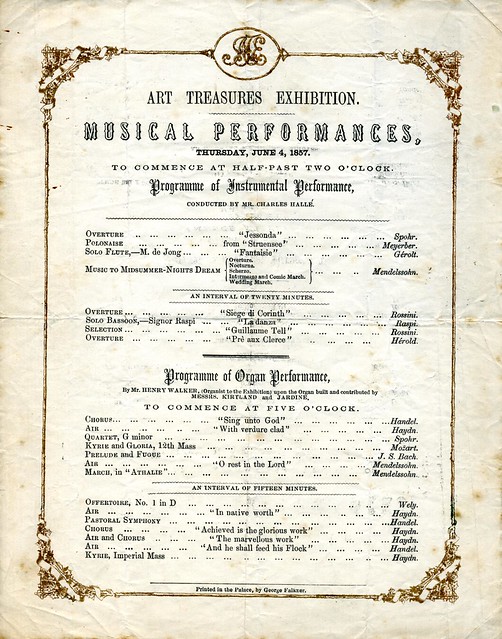
As the decade progressed, Hallé combined all of these commitments with a full recital schedule, until a major event in 1857 presaged what was to follow. This year Manchester was host to the ‘Art Treasures Exhibition’, held in a vast exhibition hall in Old Trafford from May to October. It was the biggest public art exhibition ever held in Britain, before or since, comprising around 16,000 works of art, and it attracted well over a million visitors. Hallé was engaged to organise and conduct a series of concerts that would run alongside it.
He saw this as an opportunity to improve on the standards of musicianship then present in his Gentlemen’s Concerts band and set about engaging the best players he could to play in the musical performances, from, in Hallé’s words, “London, Paris, Germany, Holland, Belgium, and Italy, in addition to the best of our local players.”
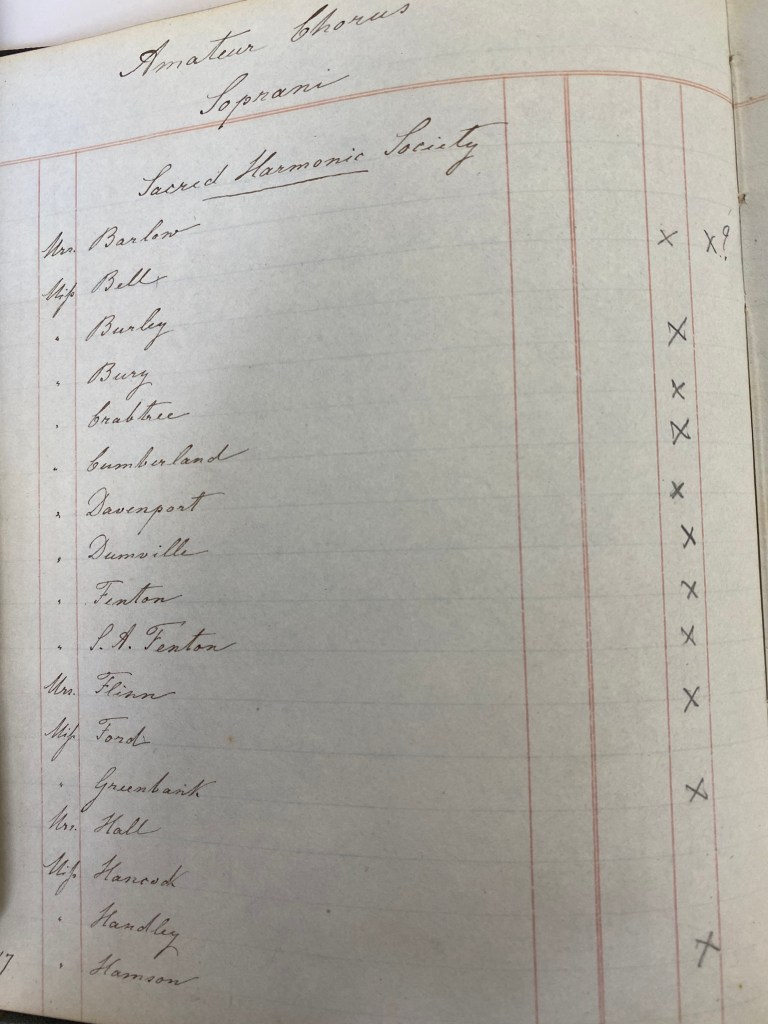
The Manchester Examiner, previewing the concerts, stated that Hallé would also be engaging a “chorus of 500”, and one of Hallé’s own notebooks, now held in the Henry Watson Music Library, contains lists of singers, sadly neither dated nor contextualised, that could well constitute the choir engaged for occasion. 493 names are listed, by part and by the choral society or church choir from which they were obtained, such as the Sacred Harmonic Society, Bolton Choral Society, Red Hall Chapel Choir from Audenshaw and Hyde Choral Society.
Two things are worthy of note in these lists. Firstly, the singers are described as a completely amateur choir, like the present day Hallé Choir but unlike the choirs Hallé would engage in the aftermath of the exhibition, as will be seen in the next post. Secondly, though the sopranos listed are female, with just a sprinkling of boy trebles from church choirs, the singers in the alto section are overwhelmingly men, as we saw earlier with the Hargreaves Choral Society.
The choir sang at many of the regular concerts at the exhibition, conducted by Hallé, including the opening concert which included ‘The Heavens are Telling’ from Creation, the ‘Hallelujah Chorus’ from Messiah, and a setting of the ‘Old Hundredth’ psalm. When Queen Victoria visited in June, there was more from Creation, the ‘Hallelujah Chorus’, and part of Mendelssohn’s Hymn of Praise.
Mr Hallé’s Grand Orchestral Concerts
The public response to Hallé’s concerts at the exhibition was extremely positive. Hallé himself wrote: “Thousands and thousands of people from the northern counties there heard a symphony for the first time, and it was interesting to watch how the appreciation of such works grew keener and keener almost with every week.” When the exhibition closed, he found it “excessively painful” to have to disband the orchestra he had assembled, and an idea formed in his mind to continue the concerts on a regular weekly basis during autumn and winter at his “own risk and peril” and trust to the “now awakened taste for music for success and perhaps remuneration.” By the beginning of 1858 he was ready to begin the first season of concerts. Importantly these were not to be subscription concerts, as had been the norm up to that time. He saw them in Kennedy’s words as being “music for the general public, through a deliberate policy of cheap seats, rather than for a private society of subscribers drawn from one class.”
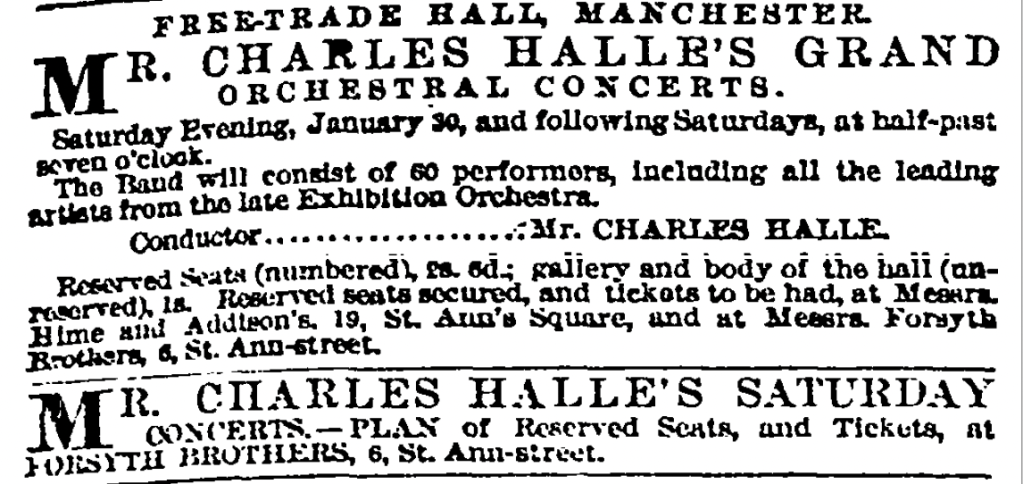
This would be the first time he had run an orchestra under his own auspices, and therefore the concert he gave at the Free Trade Hall on January 30th, 1858, is counted as the first performance by what we now call the Hallé Orchestra. Back then the orchestra didn’t have a specific name. The concert was promoted simply as the first of ‘Mr Hallé’s Grand Orchestral Concerts’, with a band of 60 performers, “including all the leading artists from the late Exhibition Orchestra”, conducted by Hallé. Despite being headed by a performance of Beethoven’s 1st Symphony, the concert was not a success. Hallé described it as being “vehemently applauded by the meagre audience,” and it made a loss, as did many of the subsequent concerts until gradually audiences began to pick up until the first season ended with full houses. At the end of the season Hallé made an overall profit of two shillings and sixpence, paid to him by his managers Forsyth Brothers in the form of “ten brand-new threepenny bits.”
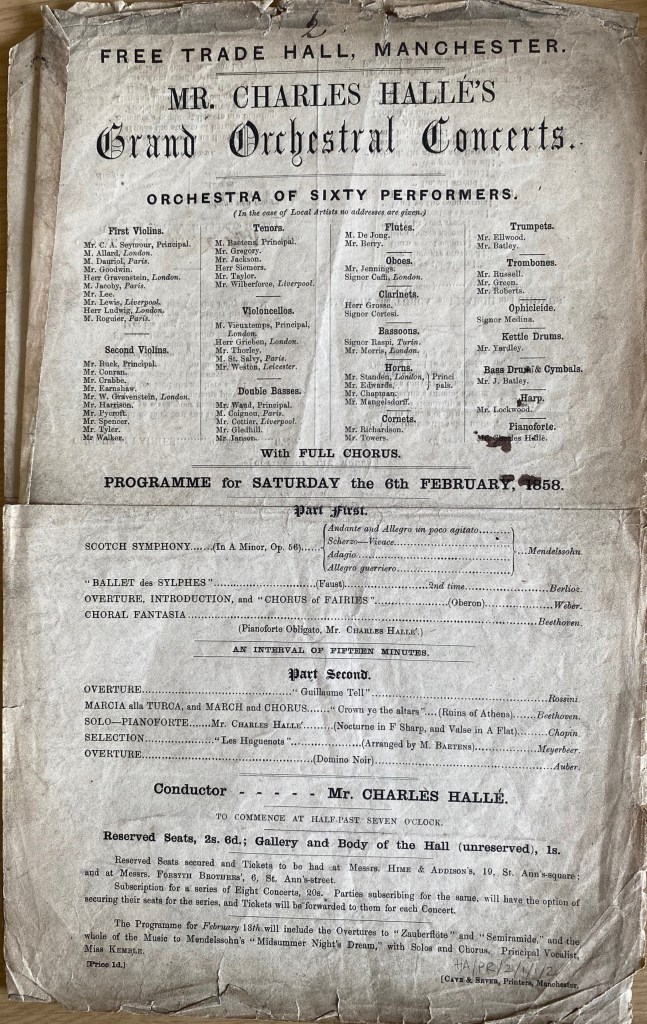
In terms of our story the most important concert of the season was the second of the series and especially the performance of Beethoven’s Choral Fantasia, the first time a choir sang with the orchestra that became the Hallé, and therefore to all intents and purposes the first concert by the Hallé Choir. Not that it would have thought of itself as the Hallé Choir at that time, of course, or even as an organised choir at all. Unfortunately unlike the orchestra whose names are all printed in the programme, no records exist of the actual makeup of the choir. Michael Kennedy states that Hallé used singers from the pre-existing Manchester Choral Society, not to be confused with the Manchester Choral Society he himself founded later that season, but Robert Beale thinks that Hallé was possibly also using singers from the St Cecilia Society, the Liedertafel (a choir formed by the Manchester German community), and the choir of the Gentlemen’s Society. As such the choir would have been a mixture of professional and amateur singers from a number of different choirs, effectively what we might call today a pick-up choir.
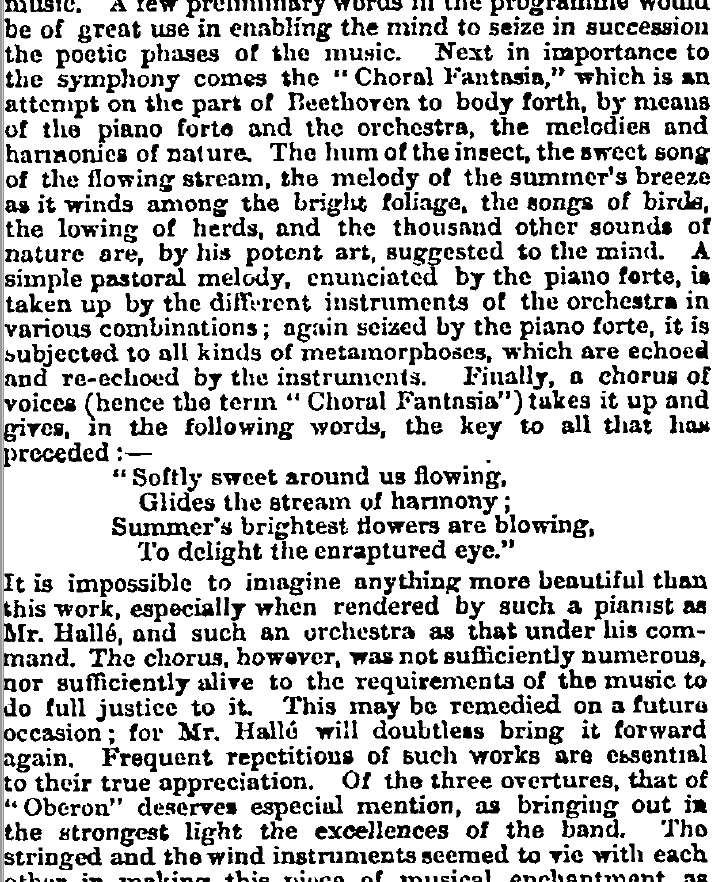
It would be nice to report that the performance of the choir received universal praise, but sadly that was not so. The reviewer in the Manchester Guardian praised the work, saying that “it is impossible to imagine anything more beautiful than this work.” However, he saw the chorus as being “not sufficiently numerous, nor sufficiently alive to the requirements of the music to do full justice to it.”
It appears that the quality of the choir did not match the quality of the orchestra in the opinion of many attendees. A letter published in the Guardian three days after this review is worth quoting in full, as it both sums up the situation and hints at a solution to the problem.
‘Sir, – Having been present, on Saturday evening last, at Mr. Hallé’s concert, I may be allowed to express my thanks to that gentleman for the very excellent musical treat he has provided for the residents of this city and the neighbourhood. What I would now beg to suggest is, that Mr. Hallé should, if possible, endeavour to organise a vocal corps qualified to support the high class of instrumentalists who compose his admirable orchestra. London can boast of its Benedict’s Vocal Union, Henry Leslie’s Choir, and many other similar societies; while here we have no regular body of choristers who can be taken collectively with any degree of certainty. Let Mr. Hallé only advertise for a select choir, and if he will spare the pains to give the applicants a hearing in private, a first-class body of vocalists can be secured worthy of his great name. For myself, no one would rejoice more to hear of a “Hallé’s Vocal Union,” and thus break down the fearful system of monopoly which has for a long time existed here in reference to choral singers, – a system which is mainly carried on by a species of “beer-barrel” bribery; the selection of voices being usually left to one of their own body, who is of too amiable a disposition to refuse a favour to a friend – I am, sir, yours respectfully, AMATEUR’.
Letter to Manchester Guardian – February 11th, 1858 (Guardian Archives)
As we shall see in the next post, this is largely the course of action that Hallé took, such that even by the end of this first season the reviews of the choir took on a much more rosy hue.
Sources
Beale, Robert, Charles Hallé: A Musical Life (Aldershot: Ashgate, 2008).
Blezzard, Judith, ‘Choral Music – Introduction’, in Music Making in the West Riding of Yorkshire, ed. by Adrian Smith (Huddersfield: R.H. Wood, 2000).
Guardian Archives, provided by Manchester Library and Information Services
Hallé Archives, Bridgewater Hall, Manchester
Hallé, Charles, Life and Letters of Sir Charles Halle (London: Smith, Elder & Co, 1896).
Johnson, Rachel M., ‘Musical networks in early Victorian Manchester’ (Thesis (Ph.D.), Manchester Metropolitan University, 2020) <http://e-space.mmu.ac.uk/627596/>.
Kennedy, Michael, The Hallé Tradition: A Century of Music (Manchester: Manchester University Press, 1960).
Kern Holoman, D., ‘Vox Humana: Choral Voices in the Nineteenth-Century Symphony’, in Nineteenth-Century Choral Music, ed. by Donna Marie Di Grazia (New York ; London: Routledge, 2013).
Manchester City Archives and Henry Watson Music Library, provided by Manchester Library and Information Services
Palmer, Fiona M., ‘The Large-Scale Oratorio Chorus in Nineteenth-Century England: Choral Power and the Role of Handel’s Messiah’, in Choral Societies and Nationalism in Europe, ed. by Krisztina Lajosi and Andreas Stynen (Leiden; Boston: Brill, 2018).
Parrott, Andrew, ‘A brief anatomy of choirs c.1470-1770’, in The Cambridge Companion to Choral Music, ed. by Andre De Quadros (Cambridge: Cambridge University Press, 2012).
Rees, C.B., One Hundred Years of the Hallé (London: MacGibbon & Kee, 1957).
Russell, Dave, Popular Music in England, 1840-1914 : A Social History (Manchester: Manchester University Press, 1997).
Smither, Howard E., ‘Messiah and Progress in Victorian England’, Early Music, 13 (1985), pp. 339-48.


 Home
Home 
Leave a reply to Hallé Choir Knights Part 2 – Bliss, Willcocks, Groves, Boult and Davis – The Hallé Choir History Blog Cancel reply