Introduction
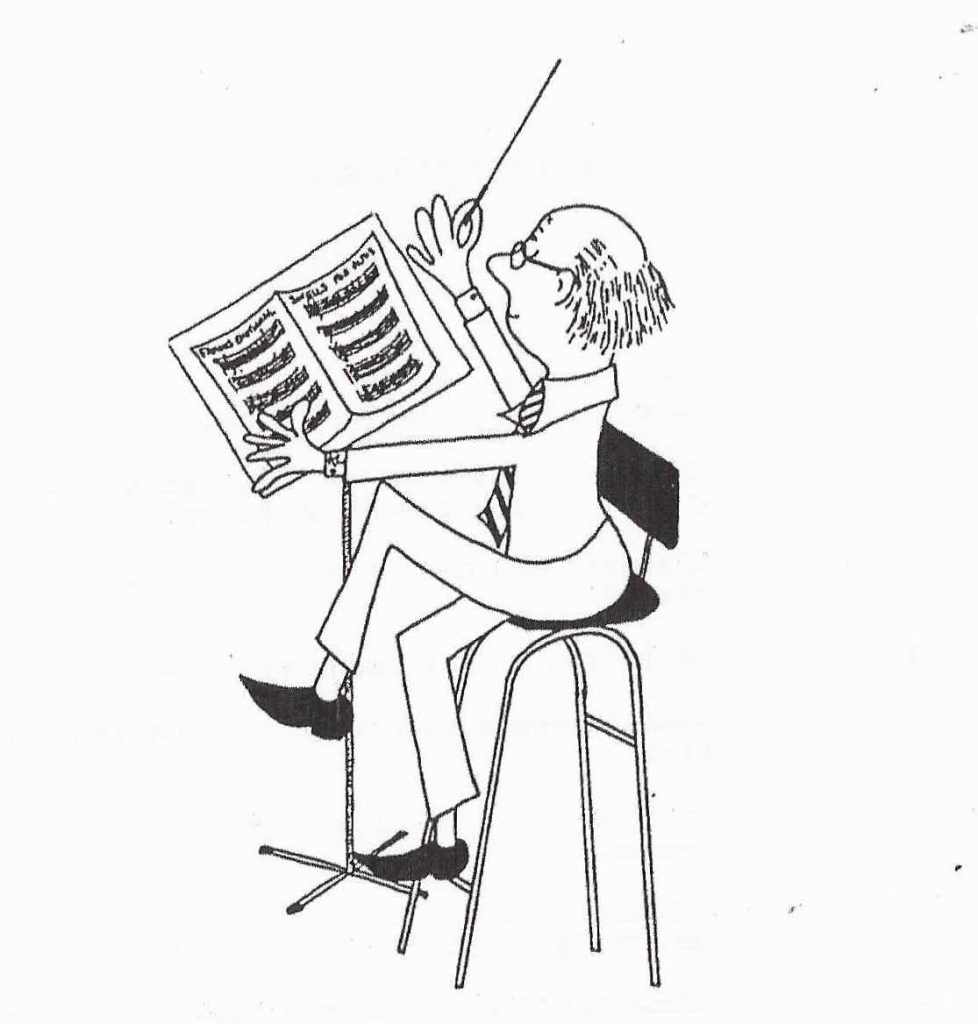
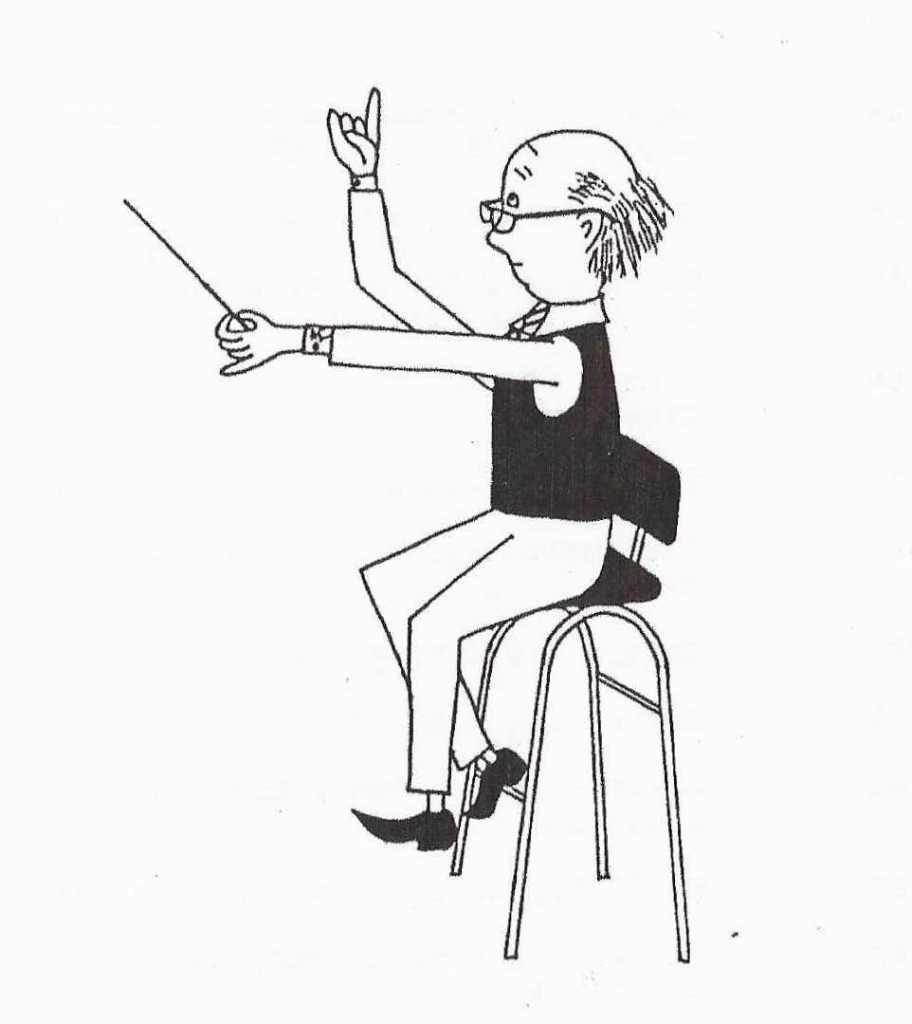
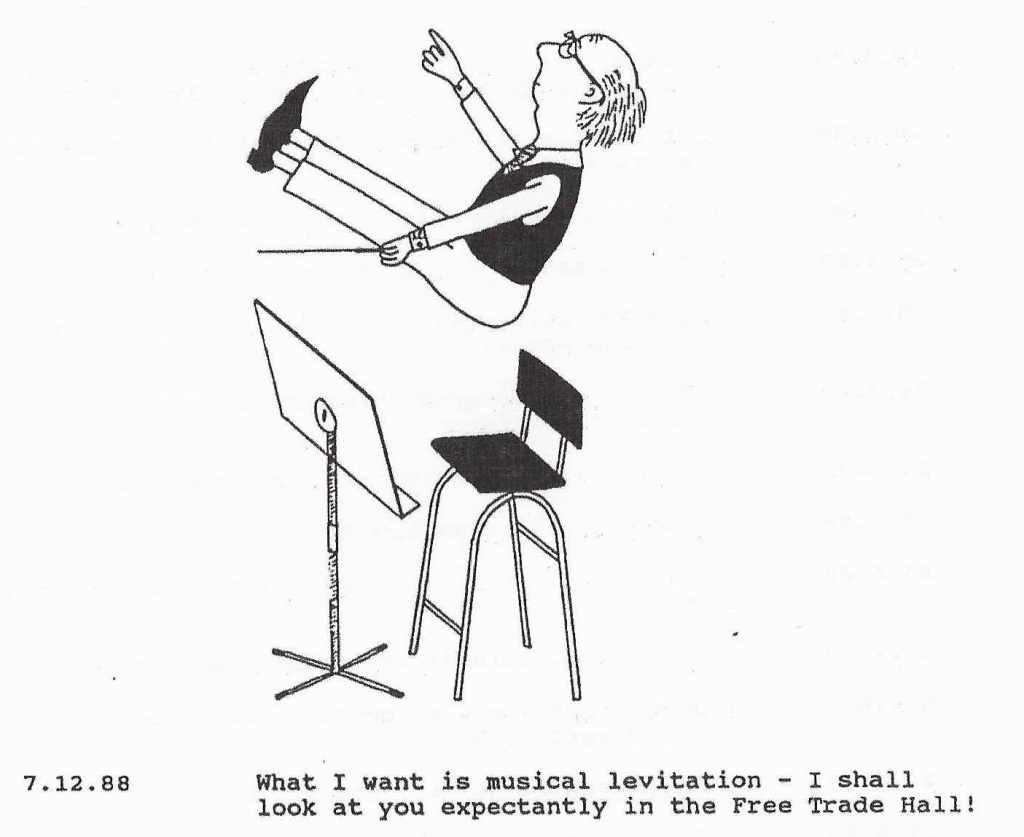
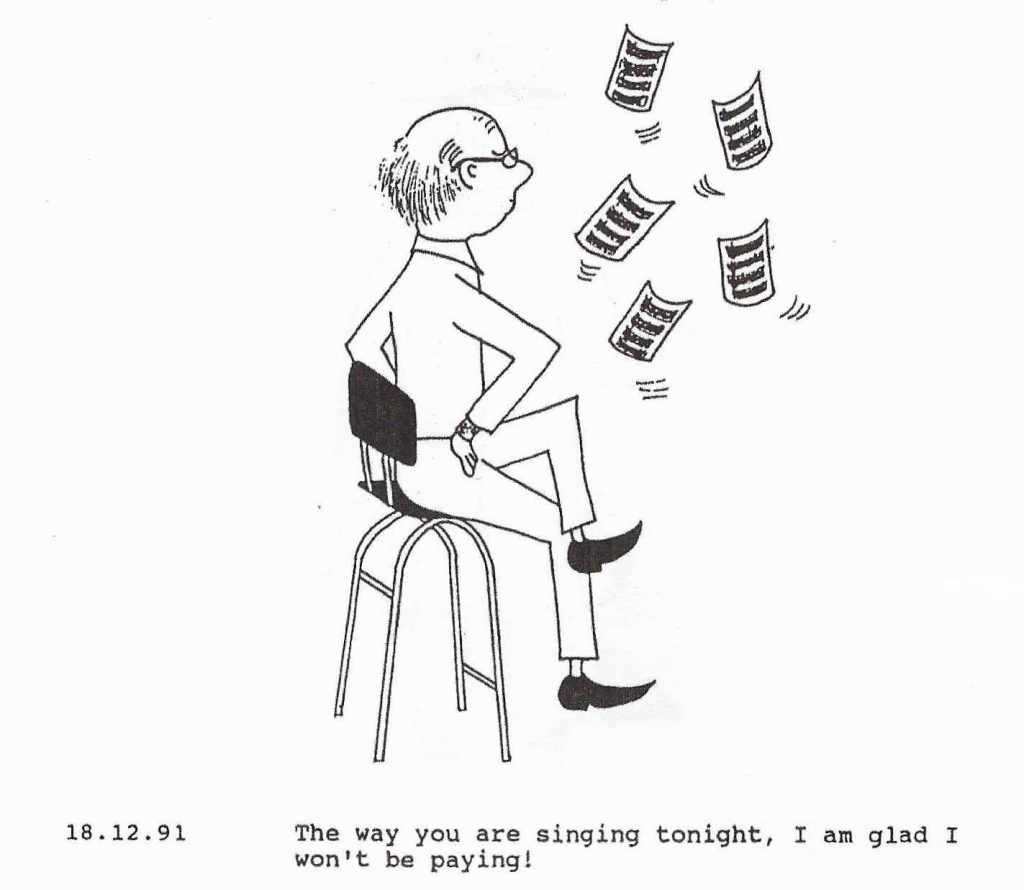
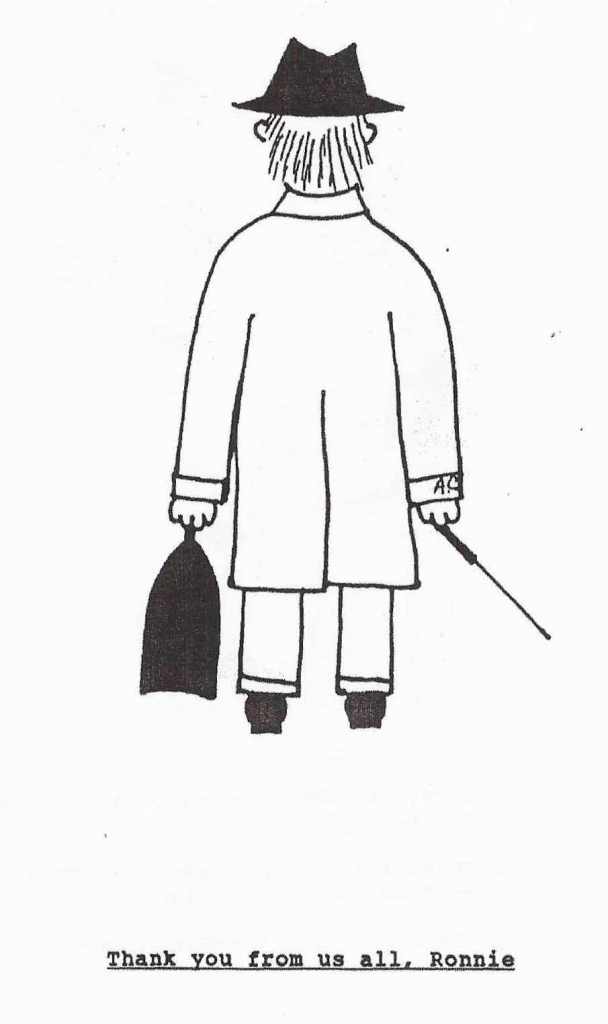
In the first part of this blog I summarised the career of Ronald ‘Ronnie’ Frost, organist and choirmaster, up until the time he took charge of the Hallé Choir in 1972. In part two I will take the story through his years with the choir and beyond up to his death in 2015. I will concentrate mostly on the performances that the choir made under Ronnie and also the increasingly adventurous trips abroad that the choir made. I will also touch on the wit and wisdom of Ronald Frost, as chronicled by choir members! Please note that all of the cartoons of Ronnie are taken from The Sayings of Ronnie, put together by Malcolm Blackburn with illustrations by Angela Christensen to mark Ronnie’s retirement from the choir in 1992.
First seasons
The Hallé Choir, in its first full season under its new Chorus Master, Ronald Frost, embarks on an exciting season of works familiar and unfamiliar. Mr. Frost, let it be said, is no stranger to the members of the Choir for he has been accompanist for a number of years and on many occasions has taken piano rehearsals himself.
From Hallé magazine, Season 1972/73 edition
With these words the Hallé magazine introduced the first season The Hallé Choir would undertake under Ronnie Frost. The last sentence was important – the choir was not an unknown quantity to Ronnie, nor he to them. He came to the job knowing what had to be done to raise the status of the choir. As one current choir member who worked with him told me, he was keen to create a specific ‘Hallé Choir’ sound, much as Barbirolli in the three preceding decades had worked to establish a distinctive sound for the orchestra. This would mean creating a sense of family within the choir and encouraging members to stay for the long term. Unlike previous and future chorus masters, he wasn’t particularly interested in those such as students who would join the choir for a brief period and then move on. He wanted choir members who were committed to his vision for the choir.
His first season would be both interesting and challenging, including for the first time in a while performances of Messiah at both Christmas and Easter, the first and thus far sadly only performance of Vaughan Williams’ powerful anti-war cantata Dona Nobis Pacem, Verdi’s Requiem, and an intriguing-looking performance of Berlioz’ take on Shakespeare’s Much Ado About Nothing, Beatrice et Benedict.
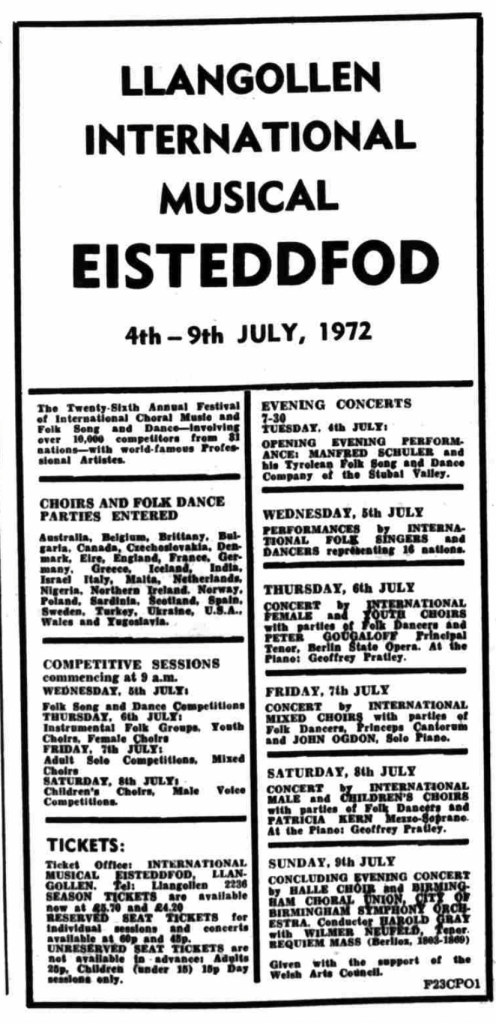
As I outlined in the first part of this blog, Ronnie took over the choir on an interim basis in the spring of 1972, and in fact had his first exposure to Berlioz in July when the choir were invited to sing with the City of Birmingham Symphony Orchestra in a performance of Berlioz’ Grande Messe des Morts – more commonly known as his Requiem – at the Llangollen International Musical Eisteddfod. This festival was established in 1947 as an adjunct to the Welsh National Eisteddfod, a specifically Welsh language festival which takes place in a different town every year. The International Eisteddfod is held every year in the small town of Llangollen on the River Dee and invites amateur singers and dancers from across the world to compete against each other in various categories. Though it now takes place in a permanent pavilion, at this time it took place in an enormous tent that was erected and taken down every year. I remember myself attending the festival around this time and sweltering in the tent while listening to to the male voice choir competition.
Alongside the competitions the Eisteddfod has also always featured celebrity concerts, which over the years have featured the likes of Kiri te Kanawa, James Galway, Montserrat Calle and Luciano Pavarotti who famously had first attended the festival as a member of a competing amateur choir in 1955. Although the Hallé Choir have appeared at the National Eisteddfod on a couple of occasions, famously once singing Beethoven’s Missa Solemnis in Welsh, this would their only appearance in Llangollen. Singing with them alongside the CBSO were the Birmingham Choral Union – the City of Birmingham Symphony Chorus would not be founded until the following year otherwise they doubtless would have been there too. Sadly no review exists of the concert – I would be interested to know what it was like to sing such a massive work in what must have been a very warm tent.
So to January 1973 and the highlight of Ronnie’s first season in charge of the choir. It is somewhat deflating now to remember the fanfare that accompanied the United Kingdom’s accession in 1973 to the European Economic Community, the forerunner to the European Union and the body the UK would withdraw from 47 years later amidst enormous acrimony. The fanfare took literal form in the ‘Fanfare for Europe’, a countrywide celebration of the accession that took place at the beginning of 1973. One of Manchester’s contributions to the event was the performance on January 4th by the Hallé under James Loughran of the aforementioned Beatrice et Benedict. The performance included not only Berlioz’ opera itself but also interpolated excerpts from Shakespeare’s original play performed by two giants of the British stage, Paul Scofield and Vanessa Redgrave. It was sem-staged by the Theatre 69 company, with the choir being directly involved in the action, for example waving beermugs at the end as balloons and confetti descended from above.
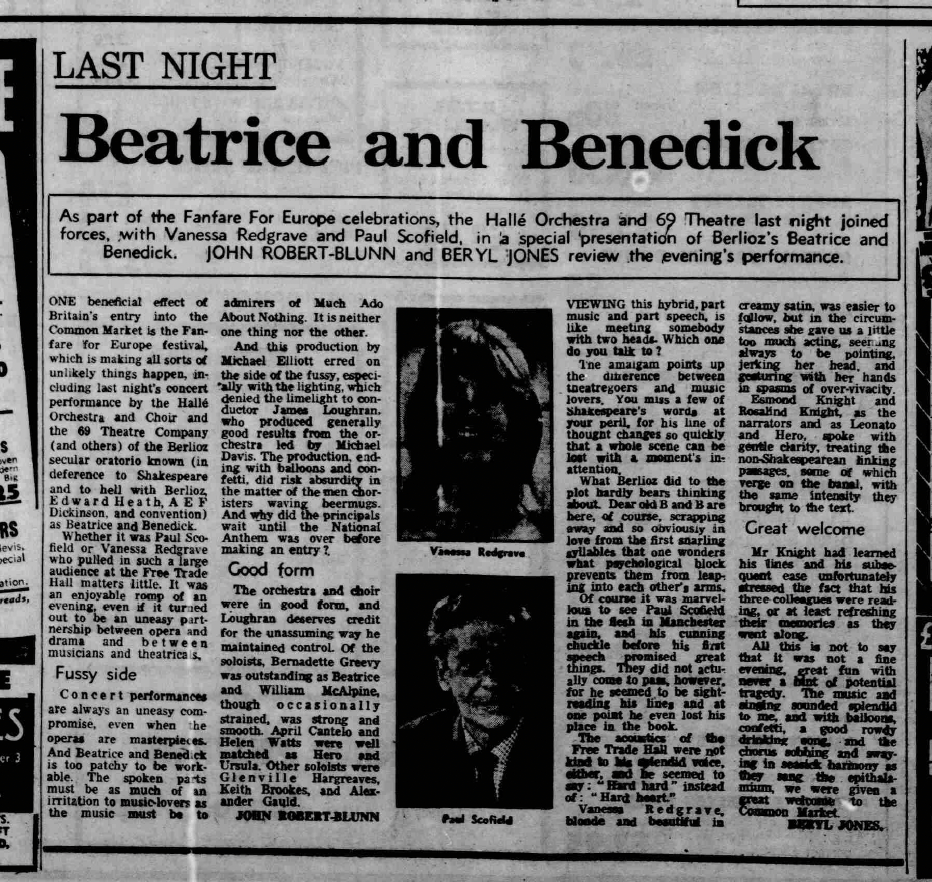
It was an important enough event that the Manchester Evening News saw fit to publish two reviews, one by music critic John Robert-Blunn and the other by drama critic Beryl Jones. Sadly, the choir got little mention other that Robert-Blunn writing that orchestra and choir were ‘in good form’, and as whole the performance fell flat, at least as far as the critics were concerned. Robert-Blunn wrote that ‘the spoken parts must be as much on an irritation to music-lovers as the music must be to admirers of Much Ado About Nothing’, and Jones was particularly scathing of Vanessa Redgrave: ‘…she gave us a little too much acting, seeming always to be pointing, jerking her head, and gesturing with her hands in spasms of over-vivacity.’
Gerald Larner’s Guardian review of the performance of Dona Nobis Pacem the following month, conducted by Meredith Davies, was testament to the progress the choir was making under Ronnie: ‘It was the best possible combination of precise and dramatic attack with the soft-edged poetry of the English choral tradition. The Hallé Choir seemed at ease amid the numerous rhythmic difficulties and, though once or twice upset by the strange modulations, they sang with sense of knowing what the harmonies are about’. Indeed many of the reviews of the choir at around this time specifically comment on the improvement in the choir under Ronnie’s leadership. It feels very similar to the improvement the choir would make 3o years later under James Burton who also, like Ronnie, brought in to manage the choir under a new conductor, in Ronnie’s case James Loughran, and in Burton’s, Mark Elder.
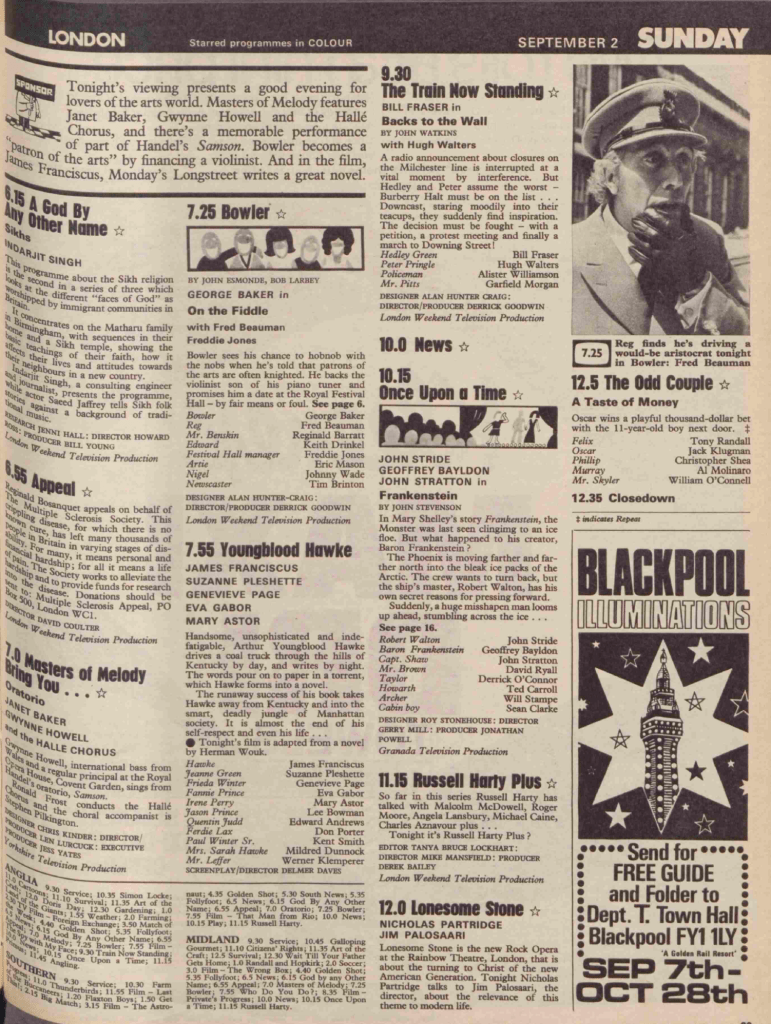
The following season gave two further indications of where the choir was moving, both artistically and in terms of national profile. I’ve covered in a previous post the plethora of recordings and television appearances that the choir made during Ronnie’s tenure which helped propel the choir to a national audience. I dwell only in passing on those here, but feel I should comment on an early television performance, especially now that I have found the relevant TV Times listing for it. Here we can see the choir’s first appearance, in August 1973, on Jess Yates’ Masters of Melody programme, which highlighted the popular classical repertoire with many starry guests, such as on this occasion Gwynne Howell and Janet Baker. I have checked the Radio Times listings for the same day and can confirm that the choir were up against stiff competition on BBC1, a Songs of Praise special from Butlin’s Holiday Camp, Ayr!
The choir’s artistic progress was evident in two concerts that the choir gave in November 1973, remarkably less than a week apart and with Christmas barely a month away. The first was a performance on November 18th of Benjamin Britten’s monumental War Requiem, conducted again by Meredith Davies, who, at a time when it was felt the work required two conductors, had conducted the chamber orchestra alongside Britten conducting the main orchestra at the work’s premiere in Coventry Cathedral. Another survivor from the first performance of the work was Heather Harper, who would be the soprano soloist. John Robert-Blunn in the Manchester Evening News felt that the combination of choir and orchestra was ‘grand’, and talked of the ‘continued improvement’ of the main choir (i.e. the Hallé Choir – the boys of Manchester Grammar School formed the children’s choir), with only the men exhibiting occasional signs of ‘strain and roughness’. Most impressively, in the extremely difficult final Libera Me section of the piece, he felt the choruses were ‘splendidly controlled’.
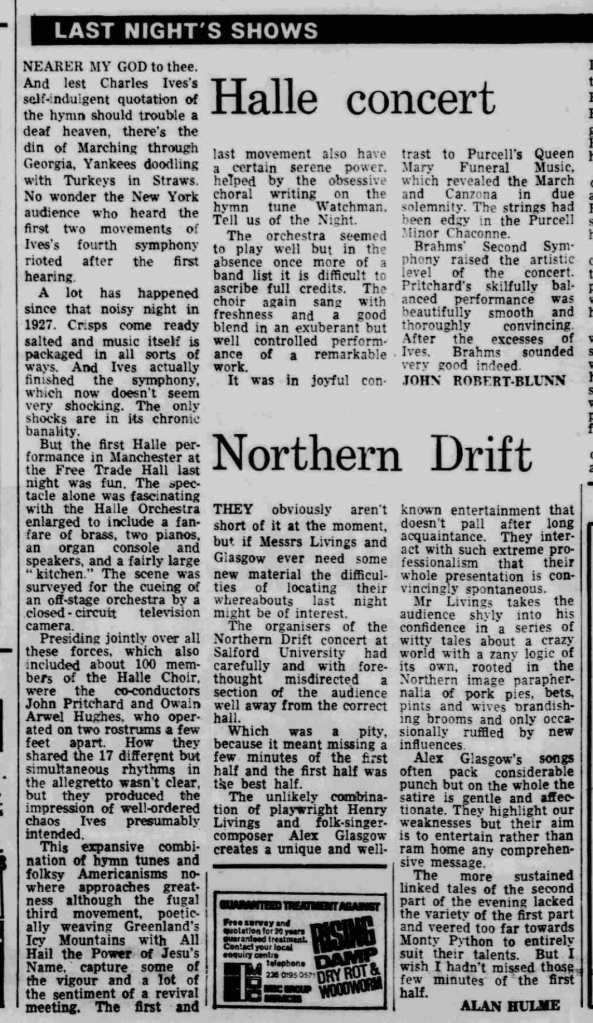
Only four days later the choir took part in a performance of Charles Ives’ madly wonderful 4th Symphony with its mix of Brahmsian melody, Victorian hymn tunes, modernist dissonance and polythymic mash-ups of popular American melodies. It is another work that like War Requiem has been felt to require more than one conductor. In this instance conducting duties were shared between John Pritchard and Owain Arwel Hughes, with Ronnie Frost assisting Pritchard during the performance. The choir’s contribution is limited to an arrangement of the hymn Watchman Tell us of the Night at the end of the first movement and a wordless rendition of another hymn tune in the last movement, which will explain how it could be rehearsed alongside War Requiem with Messiah coming along two weeks later. Of the performance Gerald Larner in the Guardian thought the first movement ‘well though the Hallé Choir sang, lacking in atmosphere’, but overall thought the performance ‘was a great achievement and such an illumination that Brahms [whose 2nd Symphony formed the second half of the concert] seemed only irrelevant’. This and two subsequent performances over the next few days in Leeds and Sheffield that did not involve the choir are the only performances of the symphony the orchestra have given of the symphony. I can only think it is time this proto-modernist masterpiece is revived and the choir are given an opportunity to experience it again.
Directing the choir
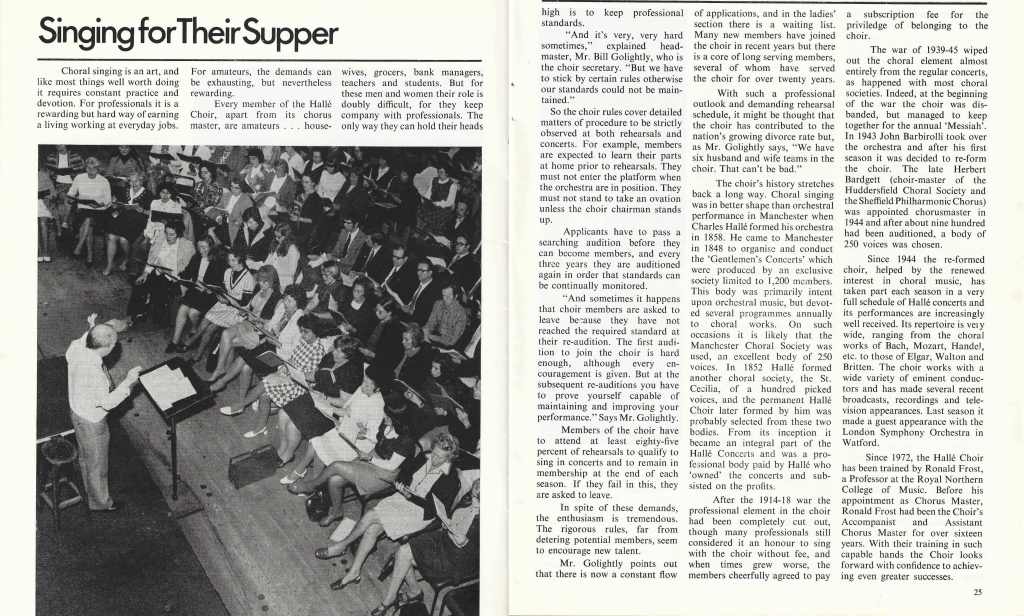
By the end of 1974, Ronnie had his feet well and truly under the choral table, so much so that the Autumn 1974 edition of the Hallé magazine devoted a two-page spread to the choir under Ronnie, its history, makeup and development. Note that it contains a photograph of Ronnie taking the choir in rehearsal. Though photographs and videos of the choir in rehearsal are nowadays a frequent element of the Hallé’s social media campaigns for concerts, there are very few pictures from this period in the choir’s history showing the choir rehearsing. I shared the picture with choir members and the general consensus is that it would have been taken at the Zion Centre in Hulme, the choir’s regular rehearsal venue at this time. What was also commented on is the number of choir members singing cross-legged, a practice frowned upon these days! Though most of the article is based on an interview with Bill Golightly, the then choir secretary, it gives insight into Ronnie’s expectations of the chorus:
Every member of the Hallé Choir, apart from its chorus master, are amateurs… housewives, grocers, bank managers, teachers and students. But for these men and women their role is doubly difficult, for they keep company with professionals. The only way they can hold their heads high is to keep professional standards…
So the choir rules cover detailed matters of procedure to be strictly observed at both rehearsals and concerts. For example, members are expected to learn their parts at home prior to rehearsals. They must not enter the platform when the orchestra are in position. They must not stand up to take an ovation unless the choir chairman stands up.
From Hallé magazine, Autumn 1974 edition
The article ends with this endorsement of Ronnie: ‘With their training in such capable hands the Choir looks forward with confidence to achieving even greater successes.’
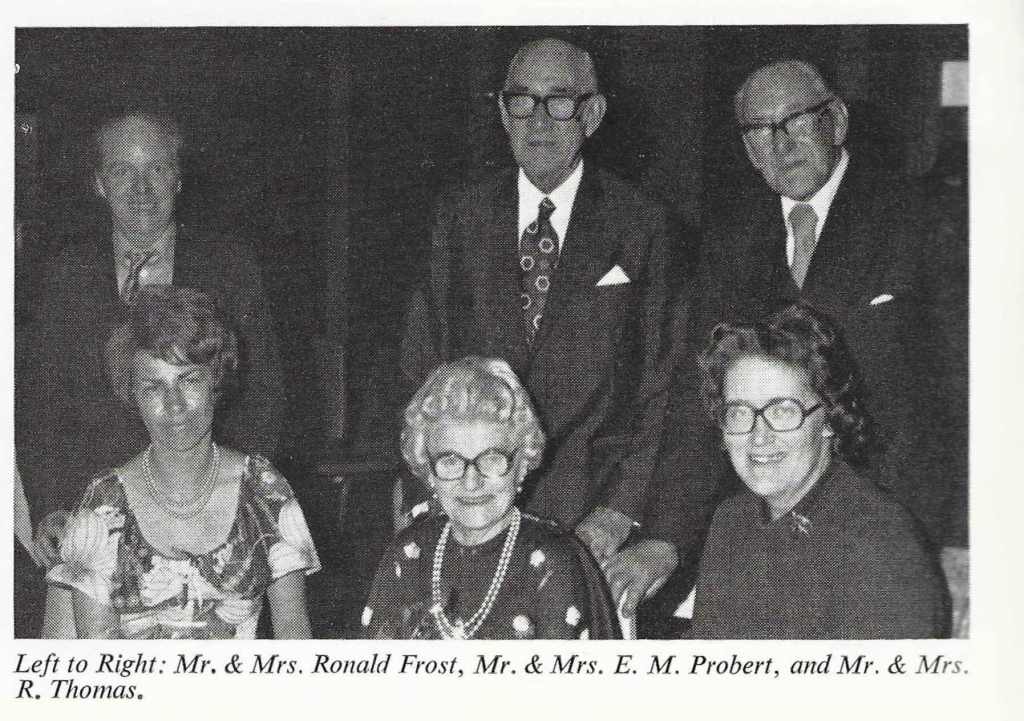
Part of Ronnie’s success out of the blocks was doubtless the fact that he had actually been associated with the choir as accompanist since the mid 1950s. Indeed he was only four years into his tenure as choral director when a celebration dinner was held at the new Hotel Piccadilly to celebrate his 20 years with the choir. It also celebrated two men of the choir, Max Probert and Roland Thomas, who had been in the choir for 50 years. It is a remarkable feature of the Hallé Choir and its longevity and the longevity of its members that there are many current choir members who have fond memories of singing under Ronnie, and that Ronnie in his time rehearsed members who had sung under Sir Hamilton Harty – two degrees of separation between now and the 1920s. A photo in the Summer 1976 edition of the Hallé magazine showed Ronnie and his wife Barbara (they had married in 1959), and Max Probert and Roland Thomas and their respective spouses.
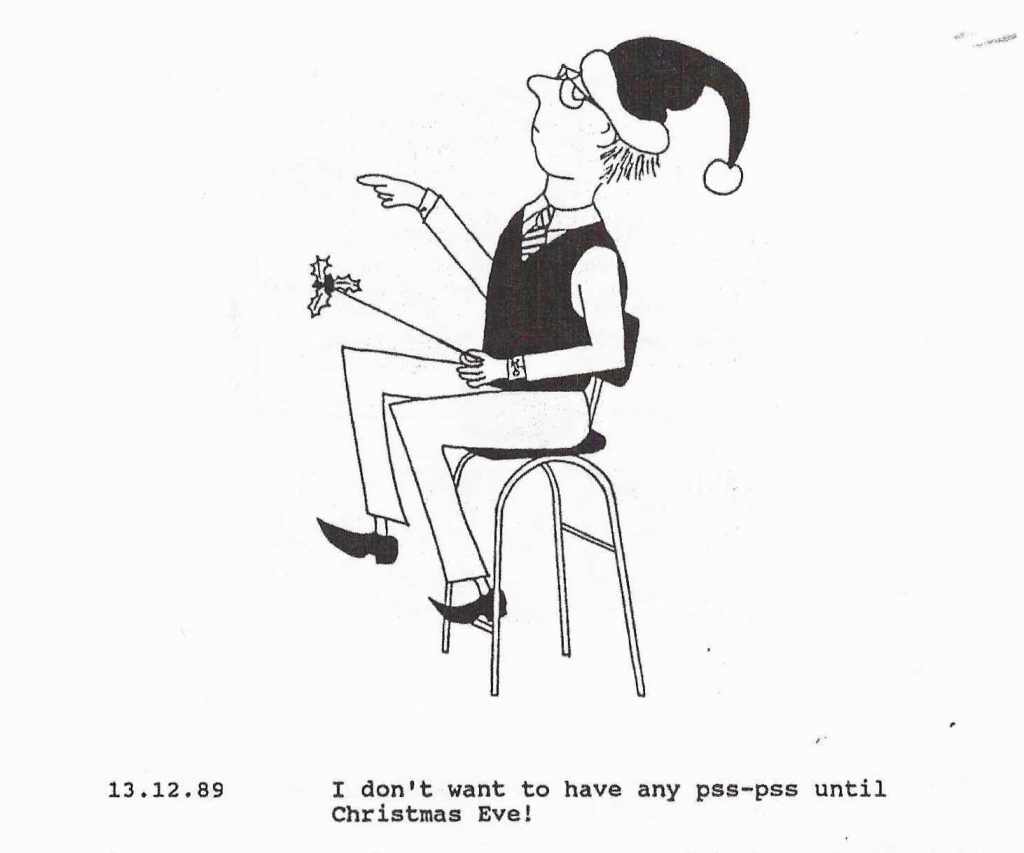
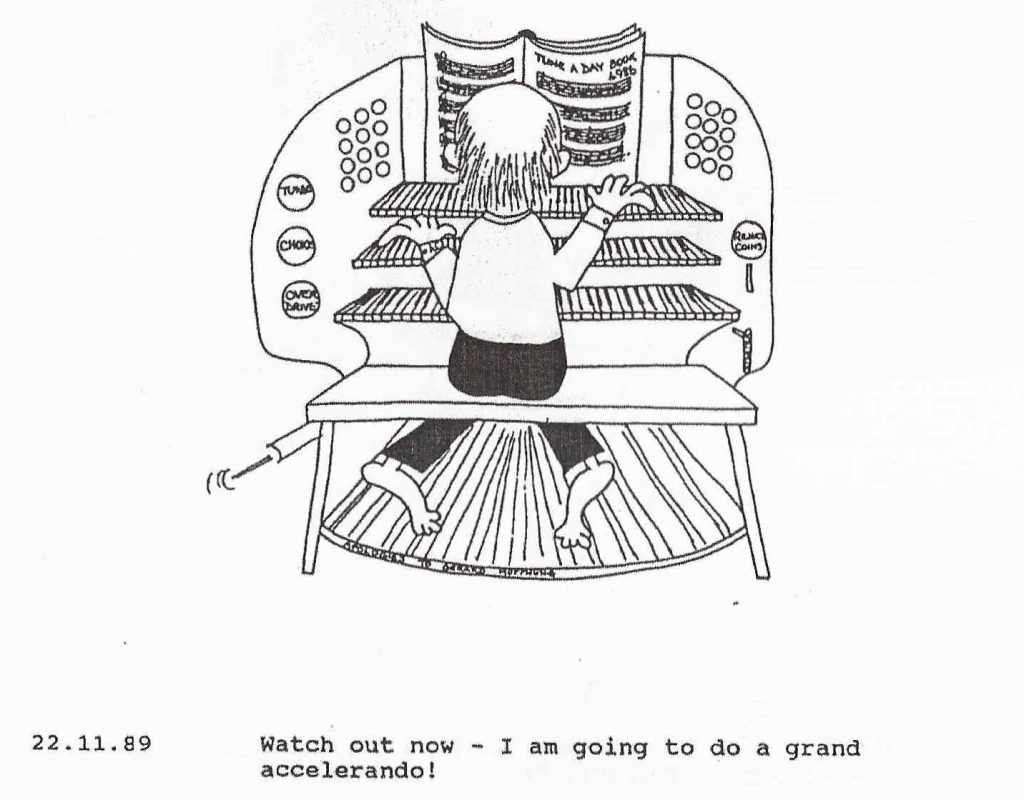
What is not necessarily clear from articles such as these, but is abundantly clear from talking to those who sang under him, is that rehearsing with Ronnie was huge fun and people remember him with great affection, not least for his many and various misspeakings. All choral directors (and the current Hallé Choir choral director and associate choral director are no exceptions!) are prone to unintentional faux pas and double entendres that cause rehearsals to collapse in hilarity. Ronnie was more prone to these than most, with the result being the aforementioned The Sayings of Ronnie, which collated some of the most recent examples at the time of his retirement in 1992, listed with the exact date on which they were uttered. Here are a few of the more repeatable examples:
OK ladies – I am ready when you are (12th November 1986)
Excerpts from The Sayings of Ronnie complied by Malcolm Blackburn
But you’ve not sung it before with the men doing what they’re going to do to you in a minute (27th May 1987)
You’re not so happy with your ding-dongs, ladies (6th December 1987)
Sopranos, I know you haven’t been up there since August – straight in! (20th January 1988)
I am going to stagger the break and look at the men’s parts (28th September 1988)
I lie awake at night thinking of tenors (27th September 1989)
Altos – I don’t want to tire you tonight as we’ve got to do it again tomorrow (16th April 1990)
It must be very tiny – so tiny that I’ve lost it (24th April 1991)
I am always amenable to suggestions from sopranos (18th March 1992)
Foreign Visits
One thing that mushroomed under Ronnie’s stewardship, aided by erstwhile choir administrator and chair Bill Golightly, was the idea of the choir travelling abroad to perform independently from the orchestra. In my post about the choir’s television appearances I talked about the trip the choir made to the Azores in 1988, during which visit they appeared on local TV, but the choir’s horizons had began to be expanded almost 10 years before.
Thus we see in the Summer 1979 edition of Hallé magazine an item about a forthcoming trip to the Netherlands by the Hallé Choir, led by Ronnie, that was due to take place in May of that year. The trip was at the behest of a choir in Ijmuiden, the Christelijke Oratoriumvereniging of Ijmuiden, who had visited Manchester the year before. Choir members were to stay with the families of members of that choir and would perform works by Vivaldi, Schubert, Tippett and Purcell in venues in Ijmuiden itself and Amsterdam.
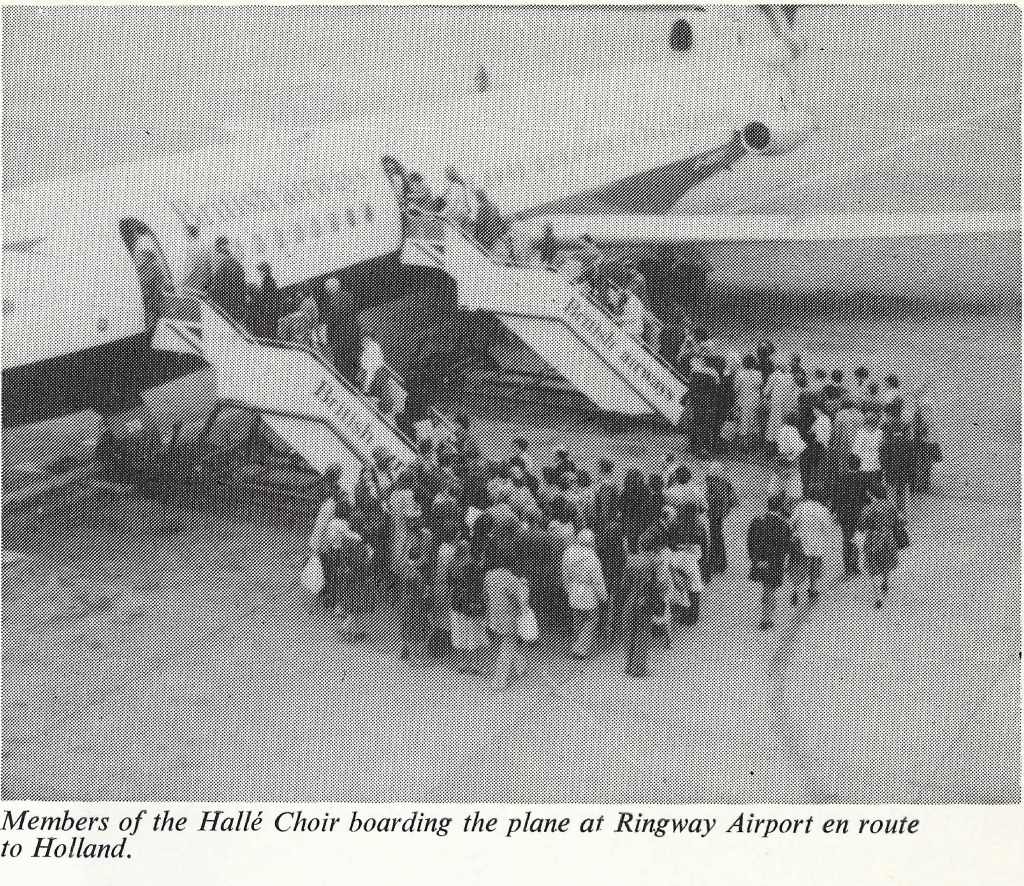
The trip was written up by Bill Golightly in the Winter 1979/80 edition of Hallé magazine. The choir travelled to Amsterdam in a specially chartered British Airways jet and were then whisked off to Ijmuiden to meet with their host families. The report goes on to recount their travels and performances and particularly the camaraderie that existed within the choir and also between the choir and the members of the hosting choir. This was emphasised by a party at which the choir repaid their hospitality by singing Land of Hope and Glory and Polly Wolly Doodle, a party piece of the choir that would crop up again two years later in their appearance on Russell Harty’s television show.
Their first concert was at the Westerkerk in Amsterdam, a short distance from the Ann Frank House, as I know personally as it was the church I went to for quiet contemplation after visiting the house for the first time a few years ago. In front of an audience of 1,000 the choir performed pieces by Purcell, Mozart and Vincent Novello, with Ronnie conducting and Stephen Pilkington accompanying the choir on the organ. Mention of the organ brings the mind the fact that 1978 had seen Ronnie take up the job of organist at St Ann’s church in the centre of Manchester showing that his organ career was proceeding in parallel to his choral career. Indeed the report of the trip to the Westerkerk mentions its ‘huge and ornate organ, which made our Chorus Master, Ronald Frost’s mouth water and on which he was invited to play’.
The musical highpoint of the trip, however, was a performance in the Nieuwekerk in Ijmuiden at which the choir were joined by the host choir and the North Holland Chamber Orchestra. The Hallé Choir sang Vivaldi’s Gloria, Schubert’s Mass in G and the spirituals from Tippett’s A Child of our Time, conducted by Ronnie, with the local choir contributed pieces by Mozart and Purcell. A sold-out audience, including the Mayor of Ijmuiden and the British Vice-Consul, packed the church for the concert. As Bill Golightly reports, the local papers were effusive in their praise for the performances: ‘the fame that the Hallé Choir has spread over the North Sea was fully verified… When the final magisterial sound had died away the Choir was rewarded with a great standing ovation.’ Following the concert a ‘glittering reception’ was held at which Ronnie read and presented a special message from the Lord Mayor of Manchester to the Mayor of Ijmuiden, and in return received a commemorative plaque from the Mayor.
One final visit to Haarlem followed, during which Ronnie had the chance to play on the organ of the gothic St Bavo church and, as Golightly wrote, he became ‘the proud possessor of a mounted photograph to prove it’.
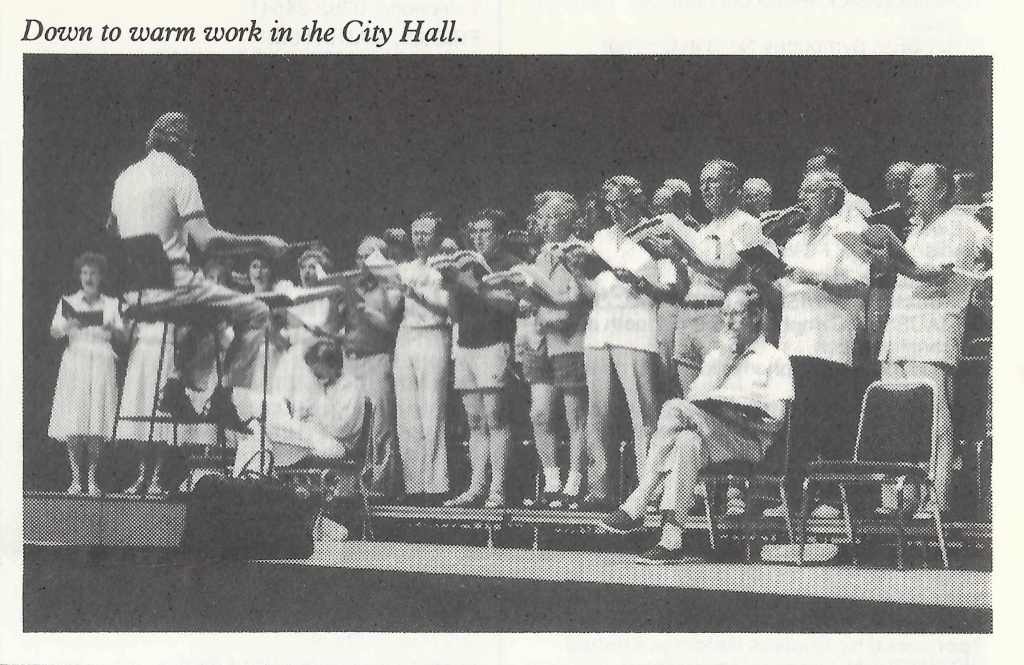
A group from the Hallé Choir should have visited Hong Kong and India in 1983 but last-minute difficulties meant the trip had to be cancelled. However, sterling fund-raising efforts, including a fund-raising concert conducted by Maurice Handford, cake raffles and a sponsored mountain climb, meant that the choir were able to travel to Hong Kong in the sweltering heat of the July and August of 1984. Ronnie Frost was not involved on this occasion – Maurice Handford conducted performances of Haydn’s Nelson Mass, Vivaldi’s Gloria and Handel’s Messiah in front of large, enthusiastic audiences with Stephen Pilkington accompanying on the organ, but it was further evidence of the choir’s increased profile under Ronnie.
Notable Concerts
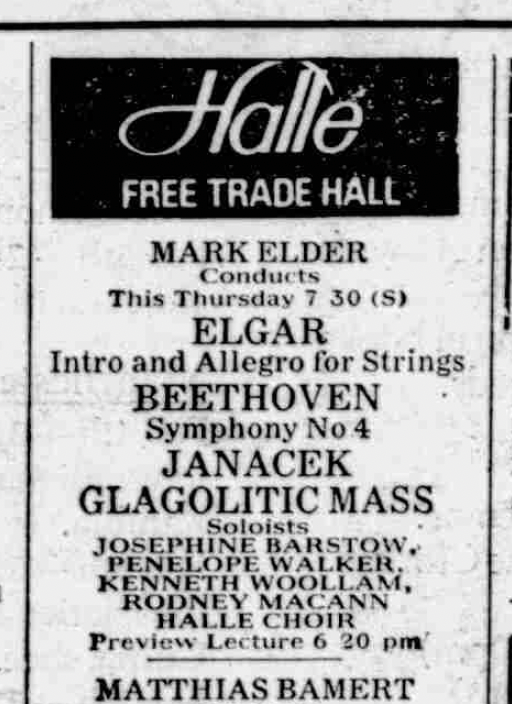
As the 1980s progressed and the choir expanded its horizons musically and geographically and in its increasing number of recordings and television appearances, Ronnie continued to lead the choir through a series of notable concerts. I mentioned in passing in my post on the effect Mark Elder has had on the choral output of the Hallé that Elder’s second appearance with the choir came in 1986 with a performance of Leoš Janáček’s stunning Glagolitic Mass, a piece forged in the composer’s late flowering of creativity that also included works such as his Sinfonietta. It was the first time the choir had performed the work, and given the work has a monumental part for organ, it was obvious that as well as preparing the choir Ronnie would, in his role as official Hallé organist, would be asked to play that part. Judging by John Robert-Blunn’s review in the Manchester Evening News, he did that with aplomb:
The man at the Wurlitzer – a much better instrument than some of the electronic toys the Hallé played with in the past – was the chorus master Ronald Frost. What an exciting contribution was his solo postludium.
From a review in Manchester Evening News, 7th February 1986
His duties did not end there, of course. Robert-Blunn reports that ‘the choir, singing in what I understood was Czech [in fact it was Old Church Slavonic], maintained their recent impressive form’.
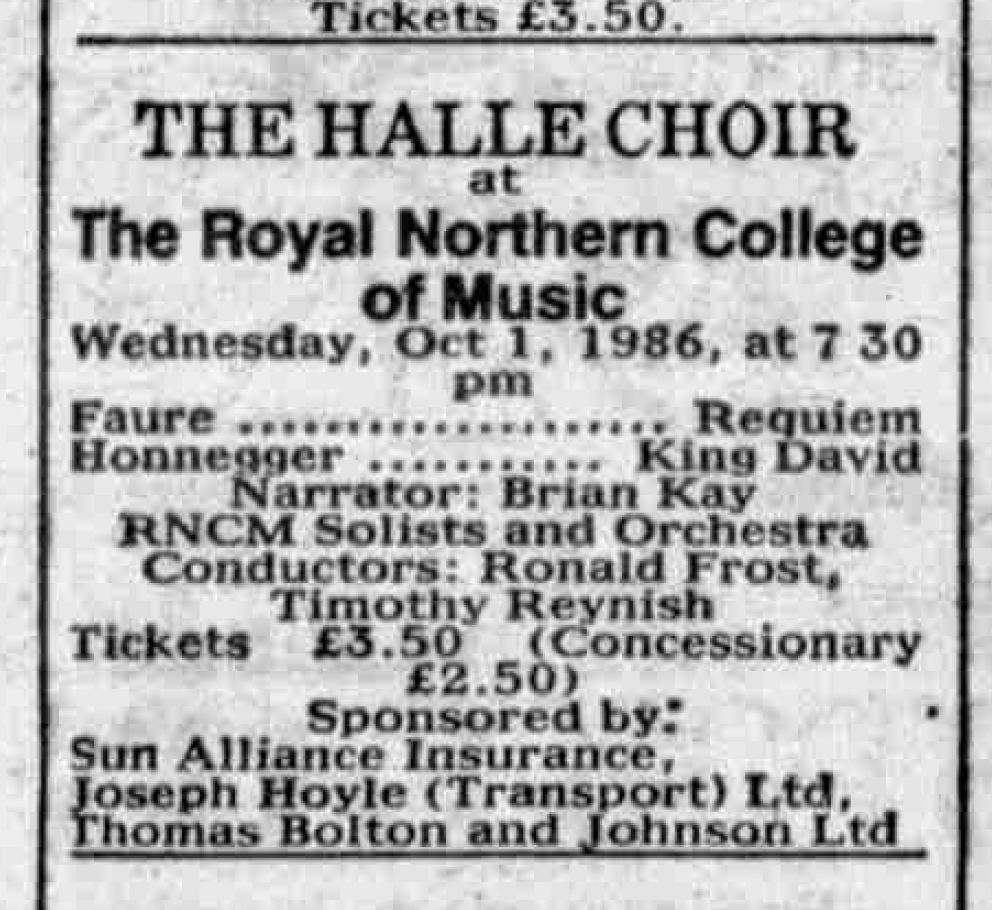
Later that year there was a very special concert held at the Royal Northern College of Music in which the Hallé Choir joined forces with soloists and musicians from the college. The purpose was to celebrate to work of Ronald Frost, and his long association with both the choir and the college.
Ronnie himself conducted the first piece in the programme, a performance of Faure’s Requiem that featured a very early appearance by the 20 year old soprano Amanda Roocroft, then a student at the RNCM and later to make a name for herself on opera stages across the world. The concert also featured a definite rarity, a performance of Le Roi David (King David), an oratorio by the Swiss-French composer Arthur Honegger which was conducted by Timothy Reynish, at that time head of the School of Wind and Percussion at the RNCM
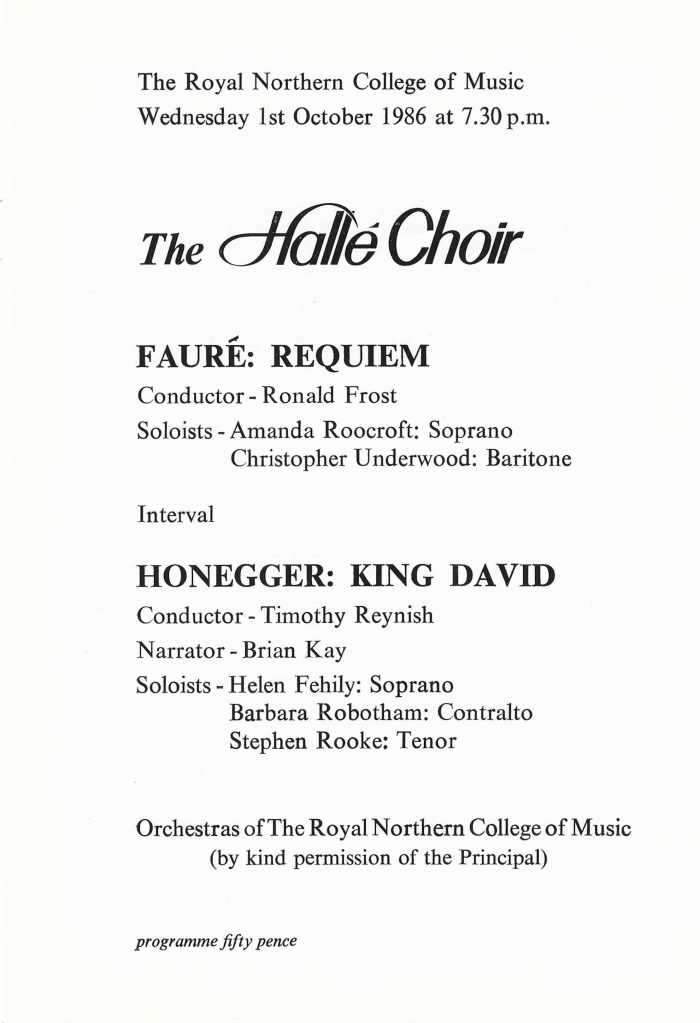
Ronnie’s biography in the programme for the concert is worth quoting in full as it crystallises his importance in the musical life of Manchester:
Ronald Frost has been associated with the Hallé Choir for 30 years. From 1956 to 1972 he was Accompanist and Assistant Chorus Master to the Choir and since 1972 has been Chorus Master, and organist to the Orchestra. In addition to preparing the Choir for its many concerts, broadcasts, recordings and TV work, Ronald Frost has conducted the Choir on many occasions on TV and in other major concerts.
There is no doubt that, since he became Chorus Master, the Choir has enjoyed a long and successful ‘golden age’. Public acclaim for its concerts has been largely due to the excellence of his preparation. These successes have included concerts both at home and abroad including Promenade Concerts in London, and tours to Holland and Hong Kong.After a long and distinguished career both as a student and Director of Studies at the Royal Manchester College of Music, during which time he received many awards, he became a member of the staff of The Royal Northern College of Music where is currently Principal Tutor in organ.
He is organist and choir master at the city centre church of St. Ann’s, Manchester, where he gives about 30 recitals each year.
His hobbies include crosswords, dog-walking, drawing, painting and watching football.
This evening’s concert celebrates Ronald Frost’s long and distinguished career and association with both the Hallé and the Royal Northern College of Music. It is undoubtedly thoroughly deserved.
From the programme for concert at RNCM, 1st October 1986
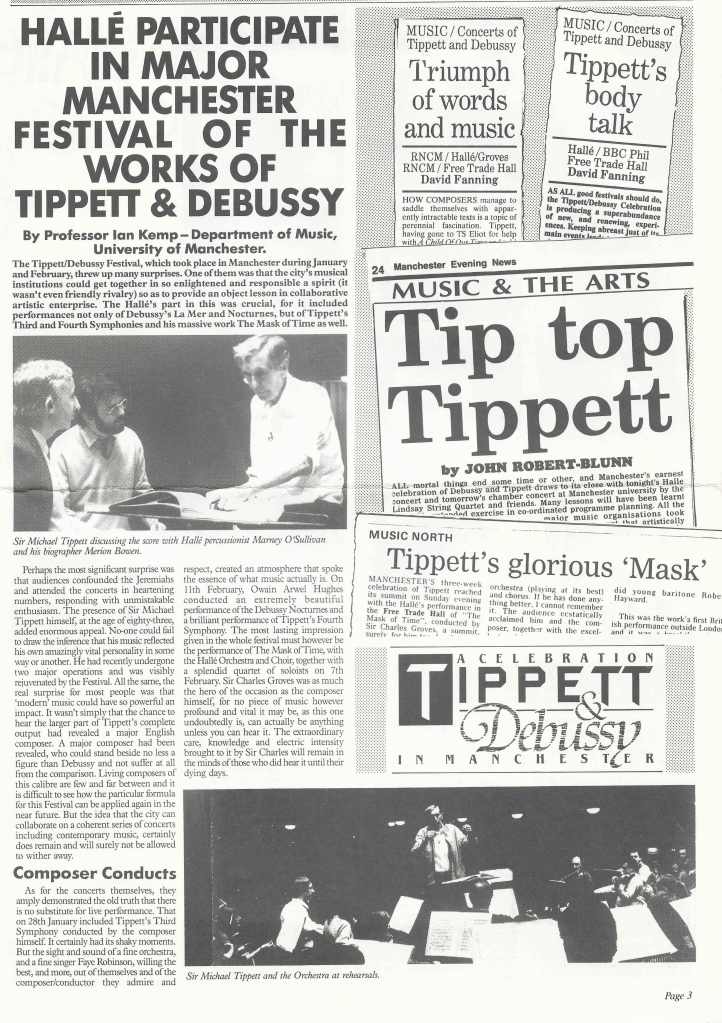
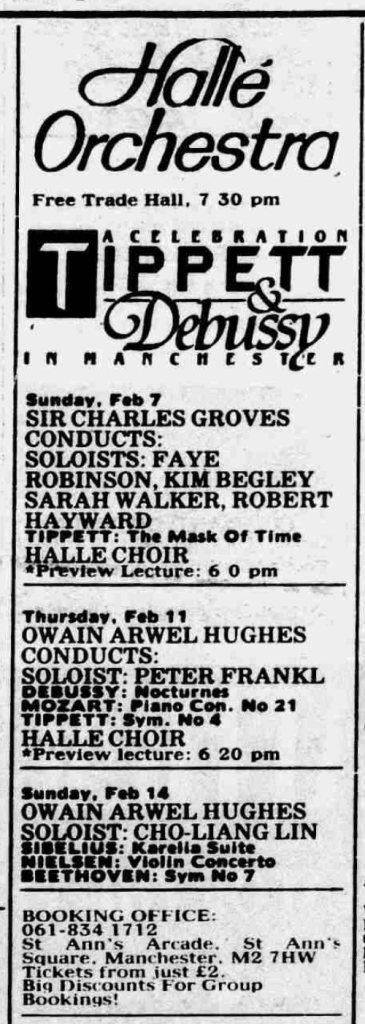
One of Ronnie’s finest achievements, however, was yet to come. It was a performance in 1988 of a work that current choir members who sang it then, or sang it when it was repeated in 2000 under Mark Elder, still remember with something of a shudder because of the sheer difficulty of what they were asked to sing. It was the one work that the Church Times specifically mentioned in its obituary of Ronnie after he died:
Contributing to the month-long Tippett-Debussy celebrations that took place in February 1988, Frost helped prepare the first provincial performance of Sir Michael Tippett’s challenging oratorio The Mask of Time. For many it remains one of the great events in Manchester’s musical history.
From Kenneth Shenton’s obituary of Ronald Frost in the Church Times, 19th February 2016
The Mask of Time was one of Michael Tippett’s later, more divisive works, light years beyond early choral works such as A Child of Time though with similar conceits, such a self-written libretto. Loosely based on Jacob Bronowski’s TV series The Ascent of Man, it was premiered in Boston in 1981 and featured many special musical effects, such as electric organ and within the supersized percussion section brake-drums and coke-hammers.
The performance took place on 7th February 1988 with Sir Charles Groves conducting and a quartet of world-class soloists. John Robert-Blunn, reviewing the concert in the Manchester Evening News described the work as ‘baffling’ and ‘a suitable subject for a PhD thesis’, but thought ‘the Hallé Orchestra (led by Pan Hon Lee) and Choir (chorusmaster Ronald Frost) seemed in very good form under the experienced baton of Sir Charles Groves’. Overall his review is largely non-committal, though he does say that the performers and Tippett (who attended the concert and helped prepare it at the age of 83) ‘thoroughly deserved the prolonged applause’.
Dave Fanning in the Independent and Michael Kennedy in the Daily Telegraph were far more effusive in their praise. Though Fanning thought Tippett’s text ‘ripe for critical slaughter’ he felt the effect of the piece ‘is not of indulgence in obscurantism but of externalising and universalising profoundly personal insights’, and the review overall is headed ‘triumph of words and music’. The choir gets special praise: ‘On the night the Hallé Choir and Orchestra surpassed themselves. It was a triumph for Sir Charles Groves, for choirmaster Ronald Frost, for the splendid team of soloists… indeed for everyone involved’. Under the title ‘Tippett’s glorious Mask’ Kennedy’s review is in a similar vein, though he makes a point of singling out the chamber choir who performed alongside the main choir, who were ‘drawn from the ranks of the Hallé Choir, [and] sang throughout with a radiance, flexibility and range of dynamics that were so beautifully controlled it was no surprise to discover that more than a year had been spent in rehearsals.’ Ronnie had obviously trained them well.
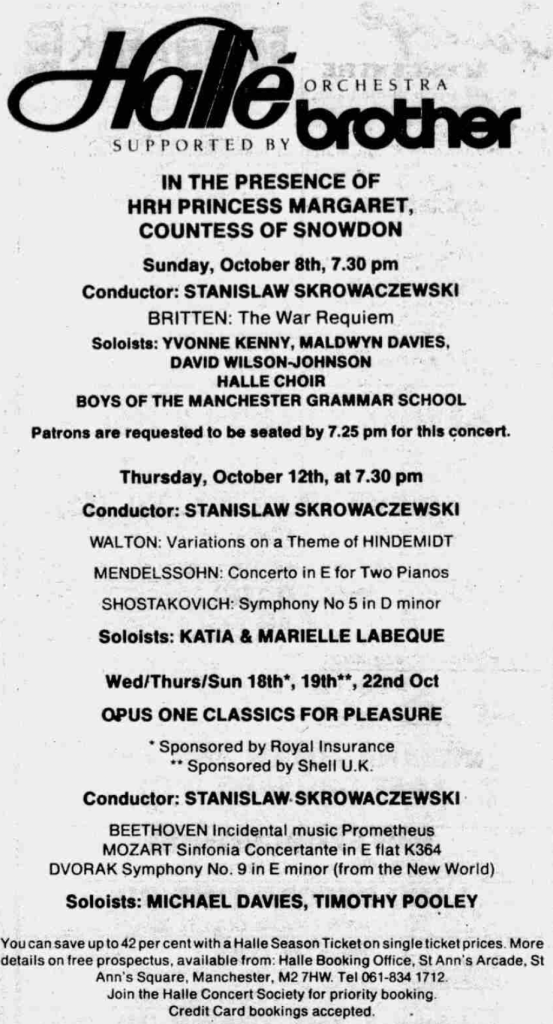
I will finish this review of notable performances of Ronnie’s time with the Hallé Choir with another performance of Britten’s War Requiem notable for two things. It was one of the few major concerts in which the choir were conducted by Stanislaw Skrowaczewski, who had taken over as chief conductor after James Loughran, and it was performed in the presence of Princess Margaret, the then Patron of the Hallé.
The orchestra had just played two performances of this work at the Musikverein in Vienna, conducted by James Judd, sadly without the Hallé Choir, but with Claudio Abbado an interested audience member for one of the concerts. For the concert on 8th October 1989 Skrowaczewki conducted the choir and orchestra alongside the boys of Manchester Grammar School.
In his review of the concert in the Manchester Evening News John Robert-Blunn couldn’t help but make reference to the Royal visitor: ‘Princess Margaret must have been there last night, to judge by the number of police and no-parking cones cluttering the surrounding streets, but like so many others in the stalls, I never glimpsed the Hallé’s patron’. He had obviously heard one of the performances in Vienna and other than in one regard compared the performance very favourably in comparison:
The Hallé, conducted by Stanislaw Skrowaczewski instead of James Judd, and accompanied by the Hallé Choir instead of the behind-the-beat Singverein, played superbly and much better than in Vienna. The Hallé Choir, trained so well by Ronald Frost, rose splendidly to the subtle dynamic niceties Skrowaczewski asked of them. So did the orchestra. The MGS boys, trained by Andrew Dean, performed adequately. (They are not the Vienna Boys’ Choir).
From review in Manchester Evening News, 9th October 1989
Final Curtain
The choir entered the 1990s apparently in rude health. The Summer 1990 edition of Hallé News reported that early 1990 saw two performances of Mahler’s 2nd Symphony and that Ronnie, Bill Golightly, conductor Owain Arwel Hughes and several choir members went on Radio 4’s Kaleidoscope arts programme to publicise a concert featuring Samuel Coleridge Taylor’s now rarely performed Hiawatha’s Wedding Feast. Also, a new choir dress for the women of the choir had been sponsored by Granada TV to the tune of £2,000 and the choir were looking forward to the ‘Manchester Olympic Festival’. However, the end of an era was near at hand.
Ronnie had always been working on a rolling one-year contract and during the 1991/92 season the choir received the sad news that his contract had not been renewed for the 1992/93 season and that he would be retiring from the post of Hallé Choir director at the end of that season.
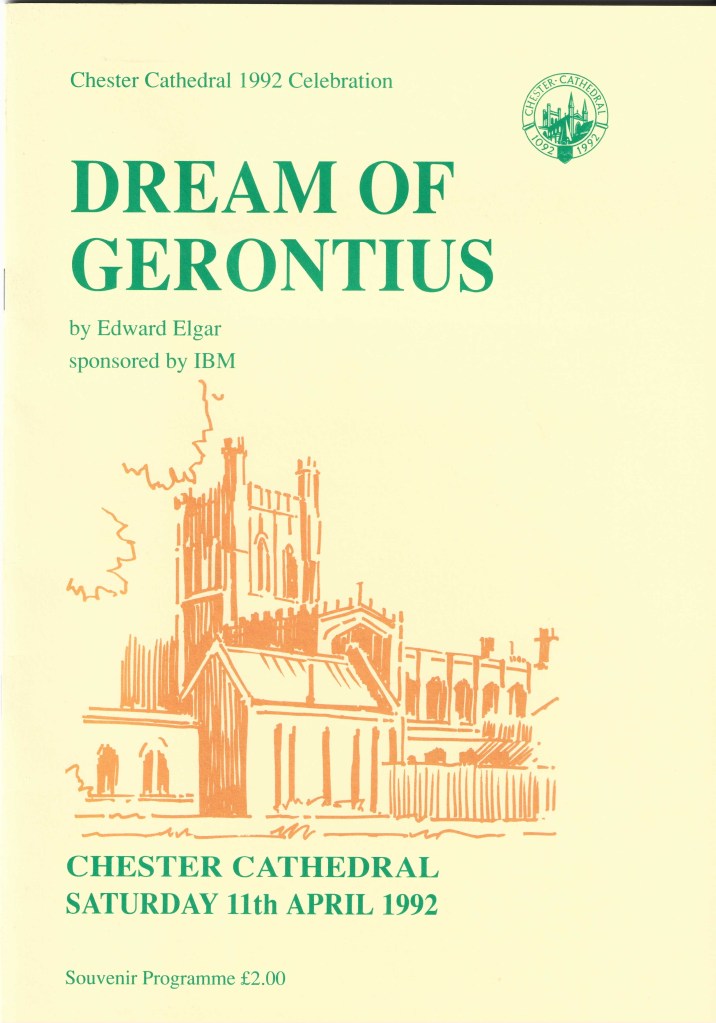
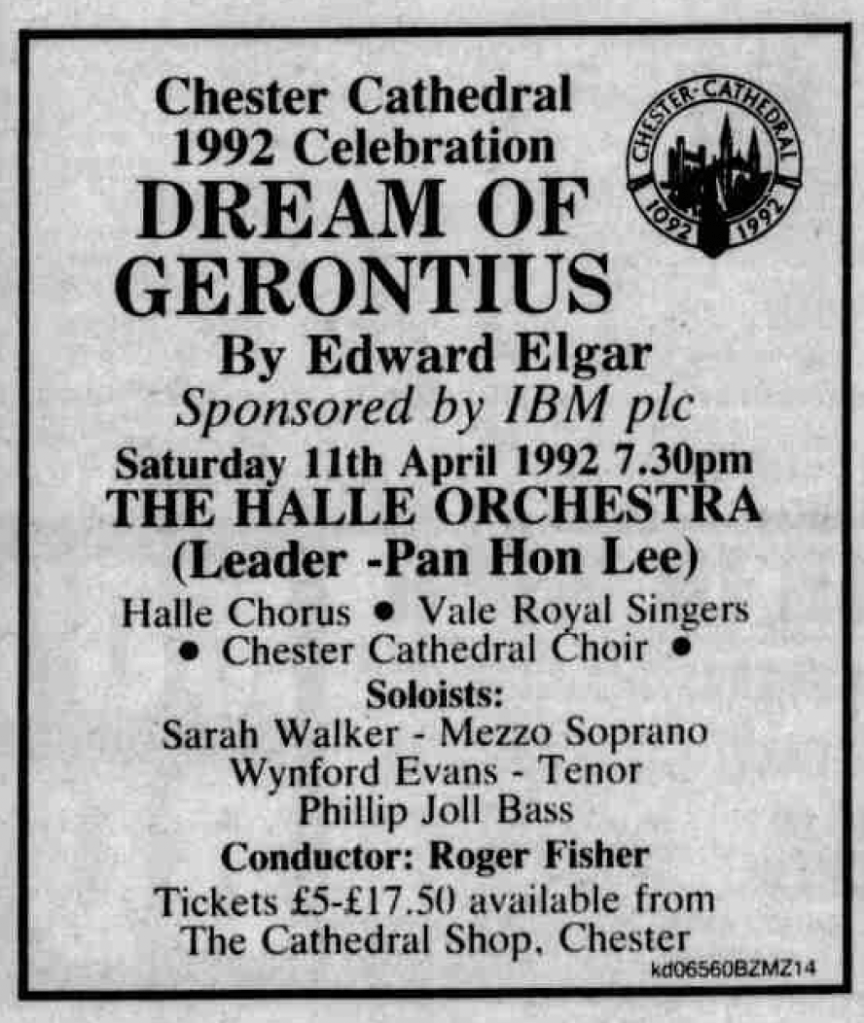
As so often seems to happen with the Hallé Choir his final concert in charge of the choir turned out to be a major Elgar event, though it happened not in Manchester but in the sandstone grandeur of Chester Cathedral. 1992 marked the 900th anniversary of the founding of the Abbey church of St Werburgh that became Chester Cathedral after the Reformation in 1541. The cathedral planned a series of events to celebrate the anniversary including, for example, a premiere performance in July of a newly-commissioned work by John Tavener, We Shall See Him As He Is, that was performed by the Chester Festival Chorus and the BBC National Orchestra of Wales and its chorus, conducted by Richard Hickox. I remember it well because it was the first time I sang in a chorus with a professional orchestra, beginning a process that would lead me to the Hallé Choir 27 years later!
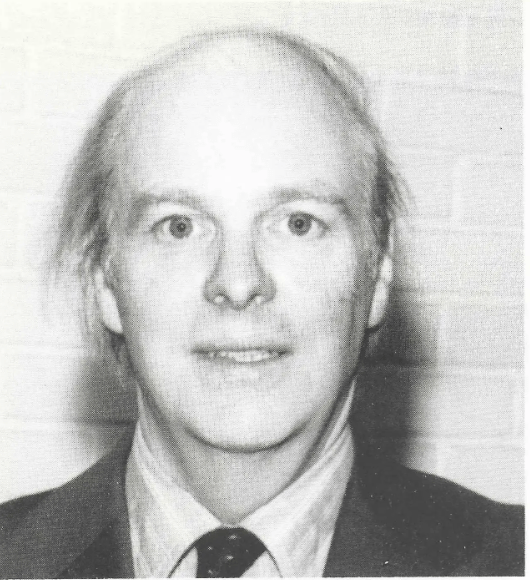
Before that, however, April saw the cathedral choir’s contribution to the celebrations. Roger Fisher, the long-serving organist and choirmaster of Chester Cathedral had a long-held ambition to conduct a performance of Elgar’s Dream of Gerontius in the cathedral and the 900th celebrations gave him the opportunity. The Hallé Orchestra were hired, along with a substantial section of the Hallé Choir and three excellent soloists, with the semi-chorus parts to be sung by the cathedral choir and local chamber choir the Vale Royal Singers. The concert also featured a very young Graham Eccles, then assistant organist at the cathedral, who played organ continuo at the Hallé Choir’s most recent performance of Messiah in December 2025 and was in his time a pupil of Ronnie’s.
It would be nice to report that the concert was a triumph, but no reviews of the concert were published in the local papers. Talking to one of the Chester singers who performed in the concert, however, it appears that it was not an entirely successful affair with the assembled forces being a little too much for Roger Fisher to handle, extremely experienced though he was as a cathedral choirmaster. As such it was therefore something of a downbeat note for Ronnie to leave on, but the affection that he was held in by the choir was evident then and is still evident today.
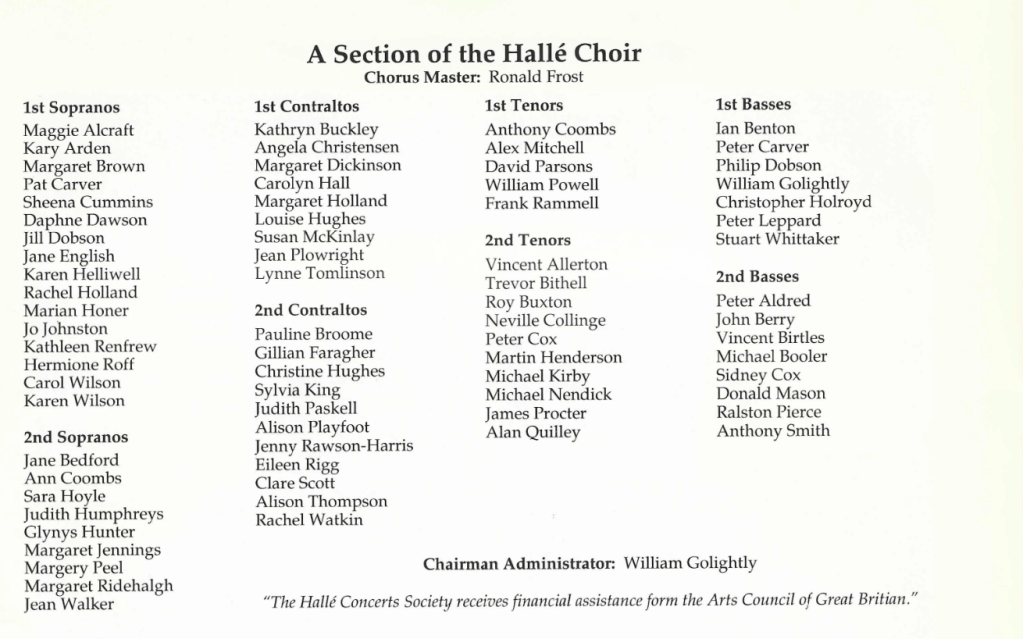
To that end I thought it would be appropriate to list the names of the Hallé Choir members who sang in the Gerontius concert, many of whom still sing in the choir today.
Ronnie continued for couple of years as organist for the Hallé Orchestra, and continued as organist at St Ann’s until May 2014, when one of the gifts given to him on his retirement was a Bury Football Club shirt with his name on, marking his other great passion in life. He died in October 2015. The first paragraph of his obituary in the Church Times summed up his life’s work:
As organist of the historic St Ann’s, Manchester, for 37 years, Ronald Frost, who died on 1 October 2015, aged 82, remained at the forefornt of the city’s music-making throughout the second half of the 20th century. He was intimately associated with the Royal Northern College of Music (RNCM), where his input and experience helped moult the creative personalities of many of Britain’s most eminent practitioners. Likewise, as one of the defining choral conductors of his generation, he brought the Hallé Choir to a level of performance which had few, if any, equals.
From Kenneth Shenton’s obituary of Ronald Frost in the Church Times, 19th February 2016
References
The research tools used were:
British Newspaper Archive britishnewspaperarchive.co.uk
The Guardian archive courtesy of Manchester Libraries
Extra information
Hallé magazine and Hallé News courtesy of the Hallé Archive
Malcolm Blackburn and Angela Christensen, The Sayings of Ronnie. (Manchester: Hallé Choir, 1992)
Kenneth Shenton, ‘Ronald Frost’, Church Times, 19th February 2016. https://www.churchtimes.co.uk/articles/2016/19-february/gazette/obituaries/ronald-frost
Extra special thanks to choir members Chris Hughes and Chris Holroyd for programmes and memorabilia
 Home
Home 
Leave a comment