Introduction
In this final post about choir members who sang in the semi-chorus for choir performances of Elgar’s Dream of Gerontius, I will pick up the strands I touched on previously with the stories of Margaret Hudson and Ernest Houghey. Firstly, I will tell the story of James Challoner Heaton who like Ernest Houghey used the choir as a springboard to a professional singing career, but unlike Houghey stayed close both to his roots in Rochdale and his love of singing. Finally I will touch briefly on the story of Lillie Hutton, who like Margaret Hudson combined an amateur singing career with a calling to teach the young.
James Challoner Heaton: Born in Rochdale in 1899, Died in Rochdale in 1947

James Challoner Heaton was born in the Rochdale suburb of Castleton in early 1899 and baptised at St Mary’s, Wardleworth on May 10th, 1899. In the 1901 census, the Heaton family was living at 91 St Martin Street in the Castleton which was presumably the house in which James was born. As can be seen from the photograph, it was a very modest 2-up, 2-down working class dwelling. His father James Sr. (36) was described as being a ‘Springmaker’ and his mother Mary Ann (31) was a housewife.
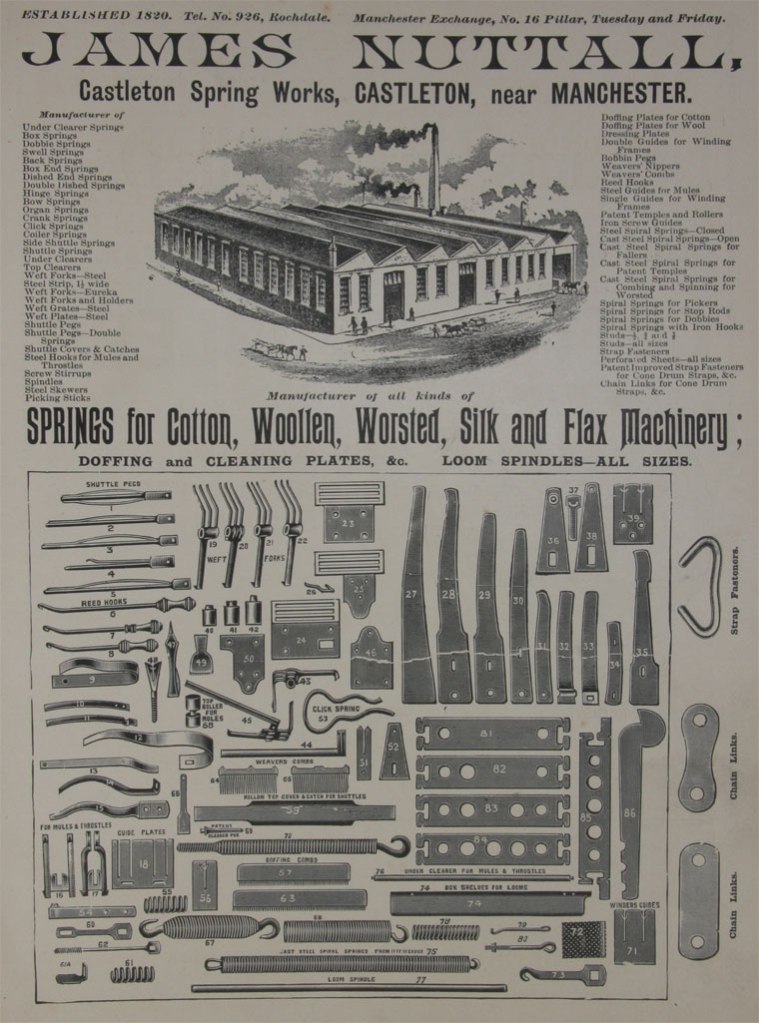
Rochdale was then, and still is now, a centre for spring manufacture, at that time largely for use in mill machinery. Although as we will see, James Sr. briefly moved away from Rochdale, in 1921 he was working at James Nuttall’s Castleton Spring Works which, given its location, was most likely where he was also working in 1901. A poster from 1917 gives an idea of the sort of products made at the works and of the size of the factory itself – a considerable enterprise.
As we will see, the actual name we attach to James Challoner Heaton is something of a problem. As you can see below, in the 1901 census he was described as ‘James C’ Heaton. I take that to imply that the name by which he was known at home was James, the same as his father. Although he later came to call himself professionally by variants of his middle name Challoner, for ease of identification I shall refer to him throughout the rest of this blog as ‘James’, and to his father as ‘James Sr.’.
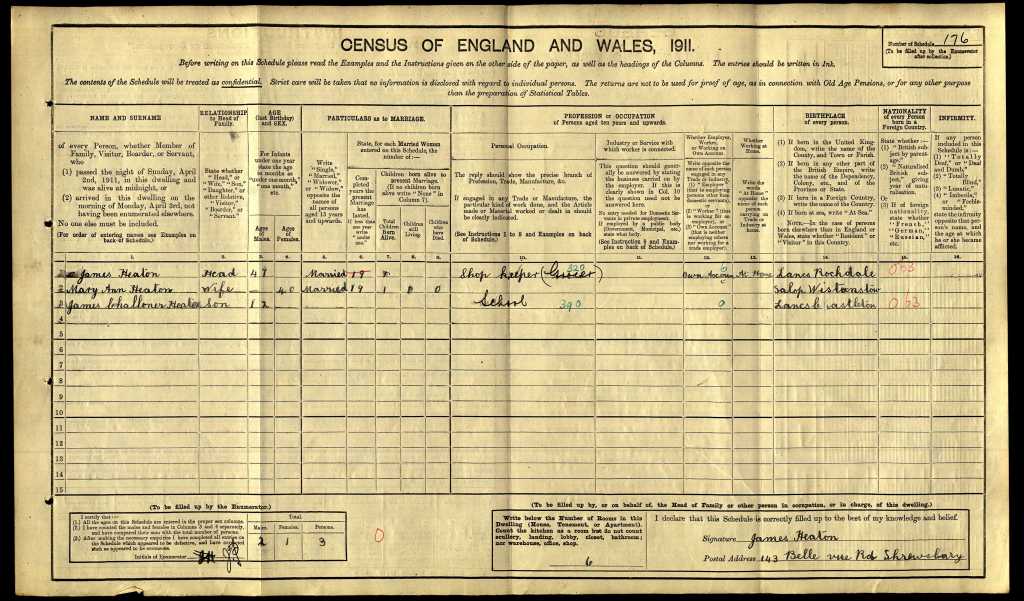
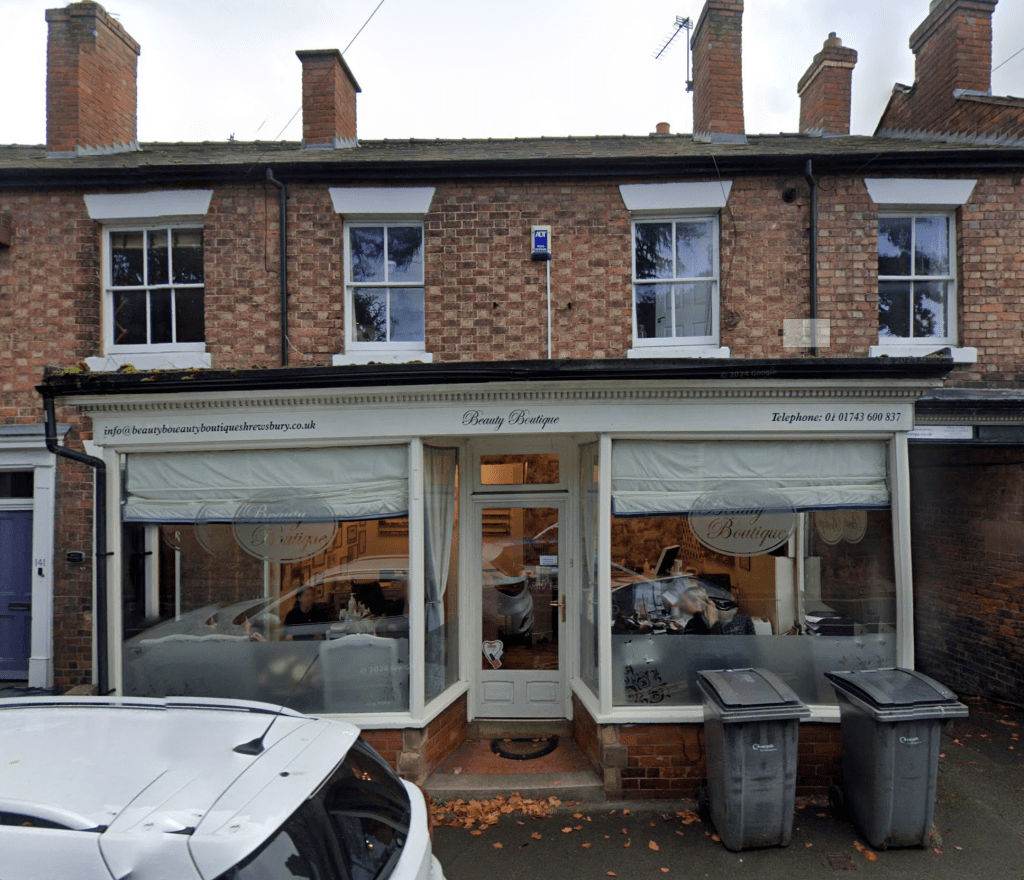
By time of the 1911 census the family had moved to 143 Belle Vue Road, Shrewsbury, where James Sr. was working as a grocer. They presumably moved there because of his wife’s roots in Shropshire – she was born in Wistanstow, 20 miles south of Shrewsbury. As you can see, the shop, which is now a beauty salon, was a major step up size-wise from the small house in which James was born. James was now listed as ‘James Challoner Heaton’ (note the spelling of his middle name for future reference) and was at school. Given James’ later musical career it may not be fanciful to imagine that his interest in music began in Shrewsbury, maybe in the choir at St. Chad’s, a Shrewsbury church with a long and venerable Anglican musical tradition.
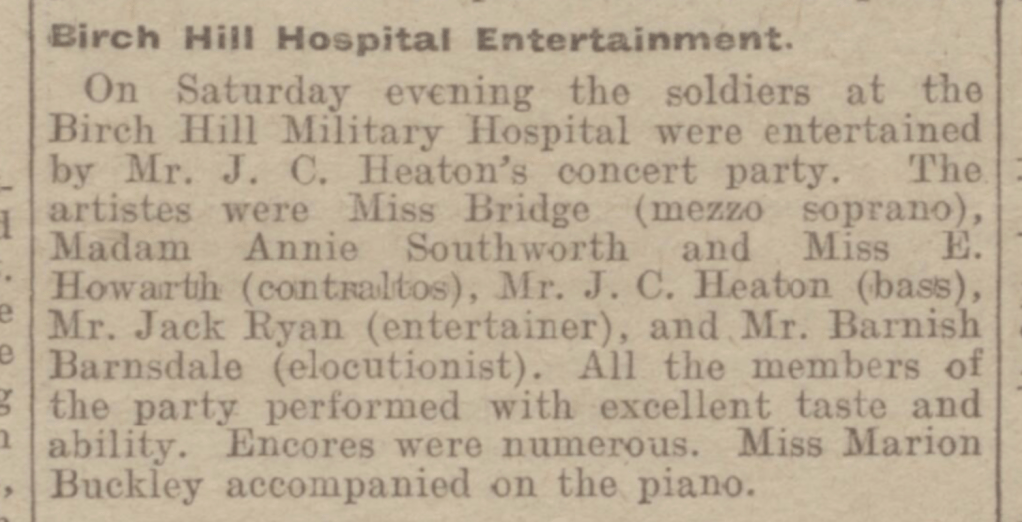
However, by 1917 the Heatons must have decided to abandon their retail experiment and the family were back living in Rochdale. However it may have started, James was already developing his talent for both singing and performing. This is evidenced by a report in the Rochdale Observer of an ‘entertainment’ given by ‘Mr. J.C. Heaton’s concert party’ at Birch Hill Hospital in Wardle, near Rochdale, opened in 1877 as a workhouse but later converted into a hospital which in 1917 was treating soldiers wounded on the battlefields of World War 1.
As I explained in the two previous blogs in this series, the concert party format was a common one at this time, with a mixture of singers, entertainers and musicians providing a varied bill of fare to audiences. Both Margaret Hudson and Ernest Houghey also performed in concert parties, but for James to be able to organise such a party at the age of only 18 is certainly impressive.
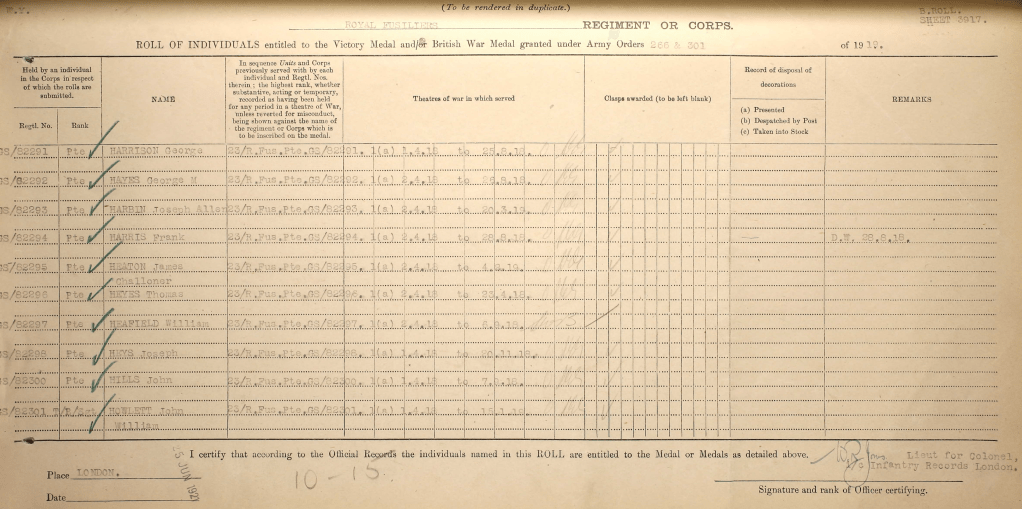
The war finally caught up with James when he was called up in April 1918. He served as a Private on the Western Front with the 23rd Royal Fusiliers, being demobilised in February 1919. He would have been involved in some of the final skirmishes of the war, including attacks on the Hindenburg line and would also have been part of the army of occupation in Cologne in early 1919. Returning to Rochdale, he obviously decided that his future lay in music, and particularly in developing his baritone voice.
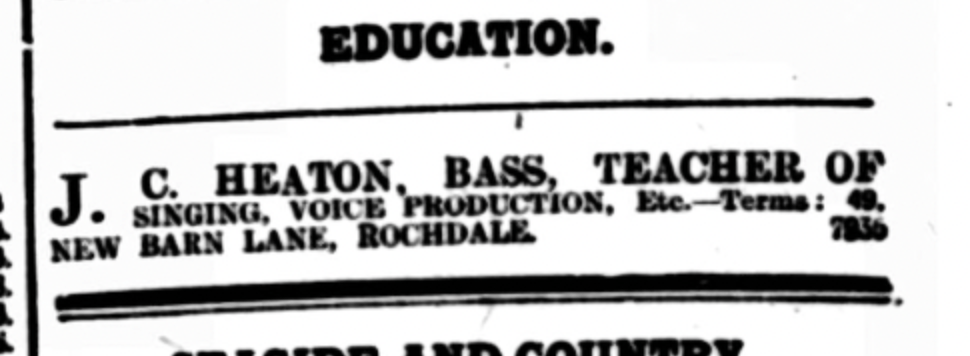
September 1919 saw James advertising his services in the Rochdale Times as a singing teacher, just as Margaret Hudson had done. He was still only 20. His address is given as 49 New Barn Lane, the street he would live on for the rest of his life, living with his parents until they died in the early 1940s.
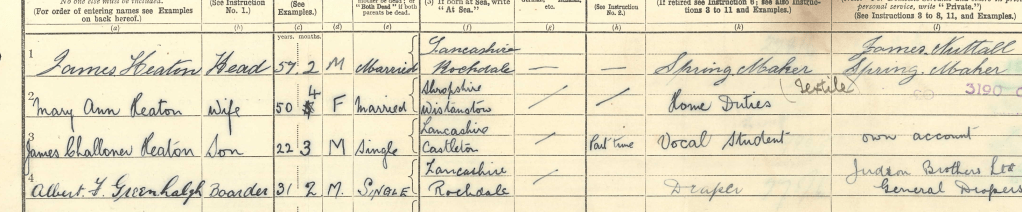
He is therefore listed in the 1921 census at 49 New Barn Lane, Rochdale as James Challoner Heaton, a part-time Vocal Student. The fact that he was part-time, combined with his later association with R.H. Wilson, suggests that he may have studying, like Ernest Houghey, at the Manchester School of Music. However, given that records of that institution have been lost makes this impossible to verify. He was, however, definitely learning his trade. Note also confirmation of the fact that James Sr. had returned to working as a springmaker in Castleton.
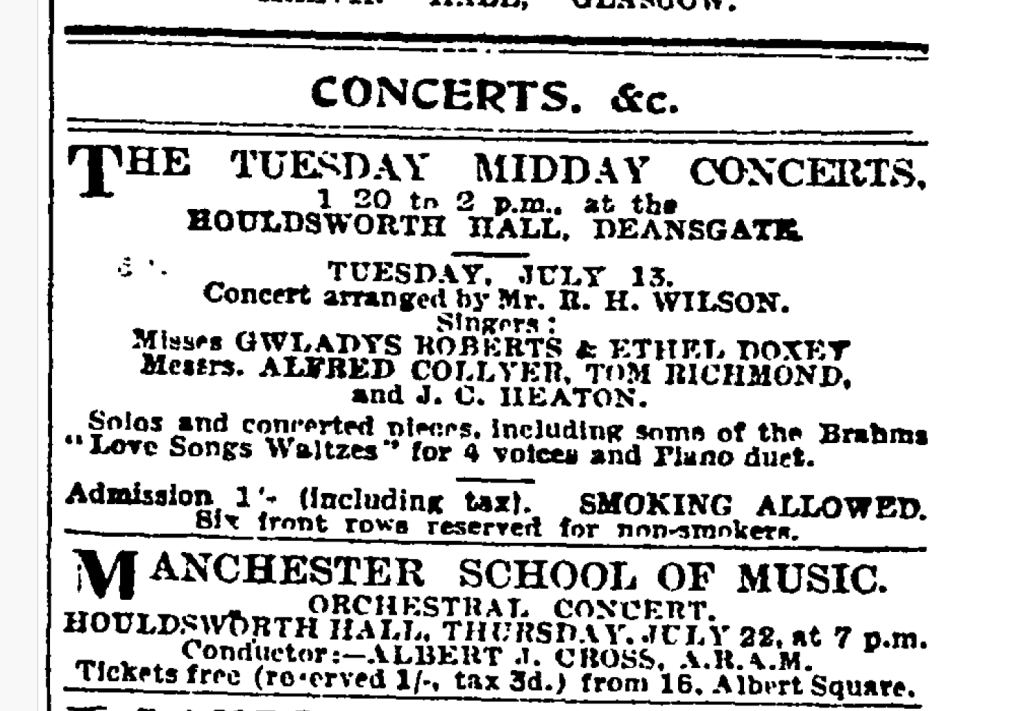
James was beginning to get solo vocal engagements. A search of the RNCM archive for ‘J.C. Heaton’ brought up a reference to Concert Programme held in the Henry Watson Music Archive of a concert given on 13th July 1920 at Houldsworth Hall as part of the Tuesday Mid-day Concerts series. James was amongst the performers. The concert was advertised in the Manchester Guardian as being ‘arranged by R.H.Wilson’, at the time the chorus master of the Hallé Choir, which may be how James’ association with the choir began. His fellow performers were also talented – Gwladys Roberts sang soprano in the Gerontius semi-chorus, first in 1916 and then in 1922 alongside James, and appeared as a choir soloist in a number of concerts in the 1910s and 1920s, including singing the soprano solo in the ‘Fourth of August’ section of Elgar’s wartime choral work The Spirit of England three days after the Armistice in November 1918.
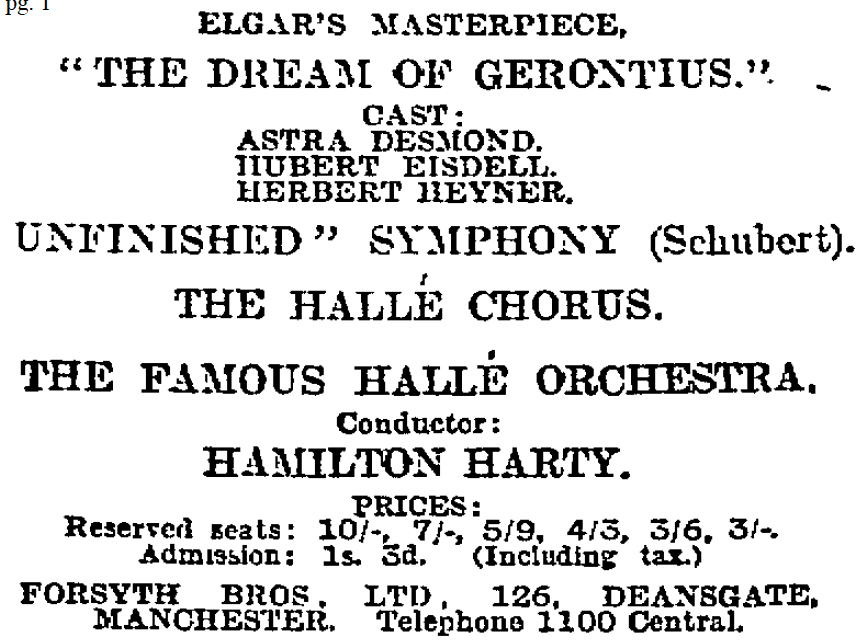
1922 saw James enter our Hallé Choir story with his first appearance in the Dream of Gerontius semi-chorus. It would also be the first performance of the work to be conducted by Hamilton Harty, who had taken over as principal conductor of the Hallé two years earlier in 1920. Surprisingly, given the immensity of Gerontius, the concert also included a performance of Schubert’s 8th symphony, the so-called Unfinished, a programming decision that caused some comment in reviews of the concert.
Samuel Langford’s review in the Manchester Guardian was reasonably complimentary to the Hallé Choir, but not so to the orchestra. Whilst he felt that it ‘for the first time we think, almost in our memory, [the choir] was finest in its least forcible effects’, for the passages such as the Demons’ Chorus he felt that it was ‘rather the uncertainty and occasional tardiness of the playing that failed to give certitude to the singing than any radical defect in the singing itself.’ Indeed, it was his opinion that that particular chorus was a speciality of the choir and he wrote that ‘last night the chorus did not seem less finely disposed towards its hazardous vigour than in previous years.’ The semi-chorus got a special mention at the end of the review: ‘The semi-chorus, though not always ideally in tune, was beautiful in tone and quite sufficiently powerful.’ Maybe the fact that it was Hamilton Harty’s first time conducting the work with the orchestra and choir that contributed to the blemishes in the performance.
There were fewer reservations when Langford reviewed James’ second appearance in the Gerontius semi-chorus in February 1925, again with Hamilton Harty conducting and with R.H. Wilson preparing the choir for the work for the last time before he retired. Langford described it as ‘one of the finest Elgar performances we have had for many years’, and had fine words for the choir and specifically for the semi-chorus:
Yet the singing of the chorus was excellent in its purity and variety of tone, and especially the semi-chorus was beautiful in tone and without the precarious quality of intonation which so much beset this work in its earlier years.
Samuel Langford writing in the Manchester Guardian, 6th February 1925
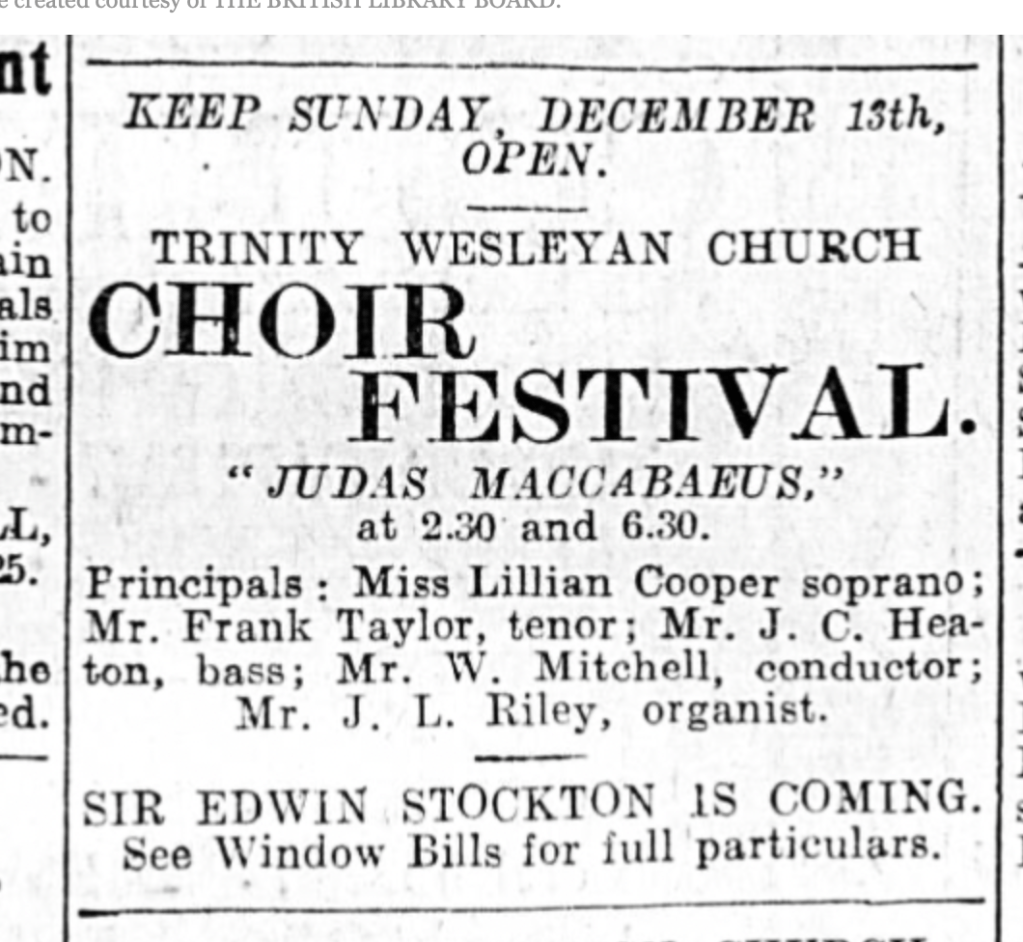
By this time, his vocal training presumably complete, James was most definitely striking out on his own as a performer. There are a number of reports of James performing in Manchester and the surrounding area, such as in an advertisement in the Macclesfield Times in December 1925 which lists J.C. Heaton as the bass soloist in a performance of Handel’s oratorio Judas Maccabeus at Trinity Wesleyan Church. By the way, ‘Sir Edwin Stockton is coming’ refers to a former Conservative MP for Manchester Exchange and prominent local industrialist whose potential presence was obviously deemed worth of mention.
The Musical Times in October 1926 has a further reference to R.H. Wilson, when as part of the congress of the Nation Union of Organists Associations in Manchester he organised a concert at the School of Technology. It included ‘J. Challenor Heaton’ as one of the singers with Wilson and Harold Dawber, who by then had succeeded Wilson as choral director of the Hallé Choir, as accompanists. Note the changed spelling of James’ middle name with the o and the e transposed, and how the ‘Challenor’ part is emphasised. Rather like Ernest Houghey became Ernest Howie, James must have decided he needed a distinctive professional name. The other soloists were the aforementioned Gwladys Roberts, Beatrice Coleman, and James Percival, and together they were described as contributing ‘some charming music.’
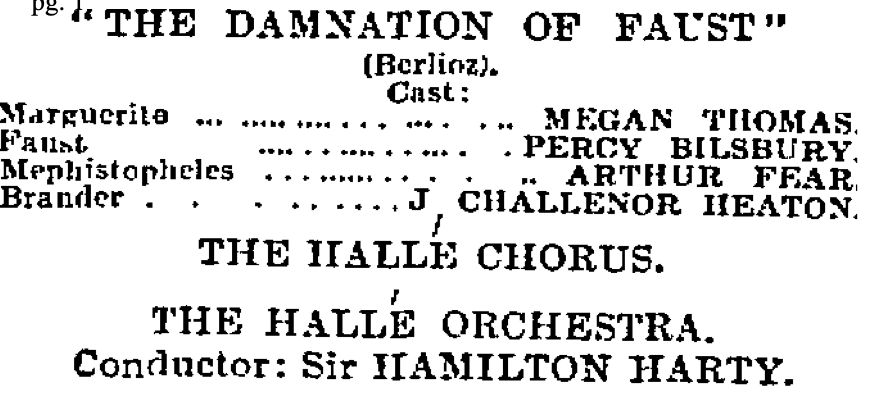
The next month saw James, now consistently using his middle name professionally, graduating from the choir to a solo role alongside the choir, namely that of Brander in Berlioz’ The Damnation of Faust, the work that was given its first British performance by the Hallé many years before. The work was to be performed in a Municipal Concert on November 8th, three days before a performance of one of Berlioz’ other choral masterpiece, the Grande Messe des Morts, also known as the Requiem. Sadly, that concert took all the press attention and there are no reviews of the performance of Faust, so we have no record of how James fared in this small but effective role.
In December of the following year, the Hallé’s celebration of Berlioz continued with a performance of his choral symphony Roméo et Juliette, and James had an unexpected call to arms, stepping into the breach in an emergency. As Neville Cardus reported in the Manchester Guardian:
There was a slight mishap during the solo-singing in “Romeo”. Mr. William Anderson sang under the handicap of a very bad cold, and at the pinch Mr. Challenor Heaton came to the rescue with much skill and spirit.
Neville Cardus writing in the Manchester Guardian, 2nd December 1927 (Guardian Archive)
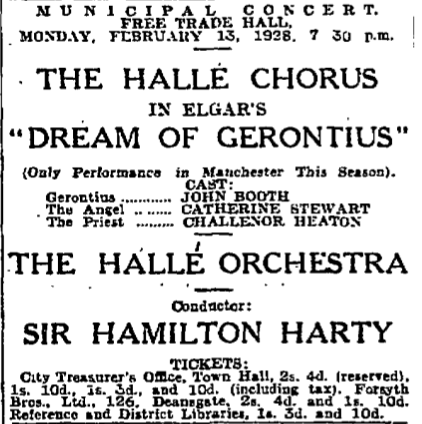
Two months later James made one further appearance with the Hallé, revisiting Gerontius not as a choir member but as a soloist, singing the bass roles of the Priest and the Angel of the Agony. Note how the Hallé Chorus gets top billing in the advert in the Guardian!
Neville Cardus’ review was not particularly encouraging for either the choir or James. With regard to the choir, ‘the choral work disappointed… The climaxes were achieved only with a sense of effort – and a paradise that had uses for hard labour did not stir either our love or imagination.’ James was damned with faint praise:
Mr. Challenor Heaton, in the two bass solos, was occasionally rendered inaudible by the orchestra, but he manfully declined to force his voice, and kept his tone and expression dignified, though here and there his music seemed pitched too low for really eloquent treatment.
Neville Cardus writing in the Manchester Guardian, 14th February 1928 (Guardian Archive)
He never appeared as a soloist with the Hallé again. Perhaps his baritone voice was not suited for the big stage, but unlike Ernest Houghey, who moved into another career when his dreams of success on the opera stage disappeared, he found a way to continue a professional singing career and stay based in Rochdale. He appeared many times in smaller scale concert party and choral society performances in the North through the late 1920s and 1930s, such as, for example, a performance in his home town of the Brahms Requiem with the Rochdale Philharmonic Choir and the Todmorden Orchestra in October 1930.
However, where he found a regular home was in the medium of radio with frequent performances on the BBC, where in a studio setting, or occasionally a concert setting, his voice could be balanced more equitably with the other instruments through the placing of microphones. The table below the Radio Times lists 25 performances by him, beginning in 1924 when he was still singing semi-chorus parts with the Hallé Choir and ending just before the outbreak of war in 1939.
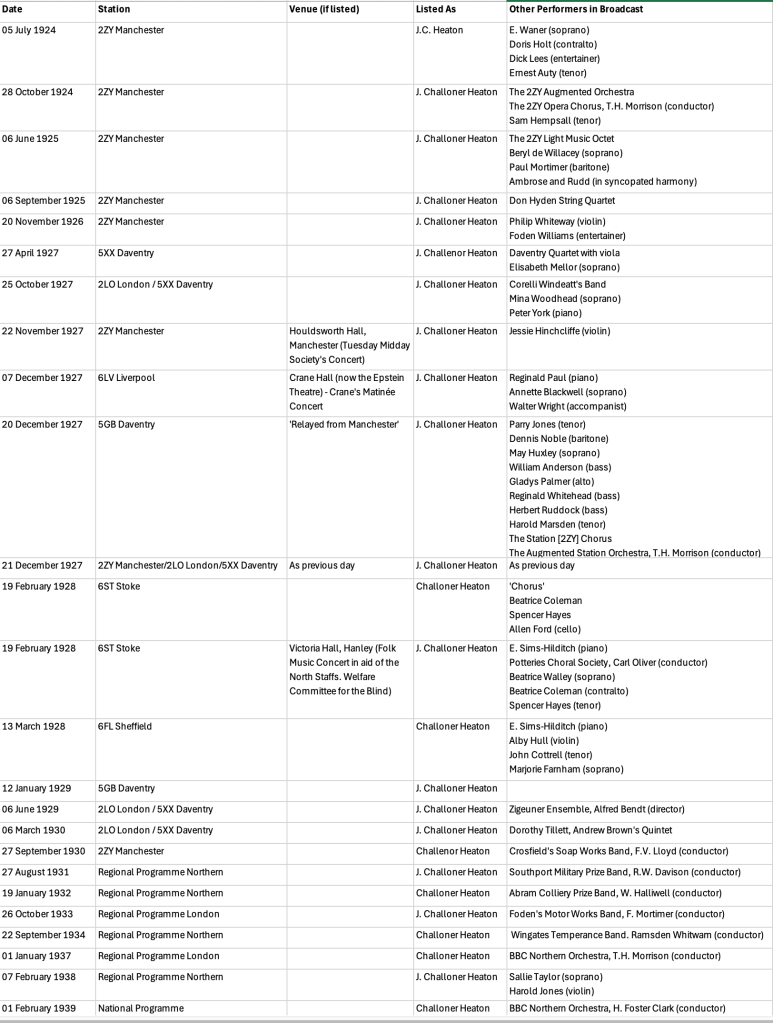
It is remarkable, looking through the Radio Times listings for this period, just how many performances there were daily of classical music both of the light and more weighty variety, and of course all of it was performed live. James ran the gamut of these. Occasionally he took part in large scale performances, such as two performances of Verdi’s Rigoletto in 1927 with the 2ZY Manchester orchestra (the forerunner of the BBC Philharmonic), but more often he would be accompanied by piano or small string ensembles. In addition, through the 1930s he also made a speciality of performing with brass bands, plugging into the great Northern brass tradition that still feeds the Hallé brass section today.
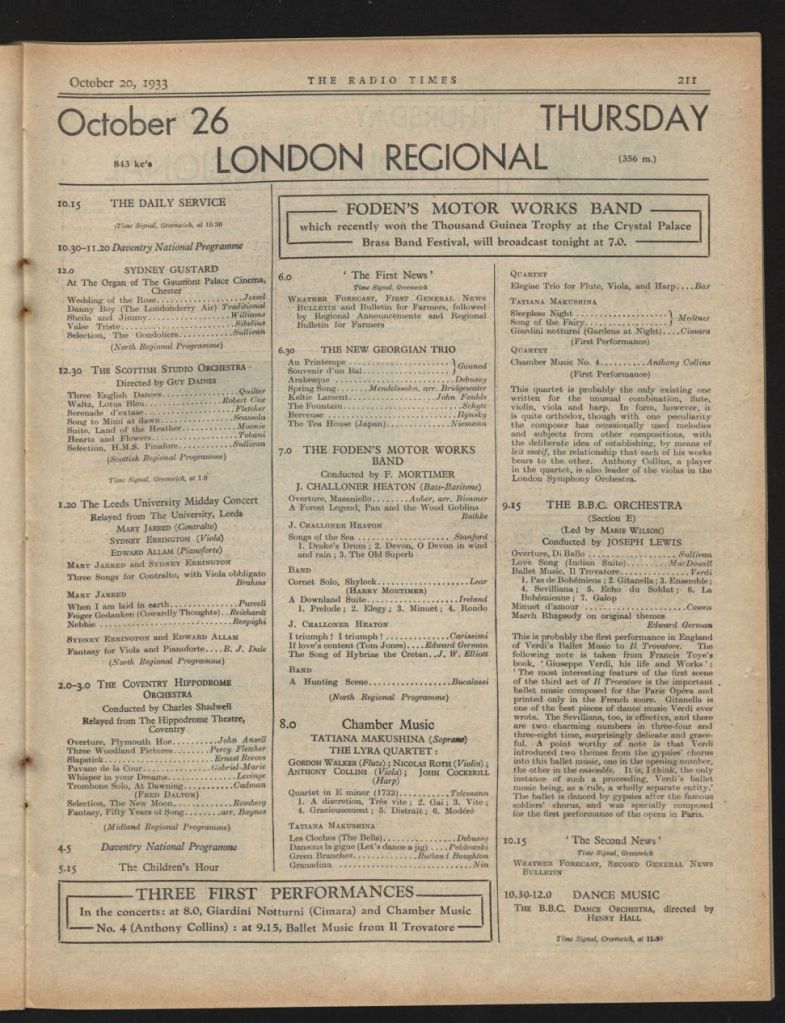
One of these brass band broadcasts is worth mentioning in detail, a performance by the prize-winning Foden’s Motor Works Band from Cheshire on the Regional London programme on October 26th, 1933, in which James was the featured soloist. The concert was led by Fred Mortimer, who conducted the band from 1926 until his death in 1953. Also featured in the broadcast playing the cornet was his son, Harry Mortimer, who went on to achieve legendary status in the brass band world as a player, composer and conductor, appearing many times with the Hallé and BBC Northern Orchestras, teaching at the Royal Manchester College of Music and eventually becoming head of brass at the BBC.
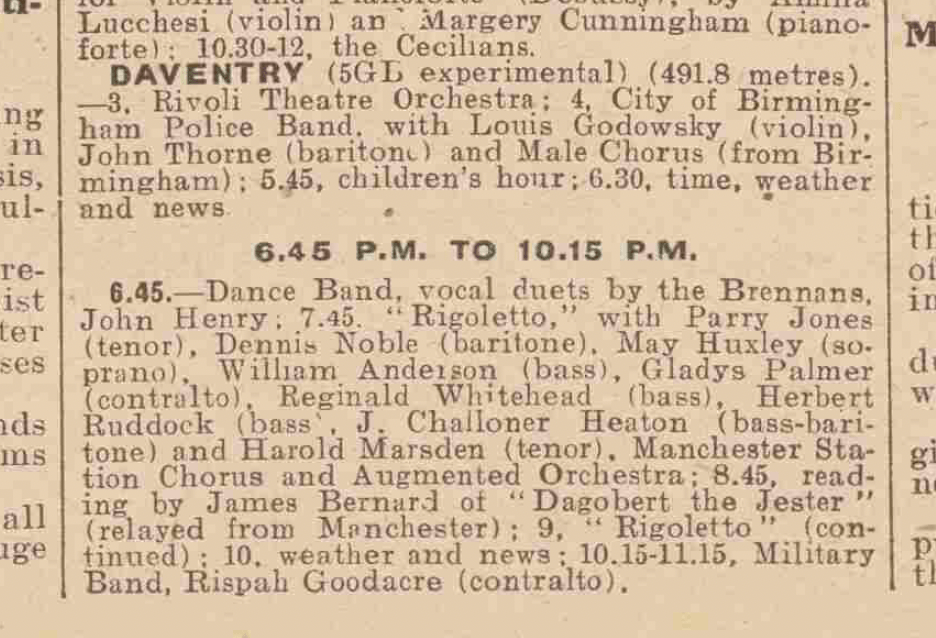
It is also mentioning in more detail the largest scale broadcasts that James was involved in at the BBC that I mentioned in passing above, two performances of Verdi’s Rigoletto that were ‘relayed from Manchester’ live in December 1927 (presumably from the BBC studios) given by the ‘augmented’ 2ZY Station Orchestra conducted by their music director T.H. Morrison. Alongside a stellar cast that included regular Hallé soloists such as Dennis Noble and Parry Jones, James played the baritone role of the jealous husband Count Ceprano. A first performance relayed on the ‘experimental’ high-power long-range 5GB station at Daventry on 20th December was followed the next day by a repeat performance on the London, Manchester and Daventry stations. The logistics of producing two live performances of such a large scale work, even in what would presumably have been a reduced studio setting, must have been immense.
James’ last BBC broadcast came in February 1929 when he performed with the BBC Northern Orchestra, essentially the same orchestra as the studio orchestra he had sung with in 1927. Conducted by H. Foster Clark, he sang songs by Rachmaninov, Tchaikovsky, Cyril Scott and Martin Shaw’s popular setting of John Masefield’s poem Cargoes.
Why he stopped singing for the BBC at this time, but it’s ominous that in the quick census taken in England and Wales at the outbreak of the Second World War later that year, still living with his parents in New Barn Lane, Rochdale (though now at number 16), he is described as an ‘unemployed’ Professional Singer.

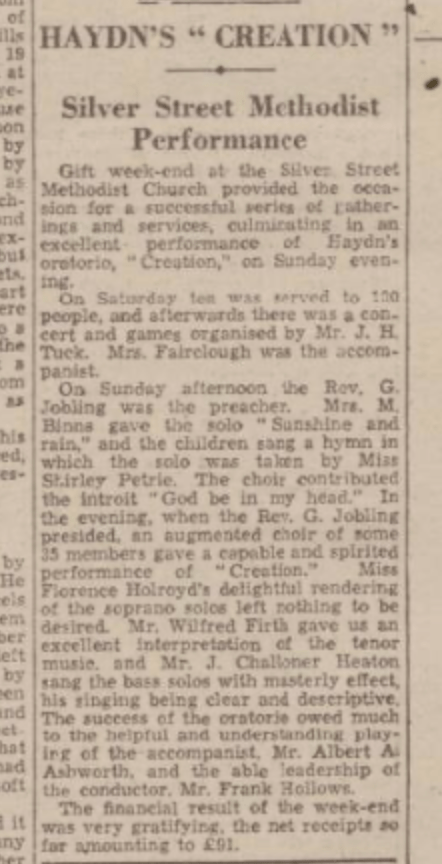
There are a couple of further references to James, both in the local Rochdale papers. In November 1939 the Rochdale Observer reported ‘Mr. J. Challenor’s “Stag Party”‘ entertaining the assembled members of the Norden Conservative Party in what the paper described as a ‘Lad’s Do’, maybe a slightly more risqué male-only version of the standard concert party format. In contrast the same paper reviewed a performance of Haydn’s Creation at Silver Street Methodist Church in which ‘Mr J. Challenor Heaton sang the bass solos with masterly effect’.
What follows is a mystery, not least because the issues of the local Rochdale newspapers that might have provided clues have yet to be digitised and so are currently inaccessible online. The facts as they stand are these. The 1947 National Probate Calendar, which provided summaries of wills and administrations of deceased individuals, has the following entry:
HEATON James Challoner of 16 New Barn-lane Rochdale who was last seen alive on 18 May 1947 and whose dead body was found 19 May 1947 Administration London 28 September to Mary Jane Sharrocks (wife of Harry Sharrocks) and Emily Heaton spinster. Effects £1017 0s 4d
Entry in the National Probate Calendar, 1947 (Ancestry)
The money he left, presumably to surviving relatives of his parents (he remained an only child), was worth around £35,000 in today’s money, a small but comfortable amount. However, during the first half of the 1940s both of James’ parents had passed away, work opportunities seemed limited, and he was too old for active service in the Second World War despite still being in the prime of life. Without further information it is difficult to speculate as to what exactly happened to James between the 18th and 19th of May, but one fears the worst. Whatever happened, it is a sad end to his story.
Lillie Hutton: Born in Manchester in 1871, Died in North Wales in 1962
The final entry in the Gerontius semi-chorus is an example of how genealogical research can be frustrating and rewarding in equal measure. I was going to present it as an example of the former – I had the middle part of the story of Lillie Hutton but could not find a way to either the beginning or the end. I gave myself one final visit to the library to access Ancestry in the forlorn hope I would find something new and almost at the very end of my session found an unexpected route to the beginning of the story when I found that the name had been wrongly transcribed, and also found a likely end point. As it is, linking this individual to the ‘Miss L. Hutton’ who sang in the semi-chorus in 1913 is based on good circumstantial evidence, rather than the certainty of the previous three singers whose stories I have told, as I will explain later.
Lillie Hutton was born in November 1870 to parents James, a Master Tailor from Liverpool, and Annie from New Mills in Derbyshire. As we can see from the 1871 census they lived at 438 Oldham Road in the old New Cross ward of Manchester, extremely close to St. Peter’s in Ancoats where the Hallé Choir now rehearse.
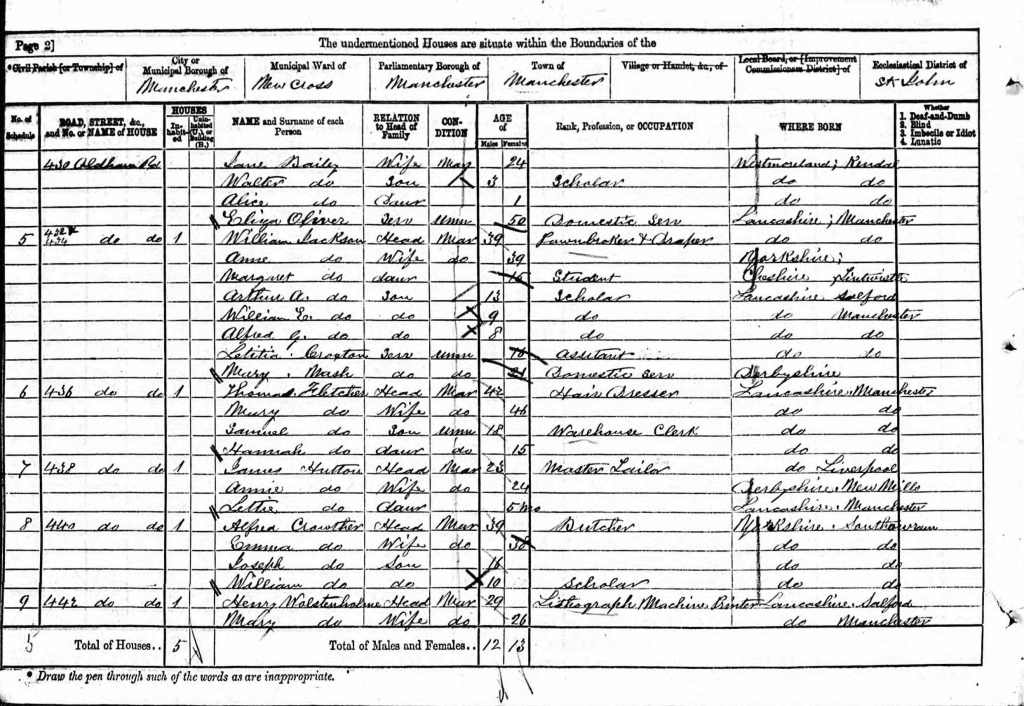
The Hutton family moved as regularly as James Hutton seemed to change jobs, and in the 1881 census they were living in Sycamore Street in Cheetham Hill, with James working as a ‘Traveller – Oil & Grease’, presumably a travelling salesman. There was an addition to the family, Lillie’s brother James Jr., who is listed as having been born in Burnley, suggesting there had been more than one move in the preceding ten years.
Indeed, ten years later they had moved again, to Perth Street, Cheetham Hill. James was now a Railway Clerk, James Jr was working as a warehouseman, and Lillie, now aged 20, was working as an Assistant Teacher in an elementary (primary) school.

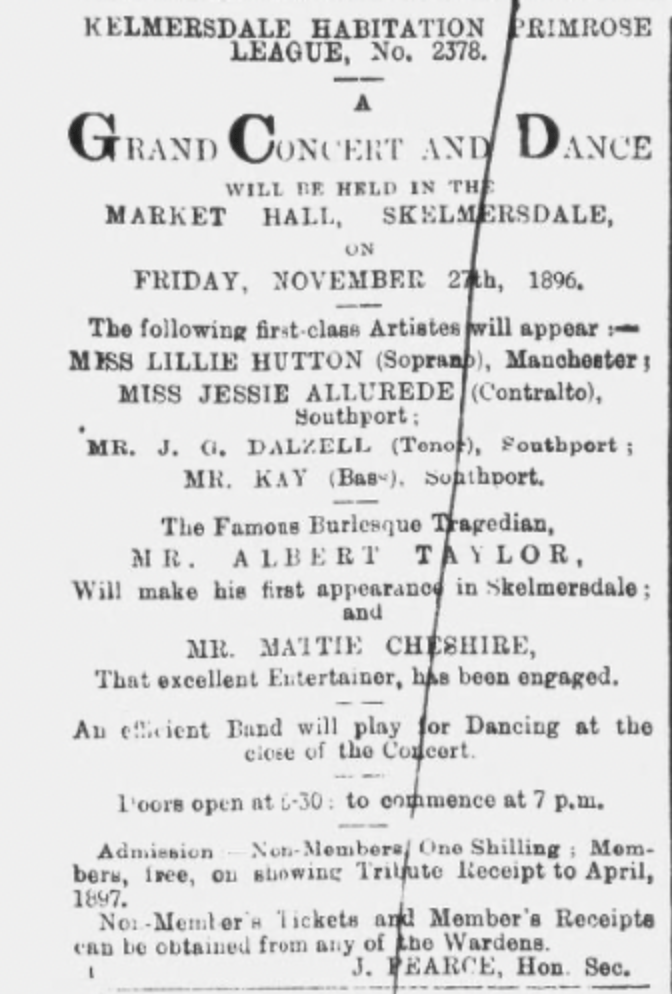
Though I have been unable to ascertain if Lillie was formally certified as a teacher, the likelihood is that at this stage she was not, but as we see in an advertisement in the Ormskirk Advertiser in November 1896, her life was beginning to follow a similar path to Margaret Hudson, combined teaching with a passion for singing. The advert was for a ‘Grand Concert and Dance’ at the Market Hall, Skelmersdale, on behalf of the Skelmersdale Habitation Primrose League, a local branch of an organisation set up in 1883 to foster Conservative principles in Britain. The concert featured vocal soloists, a ‘burlesque tragedian’ and an ‘entertainer’, in other words the standard concert party model we have seen before. Among the ‘first-class Artistes’ that would be singing was ‘Miss Lillie Hutton (Soprano), Manchester’.
The report on the concert in the next week’s Ormskirk Advertiser noted the poor audience of ‘a few over two hundred’, explaining that ‘the cricket club soiree held on the previous Wednesday had no doubt much to do with the meagre attendance’! The report did, however, go on to say that ‘the various artistes have a most delightful programme of music.’ It even listed the items each singer performed, so that we know that Lillie performed The Village Blacksmith, probably a setting of a Tennyson poem by W.H. Weiss, and a song I was unable to find provenance for, Only Once More.
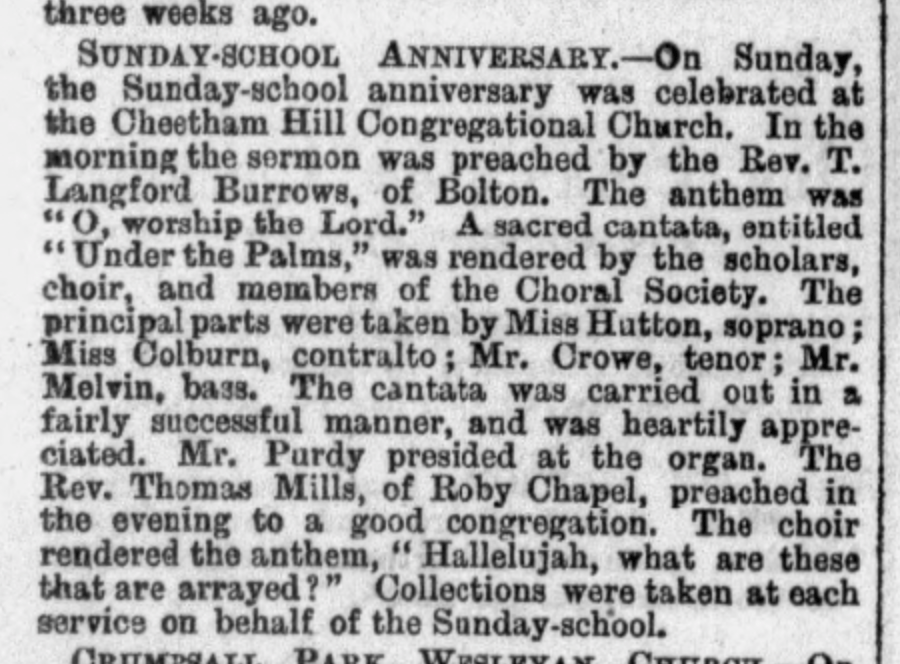
A year later we see Lillie singing closer to home, at a Sunday School anniversary event in Cheetham Hill Congregational Church. The main item sung was the ‘sacred cantata’ Under the Palms, written by the now forgotten composer G.F. Foot to words by the delightfully named Hezekiah Bullerworth, performed by members of the Sunday School, the church choir and members of the Choral Society, thought the report omits to say which Choral Society. ‘Miss Hutton’ is listed as the soprano soloist. Whether she was a member of the choral society, or engaged separately, the report does not say, but it proves that she was familiar with the choral environment. I like the review of the performance: ‘The cantata was carried out in a fairly successful manner, and was heartily appreciated’, a textbook example of damning with faint praise!
Those were the only two examples I found of Lillie singing publicly in her own right. Unlike Margaret Hudson she must not have to tried to combine a teaching and a professional singing career and concentrated instead on the teaching part with singing as a sideline.
In 1901 the Huttons had, of course, moved again, this time to Princess Road, Crumpsall, and Lillie is now listed as a fully-fledged Schoolmistress. The family had obviously gone up in the world, as they now employed a servant, Sarah Davies. However, all had changed ten years later. Lillie’s father had died and her brother had left home and she was living alone with her mother in Leach Street, Prestwich, aged 40 and described as a Teacher.
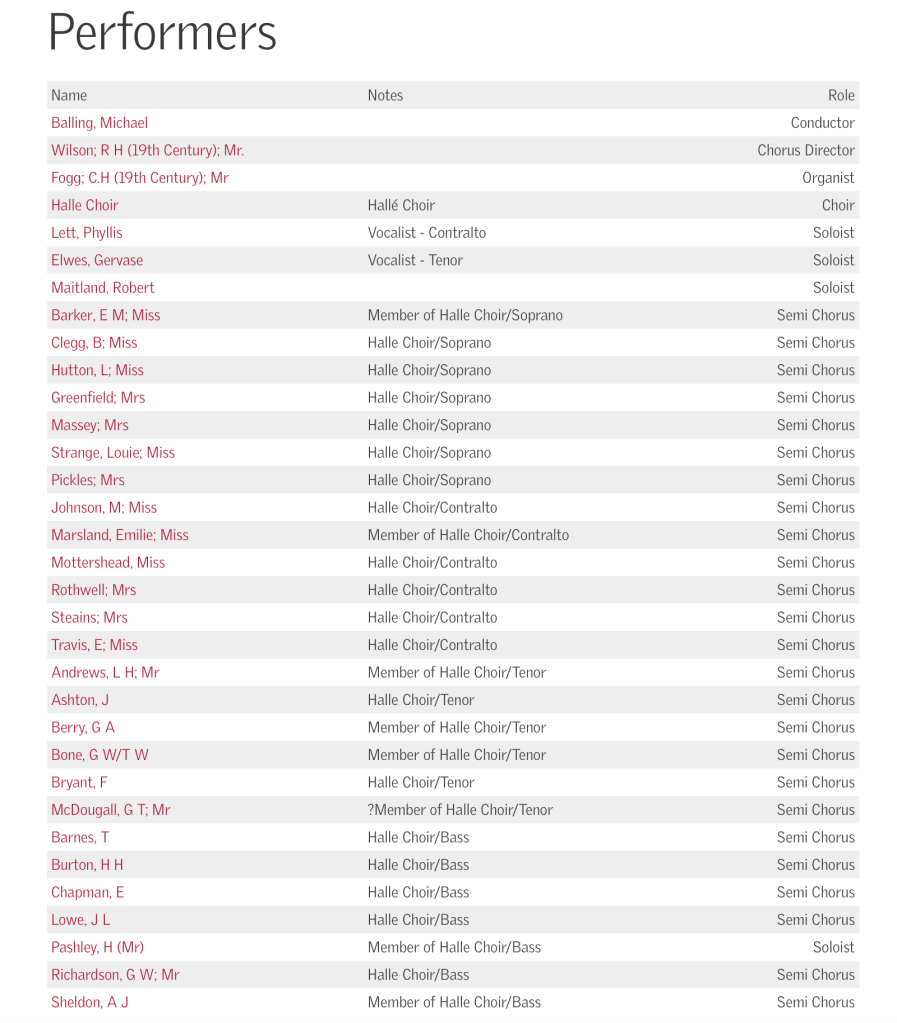
Here is where I must address this issue of circumstantial evidence. Is Lillie Hutton the ‘Miss L. Hutton’ listed in the semi-chorus for the 1913 Hallé Choir performance of the Dream of Gerontius? Hutton was a relatively common surname in Manchester at that time. However I believe that the two newspaper references above to Lillie Hutton singing are strong enough evidence, after also taking into account the number of unmarried age-eligible women named ‘L. Hutton’ in Manchester at the time plus the fact that like so many Hallé Choir members over the years Lillie was a teacher, to suggest that the L. Hutton singing soprano in the Gerontius semi-chorus in 1913 was Lillie Hutton.
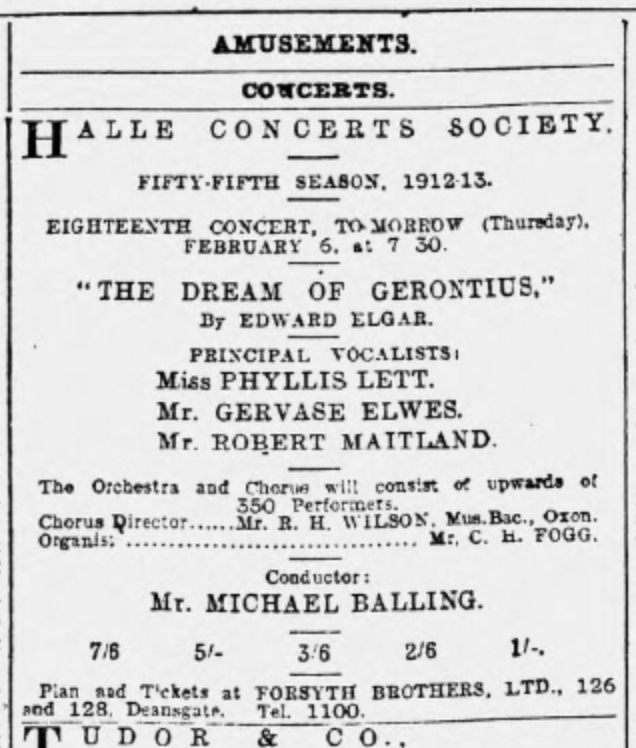
If so, it was probably from Prestwich that Lillie travelled to rehearsals for the rehearsals for the performance in February of 1913, which was to be conducted by Michael Balling, who had succeeded Hans Richter as principal conductor of the Hallé Orchestra the previous year. This would be his first (and only) performance of Gerontius with the orchestra and choir. He would only last until the outbreak of war in 1914 when being a German conductor made his position sadly untenable, so never had the opportunity to conduct first performances.
It had been ten years since the Hallé had first performed Gerontius, and Samuel Langford took stock in the opening paragraph of his review of the concert in the Manchester Guardian. Referring probably to new works by the likes of Vaughan Williams he writes that ‘the work is marvellously old for its years, and already seems quite foreign to the secularism which is now the dominant note in English music.’ He referred to strangeness of seeing Balling conduct the work (all previous performances had been conducted by Richter), but saw great improvement in the performance of the choir under his baton:
The transformation of the choir under his direction from a solid mass that was made expressive with difficulty into a naturally expressive body was clearer than ever in the singing. There was little irregularity through the divergence of his reading from custom.
Samuel Langford writing in the Manchester Guardian, 7th February, 1913 (Guardian Archive)
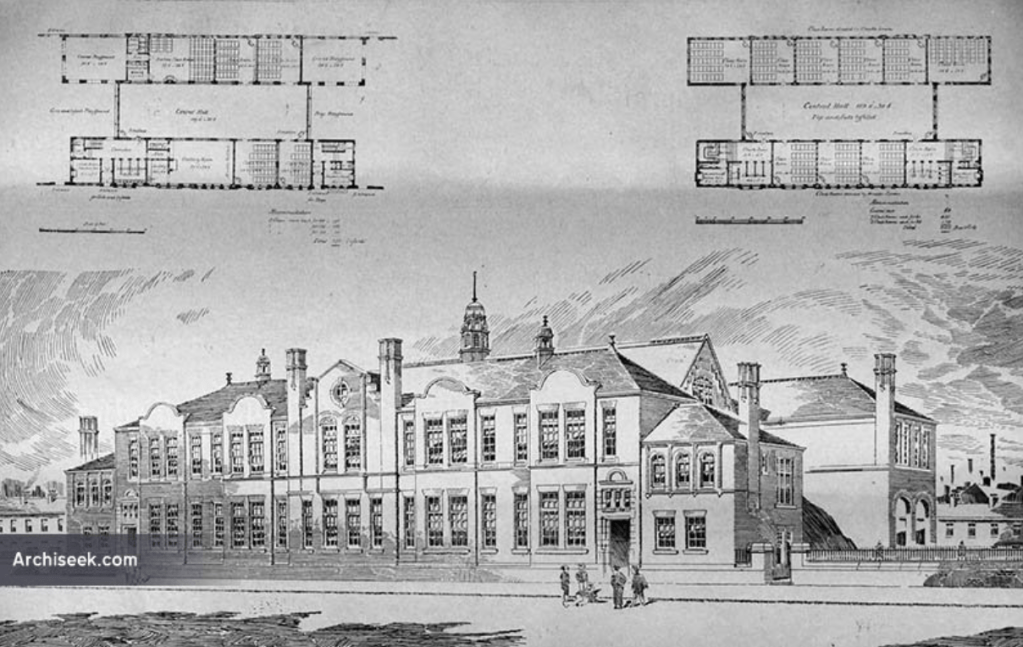
Sadly, there was no mention of the semi-chorus in the review so we cannot find out how Lillie fared. Unlike the other singers I have chronicled this was her sole appearance in the Gerontius semi-chorus. Also unlike the others there is little record of her later life beyond bare census details. In the 1921 census she is still living with her 74 year old mother Annie but had moved, again, to a comfortable semi-detached house in Heaton Norris, Stockport. Unlike in 1911, she is now listed as head of the household. Also living there was her brother, working as a Dairy Manager, and his wife, also called Annie. We do however, find out where Lillie worked as a Schoolmistress, namely the Holland Street Council School in Miles Platting, very close to where she was born. It was opened as the Holland Street Board School in 1898 to cater for 690 infants and 650 in the ‘mixed’ department, a substantial size for such a school.

By the 1939 register Lillie was 70 and long retired, living with her widowed brother in the comfortable suburban setting of Holly Road, Marple. It is possible that she moved again before she died. The only record I could find of the death of a Lillie Hutton born in 1870 was an entry the Civil Registration Death Index of Lillie Hutton dying in April 1962, at the age of 91, in Conwy, North Wales. If. this is indeed our Lillie, then rather like Edith Nicholson, who I wrote about in an earlier blog, her musical life had been a gradual crescendo leading up to a prestigious performance of an Elgar oratorio, followed by long diminuendo and a peaceful end beside the sea.
I hope you have enjoyed this three-part series on the lives of choir members who shared the privilege of singing in the semi-chorus of the Dream of Gerontius, and I hope it has given some insights in the social and musical life of Manchester (and beyond in the case of Ernest Houghey!) during the first half of the 20th century.
References
The research tools used were:
Ancestry ancestry.co.uk via Cheshire Libraries
British Newspaper Archive britishnewspaperarchive.co.uk
Guardian Archive via Manchester Libraries
Hallé Archive
Extra information
Michael Kennedy, The Hallé Tradition: A Century of Music (Manchester: Manchester University Press, 1960)
W.A. Roberts, ‘National Union of Organists Associations Congress’, The Musical Times, Vol 67 Number 1004, October 1, 1926, pp. 923-928
Fred W. Ward, The 23rd (Service) Battalion Royal Fusiliers (First Sportsman’s) : a record of its services in the Great War, 1914-1919, (London: Sidgwick & Jackson, 1920)
Anon, ‘James Nuttall’, Grace’s Guide to British Industrial History, undated. https://www.gracesguide.co.uk/James_Nuttall
Anon, ‘1898 – Holland Street School, Ancoats, Manchester, Lancashire’, Archiseek, 2013 updated 2025. https://www.archiseek.com/1898-holland-street-school-ancoats-manchester-lancashire/
 Home
Home 
Leave a comment