Introduction
I have been writing this blog for nearly three years now and I could not have done it without the help and kind words of Eleanor, Charlie and Heather at the Hallé Archive in Manchester. It has also been a constant encouragement to me how much my fellow members of the Hallé Choir appreciate what I have been doing. It was therefore doubly exciting when I was asked by the Hallé Archive to curate a small exhibition on the history of the Hallé Choir in the display case next to the choir’s rehearsal space in Ancoats, Hallé St Peters.
I was given free rein to choose whatever I liked for the display and in the end chose a mixture of items from the archive, from my own personal collection and from the wealth of material available about the choir online. Rather than try and trace the history of the choir through the display, I decided, as I have done with my blog, to build the display around a number of headings that would illustrate the breadth and depth of the choir’s activities through the years. My hope is that the result will prove interesting both to choir members and to members of general public who might pass by the display on their way to an event in Hallé St Peters.
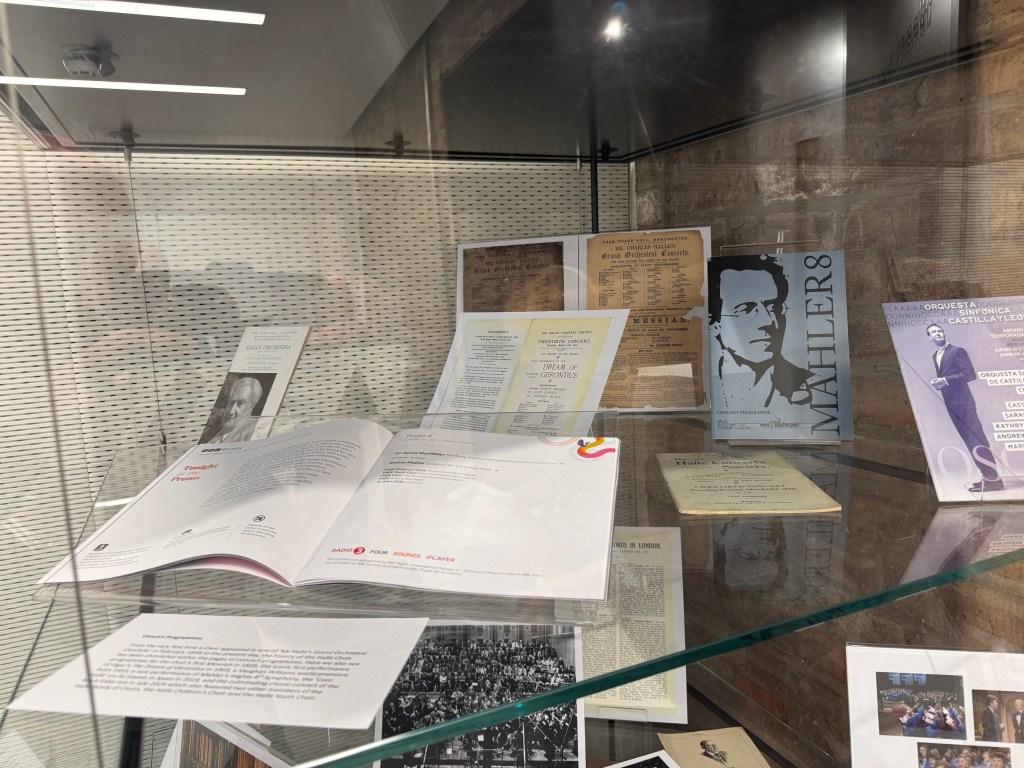
Programmes
The most obvious way in which the choir has been recorded through the years is through the pages of the programmes for the concerts in which they have appeared. The Hallé Archive hold programmes for nearly all of the Hallé concerts at the Free Trade Hall, Bridgewater Hall and other Manchester venues, plus many for out-of-town concerts. Many of the very early programmes in which the choir is simply referred to as ‘a choir’ of however many voices are now extremely fragile, too fragile to risk them being put in a display case for three months. The early years of the choir are therefore represented by copies that the Archive have made of a couple of early programme covers, including the programme for the first performance of Messiah in 1859 that I wrote about in the second part of my blog about the early years of the choir.
The choir’s rich Elgar association had to be acknowledged here, so I included the programme for the first Manchester performance of Dream of Gerontius in 1903. The choir’s history of premieres also needed to be included, with the programme for the first performances of Vaughan Williams’ Sinfonia Antartica that I wrote about here. The many big celebratory festivals that the choir have been involved in are represented by the programme for the performance of Mahler’s Eighth Symphony that the choir gave in conjunction with the CBSO Chorus as part of a symphony cycle to celebrate the 150th anniversary of the birth of Gustav Mahler. Likewise the choir’s many travels are represented by the programme for a pair of concerts that the choir (billed as the ‘Coro Hallé’) gave in the Spanish city of Valladolid in the summer of 2019. I of course could not ignore the Elder years, so pride of place was given to the programme for Mark Elder’s last concert as Chief Conductor with the family of Hallé choirs, at the Proms in July 2024.
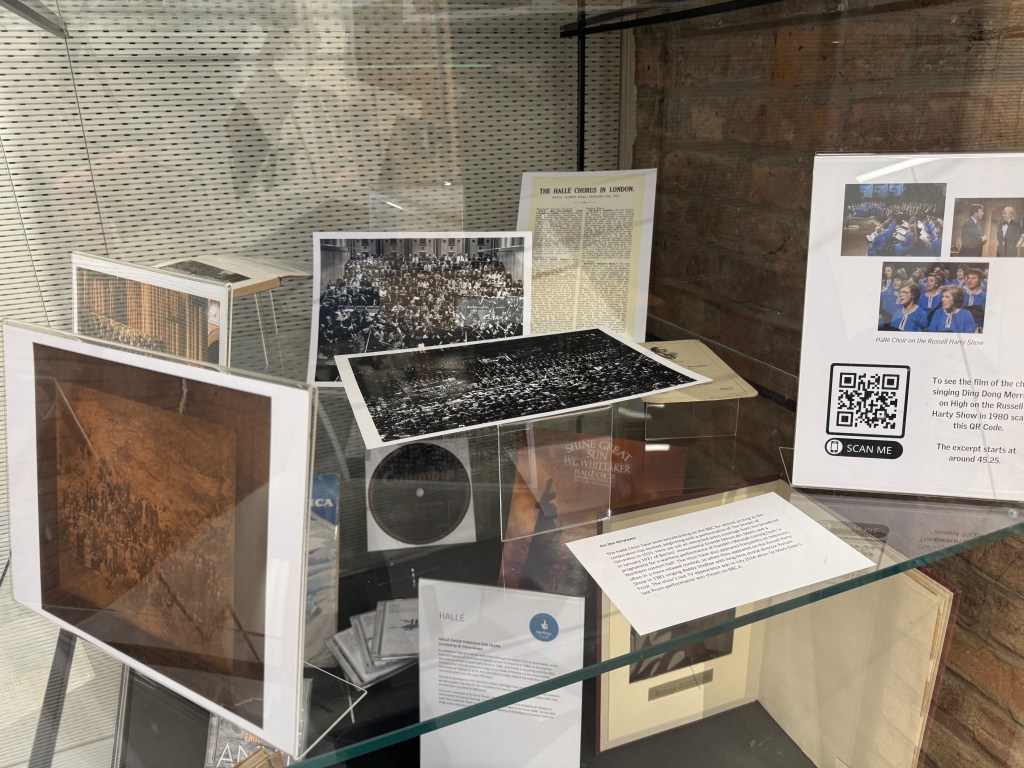
Photographs
I obviously had to include photographs of the choir through the years. Whilst the orchestra are well documented photographically in the Hallé Archive and elsewhere, historically there are far fewer photographs of the choir. However, I was able to find some good ones. The greatest find, and the earliest known photograph of the choir, was a photo in the archive of the choir having a picnic, or as the photo describes it a ‘Pic-Nic’, beneath some sandstone rocks near the village of Mouldsworth, Cheshire in the summer of 1883, presumably having travelled on the train from Manchester Central in their weekend finery. The original photograph, professionally produced by a Manchester studio, is very faded but some digital manipulation has helped bring it to life in the copy shown in the exhibition. In addition there are a couple of photographs of the choir in performance, singing Auld Lang Syne at the Last Night of the Proms with James Loughran in 1981, an event I wrote about here, and singing Verdi’s Requiem in York Minster with Mark Elder in 2022. There is also picture taken during the recording sessions for John Barbirolli’s iconic recording of Dream of Gerontius in December 1964, referred to in this blog. I also included the photograph of the choir from the programme for the 100th performance of Messiah in 1923 (though later research indicates that it wasn’t actually the 100th performance, that milestone having been reached some time before!). The photograph is notable for also including the choir’s longest ever serving choral director, R.H. Wilson, the subject of this blog post.
Radio and TV Appearances
As I outlined in my two-part blog about the choir’s radio appearances and will outline in a future blog about the choir’s TV appearances, the choir has appeared many, many times over the years on both BBC radio and television as well as occasionally on commercial stations. One of the earliest of the choir’s radio appearances in 1927 was a performance of Berlioz’ monumental Grande Messe des Morts, which is represented here by a collation of various press reviews of the performance that the Hallé put together at the time. There is also a programme from the choir’s performance of Messiah in December 1940 at the Manchester Odeon, that the BBC broadcast as coming from a ‘Northern Concert Hall’. The choir’s many TV appearances are represented in the exhibition by a collection of stills from the choir’s performance of W.G. Whittaker’s arrangement of Bobby Shaftoe on the Russell Harty Show in 1981, one of which shows the choir’s choral director at the time, the inimitable Ronnie Frost. There is also a QR code that anyone visiting the exhibition can scan to see a YouTube compilation of highlights from the Russell Harty show that includes a performance by the choir on the same show a few months earlier, singing Ding Dong, Merrily on High in a way that would nowadays be referred to as a ‘flashmob’.
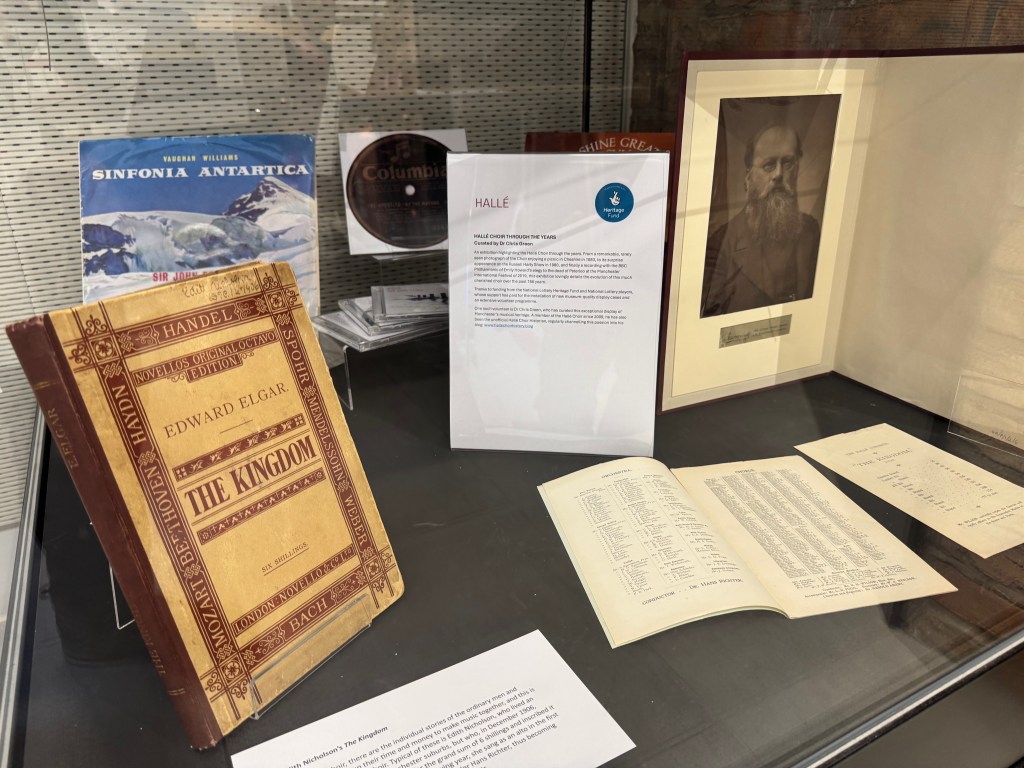
Recordings
The choir’s radio and TV appearances have been by their very nature largely ephemeral. The most tangible way in which the Hallé Choir of past years lives on today is through the recordings that they made, as I described in my three-part blog about the recording history of the choir which began here, so I had to include a section in the exhibition on that history. The Hallé Archive sadly does not have a copy of the first 78rpm record that the choir made in 1927 of a section from Elgar’s The Apostles, but the recording is represented by a blown-up copy of the original Columbia Records label that I managed to find online. I have also included a copy of the original HMV LP of the premiere recording of Sinfonia Antartica along with a relative rarity, the LP of unaccompanied music by the North Eastern composer W.G. Whittaker that the choir made with Maurice Handford in 1983. This illustration of the breadth of music the choir has covered in its recordings is amplified by the inclusion in the exhibition of the recently released CD of Emily Howard’s The Anvil, written to commemorate the 200th anniversary of the Peterloo Massacre in 2019. Once again I could not ignore Mark Elder, the man who has had the biggest impact on the choir’s recorded legacy, so I have included the CDs of the three Elgar oratorios that the choir recorded under Sir Mark, with pride of place given to the recording of The Apostles, for no other reason than that it was the only one of the three recordings on which I sang!
Edith Nicholson and The Kingdom
The be all and end all of all amateur choirs are the choir members. We are happy to give up time and money to do the thing we love the most, singing in harmony with our friends and colleagues, and doing it in a choir like the Hallé Choir to the highest professional standards. One thing I therefore realised straight away when asked to curate the exhibition was that I needed to celebrate the humble choir member, and I knew I had to go back to the blog I wrote inspired by a copy of the vocal score for Elgar’s The Kingdom found by my bass colleague Vin Allerton that he used in our 2023 performance of that oratorio. The copy had originally been bought by a member of the alto section of the choir for the first performance of the oratorio in Manchester in early 1907. By glorious happenstance, not only had she written her name on the cover, ‘Edith Nicholson’, but she had also made a note inside of the details of the first performance and written her address. Using her address I was able to piece together the details of her ordinary life, made extraordinary by her association with the Hallé Choir. In the exhibition you will see the vocal score itself, courtesy of Vin, the printed list of sits and stands that we found inside it, a copy of the programme for the concert open at the list of choir names with Edith’s name visible (‘Miss Nicholson’), and a photo from the period of the man who conducted the concert and made the first link in the chain that binds Elgar and the Hallé Choir to this day, the conductor Hans Richter.
Information
The exhibition will be at Hallé St Peters, 40 Blossom St, Ancoats, Manchester M4 6BF until February 2025. The display case can be found in the passageway that leads from the entrance to the main old church space, just before what was the main entrance of the church. If you’re not actually attending an event at Hallé St Peters but are instead, say, visiting the building’s café, I’m sure if you ask the people at the main desk nicely they will let you go down the passageway to look at it!
 Home
Home 
Leave a comment